The Pound drops below its long-run average as the Fed's rate passes Britain's
- GBP/USD breaks 1.3400 and its 200-day average as the Fed raises rates.
- Bank of England votes Thursday at 11:00 GMT, forecast six to hold, three to raise.
- Fed expects unemployment to stay at 4.1% through 2029, under its 4.2% normal.

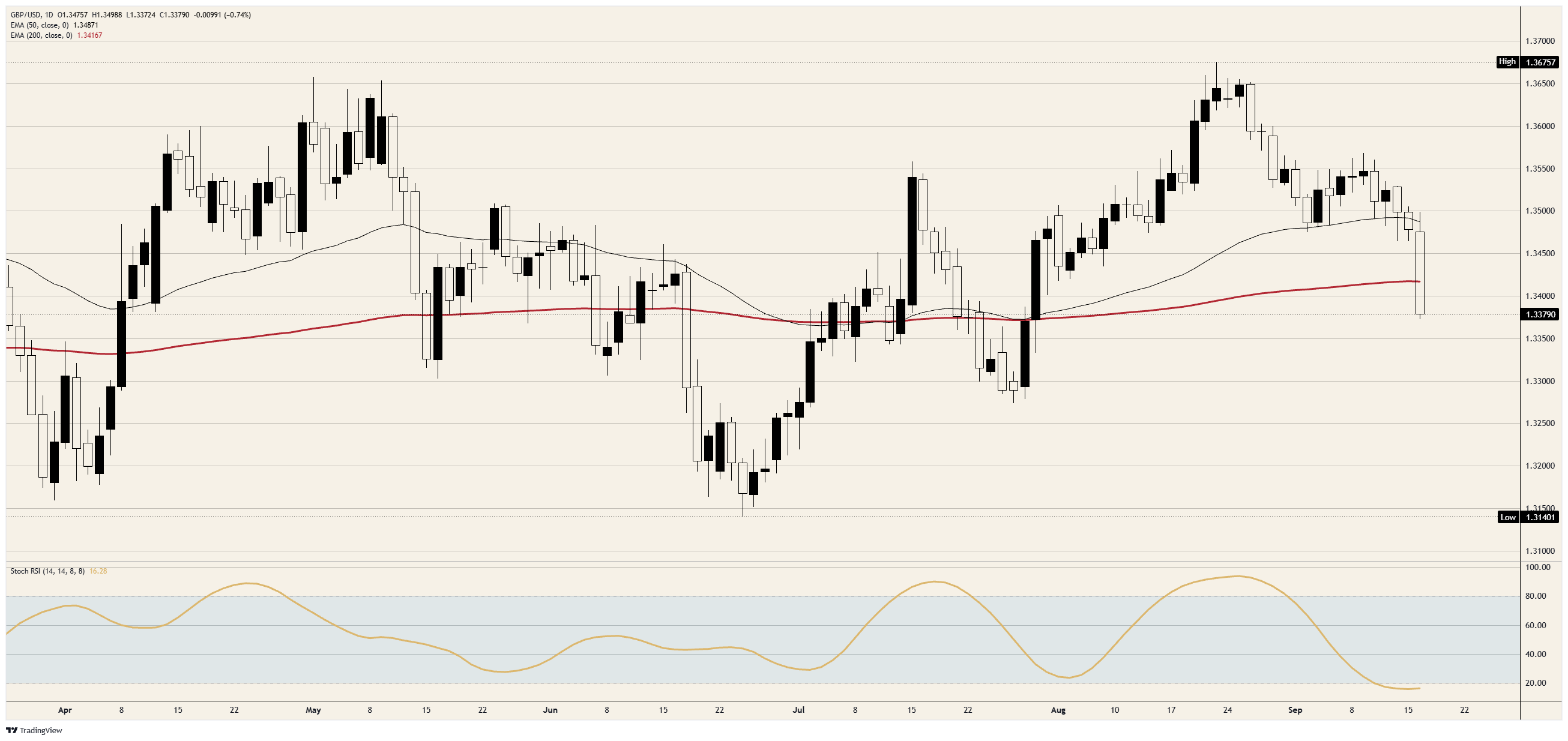
The Fed raised rates by a quarter point to 3.75-4.00% on Wednesday, the first hike since 2023, and the vote was 12-0. The middle of the new range is 3.875%, which puts US rates above the UK's 3.75% for the first time this year. GBP/USD has been down every session since September 10, Wednesday's drop was the largest of them by a distance, and the pair is trading just under 1.3400, under its 200-day average, which it hasn't been below since early August. The Bank of England meets on Thursday at 11:00 GMT.
The gap is small, and the Fed says it's going to get bigger
The UK's Bank Rate, which is what the Bank of England calls its main interest rate, has been 3.75% since December 2025, and the Bank has held it at every meeting since. The difference between the two rates is only an eighth of a point, but it's now the wrong way round for the Pound, and the Fed's forecasts say it widens from here. The committee expects its rate to be 4.1% at the end of this year and still 4.1% at the end of 2027. It also expects unemployment to stay at 4.1% through 2029, below the 4.2% it thinks of as normal. The Fed doesn't see a reason to stop for at least a year, and that's the gap the Pound is trading against.
Thursday's vote matters more than Thursday's rate
The Bank of England is expected to hold at 3.75% on Thursday, with the vote forecast at six to hold and three to raise, the same as July, when the three, Chief Economist Pill and external members Greene and Mann, wanted to go to 4% straight away. Almost nobody expects the rate to move, so what matters is how the vote splits. UK inflation came in at 3.1% in August, exactly as forecast, and the increase was mostly motor fuel, which a rate rise can't do anything about. That's the argument for the six. Factory gate prices rose 0.7% against a 0.3% forecast, and that's the argument for the three. If a fourth member joins them, the Pound's rate advantage starts coming back into view. The three lost in July, and the rematch was already on the calendar before the Fed moved. UK retail sales follow on Friday at 06:00 GMT, forecast to fall 0.2% after a 0.5% drop in July.
Levels and bias
Resistance: 1.3400, which the Pound traded through on Wednesday, then the 200-day Exponential Moving Average (EMA) just under 1.3450, then 1.3500, where the rally on the inflation release ended.
Support: Wednesday's low just above 1.3350, then 1.3300, the base the pair left in early August.
Bias: Bearish below 1.3400. The first objective is 1.3350 and the second is 1.3300. On the daily chart the Stochastic Relative Strength Index (Stoch RSI), a momentum gauge, is at 16 and has been flat there for a few days, so the selling is stretched and a bounce back to 1.3400 wouldn't change that. The bearish case is wrong if the Pound has a daily close above 1.3450.
GBP/USD daily chart
Pound Sterling FAQs
The Pound Sterling (GBP) is the oldest currency in the world (886 AD) and the official currency of the United Kingdom. It is the fourth most traded unit for foreign exchange (FX) in the world, accounting for 12% of all transactions, averaging $630 billion a day, according to 2022 data. Its key trading pairs are GBP/USD, also known as ‘Cable’, which accounts for 11% of FX, GBP/JPY, or the ‘Dragon’ as it is known by traders (3%), and EUR/GBP (2%). The Pound Sterling is issued by the Bank of England (BoE).
The single most important factor influencing the value of the Pound Sterling is monetary policy decided by the Bank of England. The BoE bases its decisions on whether it has achieved its primary goal of “price stability” – a steady inflation rate of around 2%. Its primary tool for achieving this is the adjustment of interest rates. When inflation is too high, the BoE will try to rein it in by raising interest rates, making it more expensive for people and businesses to access credit. This is generally positive for GBP, as higher interest rates make the UK a more attractive place for global investors to park their money. When inflation falls too low it is a sign economic growth is slowing. In this scenario, the BoE will consider lowering interest rates to cheapen credit so businesses will borrow more to invest in growth-generating projects.
Data releases gauge the health of the economy and can impact the value of the Pound Sterling. Indicators such as GDP, Manufacturing and Services PMIs, and employment can all influence the direction of the GBP. A strong economy is good for Sterling. Not only does it attract more foreign investment but it may encourage the BoE to put up interest rates, which will directly strengthen GBP. Otherwise, if economic data is weak, the Pound Sterling is likely to fall.
Another significant data release for the Pound Sterling is the Trade Balance. This indicator measures the difference between what a country earns from its exports and what it spends on imports over a given period. If a country produces highly sought-after exports, its currency will benefit purely from the extra demand created from foreign buyers seeking to purchase these goods. Therefore, a positive net Trade Balance strengthens a currency and vice versa for a negative balance.
Author

Joshua Gibson
FXStreet
Joshua joins the FXStreet team as an Economics and Finance double major from Vancouver Island University with twelve years' experience as an independent trader focusing on technical analysis.