The new battle for AI: Open models challenge the economics of the boom
- Deutsche Bank’s Adrian Cox argues that the open-versus-proprietary contest is becoming the next major technology format war.
- Open models challenge the scarcity, pricing power and capital-intensity assumptions embedded in leading AI valuations.
- Cheaper models could pressure proprietary-model economics without ending the broader AI capex and adoption cycle.
- China’s open-model ecosystem is becoming a genuine challenge to the durability of the US technological moat.
- The most defensible value may lie in proprietary data, distribution, product design, security, and workflow integration.
- Regulation could protect users, entrench incumbents or inadvertently weaken Western competitiveness.

The new battle for AI
The latest tremor through the AI complex was not caused by investors suddenly losing faith in artificial intelligence. It came from a more uncomfortable question: what happens to the economics of the boom when increasingly capable models become cheaper, lighter and easier to distribute?
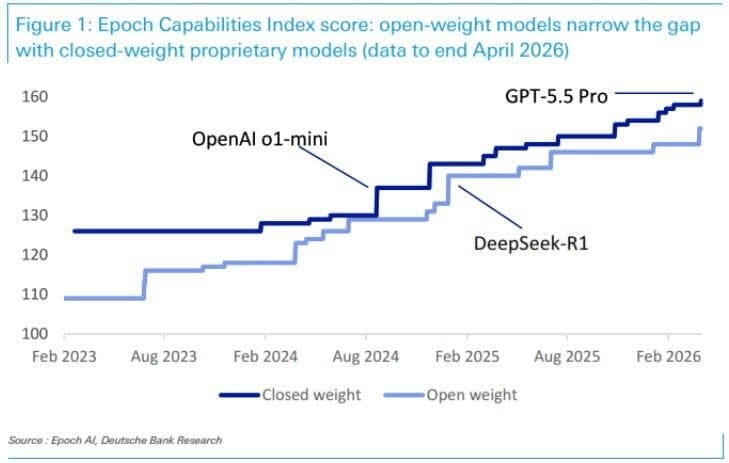
That question returned with the release of another Chinese open-weight model, reviving memories of the original DeepSeek shock. The first episode forced markets to confront the possibility that a competitive AI system could be trained with older chips and considerably less capital than investors had assumed. The latest release has pushed the same argument back across the trading desk, placing semiconductor demand, hyperscaler spending, and proprietary model pricing power under renewed scrutiny.
In a report examining the contest between open and proprietary AI, Deutsche Bank strategist Adrian Cox argues that the technology industry is entering another defining format war. The stakes extend well beyond which model performs best on a benchmark. The larger battle concerns who controls the ecosystem, where profits settle, and whether the enormous capital commitments supporting today’s AI valuations can continue to earn an acceptable return.
The initial market reaction was hardly subtle. The Magnificent Seven weakened, semiconductor shares extended their decline and investors again began questioning plans by Google, Microsoft, Amazon, Meta and Oracle to spend roughly $700 billion building AI capacity this year, around 70 percent more than last year.
The market is not arguing that AI demand is about to disappear. It is asking whether the tollbooths constructed around that demand will remain as profitable as expected.
Author

Stephen Innes
SPI Asset Management
With more than 25 years of experience, Stephen has a deep-seated knowledge of G10 and Asian currency markets as well as precious metal and oil markets.