Indian Rupee clings to recent losses ahead of Fed’s policy
- The Indian Rupee trades weakly against the US Dollar due to higher US Treasury Yields.
- Investors expect the Fed to continue the interest rate hike cycle even after raising them later in the day.
- Rising India’s inflation prompts RBI’s interest rate hike expectations.
The Indian Rupee (INR) holds onto over-a-week long losses against the US Dollar (USD) in the opening session on Wednesday. The USD/INR pair trades firmly near its seven-week high at around 96.00, as the Indian currency remains under pressure due to higher United States (US) Treasury Yields ahead of the Federal Reserve’s (Fed) monetary policy decision at 18:00 GMT.
As of writing, 10-year US Treasury Yields trade 0.35% lower to near 4.98%, but is still close to its 19-year high of 5.04% posted on Tuesday.
The Indian Rupee struggles to regain ground despite the Reserve Bank of India (RBI) intervening through spot and Non-Deliverable Forwards (NDFs) markets. According to a Reuters report, the Indian central bank likely selling US dollars to support the currency.
What’s drove US Treasuries higher
The borrowing costs for the US government have accelerated significantly as markets price in deeper Fed tightening on the back of higher inflation.
According to strategists at Deutsche Bank, investors pricing in a growing chance of a full-blown hiking cycle for the months ahead,” as markets reassessed the policy path. Looking further out along the curve, Deutsche Bank highlights that “90bps of hikes are now priced by the June 2027 meeting, underscoring how expectations for additional Fed tightening have firmed.”
What to expect from the Fed at the policy meeting
The Fed is almost certain to raise interest rates by 25 basis points (bps) to 3.75%-4.00% at the policy meeting after five straight holds. The CME FedWatch tool shows that the odds of the Fed hiking interest rates at the policy meeting later in the day are 92.5%.
Fed Chairman Kevin Warsh would be able to take a hawkish decision without any political pressure, as recent remarks from US President Donald Trump signaled that he has come into terms with higher interest rates.
While speaking to reporters at the Irish Open golf tournament over the weekend, US President Trump said that he did not know whether Fed policymakers will raise interest rates at their meeting this week. But stressed that the US "should be paying the lowest interest rate in the world" no matter what the Fed’s data indicates about inflation and the economy, Business Standard reported.
Investors will pay close attention to the monetary policy statement and Chair Kevin Warsh’s press conference to get fresh cues regarding inflation and the economic outlook. Warsh is expected to stay with “no forward-guidance policy”.
RBI seen edging toward mini hiking cycle as inflation pressures broaden
According to Societe Generale, the recent “pickup in services inflation is particularly important from a monetary policy perspective,” underscoring that price pressures are becoming more entrenched beyond volatile food components. The bank notes that “with headline inflation above the median target for a third consecutive month and underlying inflation beginning to firm, the room to look through food-led price pressures is narrowing.” Against this backdrop, Societe Generale reiterates that “we continue to believe that the RBI will initiate a mini rate-hike cycle, announcing a 25bp hike at its October meeting, followed by two similar increases at its December and February meetings.” The bank adds that, “although this is not our baseline scenario, we also do not rule out a 50bp hike,” highlighting the risk of a more forceful policy response if inflation dynamics deteriorate further.
USD/INR Technical Analysis
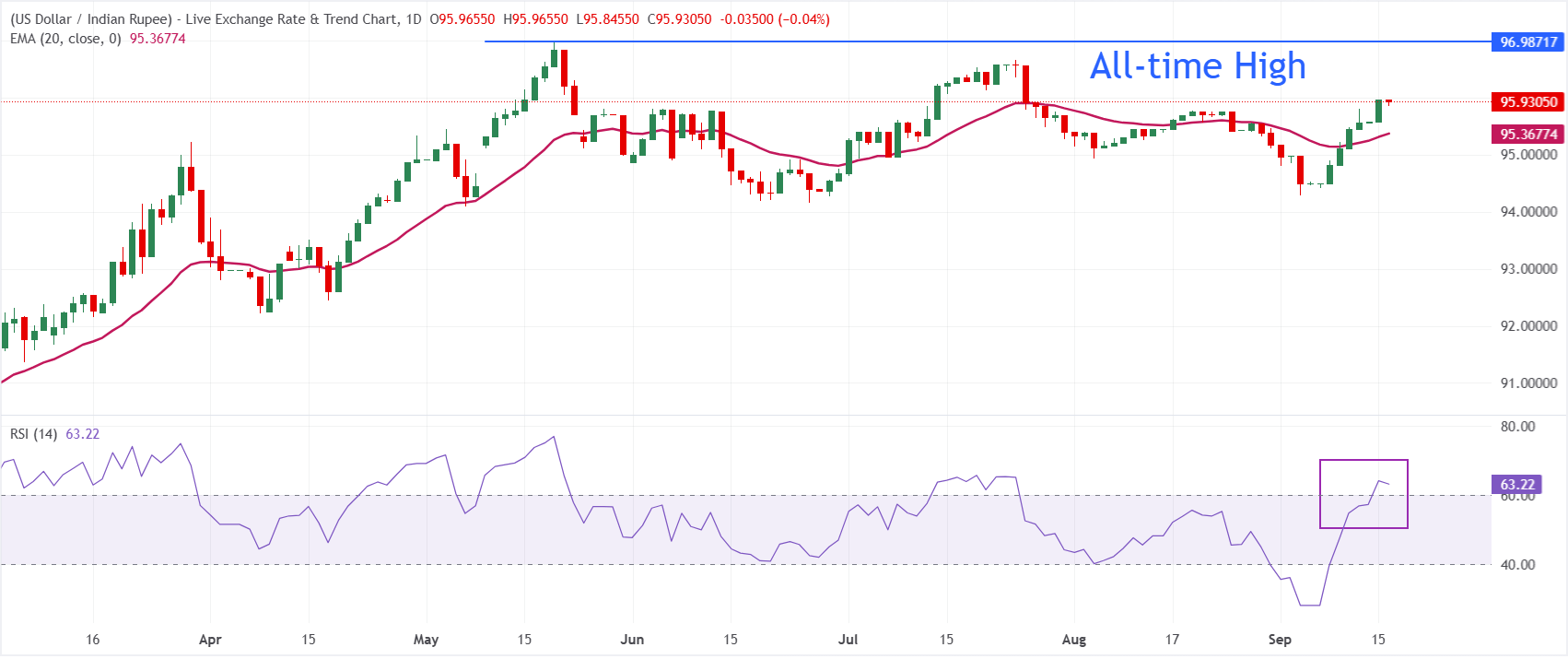
In the daily chart, USD/INR trades at 95.93. The pair holds a bullish near-term bias as it extends its rebound above the 20-day exponential moving average (EMA) at 95.37, suggesting buyers are reasserting control after the recent pullback.
The Relative Strength Index (RSI) at 63.2 sits in bullish territory but shy of overbought conditions, hinting that upside momentum remains constructive without yet signaling exhaustion.
On the downside, initial support is seen at the 20-day EMA near 95.37, where dip-buying interest could re-emerge if the pair corrects lower. On the upsdie, the pair aims to revisit the all-time high near 97.00
(The technical analysis of this story was written with the help of an AI tool. Know more.)
Indian Rupee FAQs
The Indian Rupee (INR) is one of the most sensitive currencies to external factors. The price of Crude Oil (the country is highly dependent on imported Oil), the value of the US Dollar – most trade is conducted in USD – and the level of foreign investment, are all influential. Direct intervention by the Reserve Bank of India (RBI) in FX markets to keep the exchange rate stable, as well as the level of interest rates set by the RBI, are further major influencing factors on the Rupee.
The Reserve Bank of India (RBI) actively intervenes in forex markets to maintain a stable exchange rate, to help facilitate trade. In addition, the RBI tries to maintain the inflation rate at its 4% target by adjusting interest rates. Higher interest rates usually strengthen the Rupee. This is due to the role of the ‘carry trade’ in which investors borrow in countries with lower interest rates so as to place their money in countries’ offering relatively higher interest rates and profit from the difference.
Macroeconomic factors that influence the value of the Rupee include inflation, interest rates, the economic growth rate (GDP), the balance of trade, and inflows from foreign investment. A higher growth rate can lead to more overseas investment, pushing up demand for the Rupee. A less negative balance of trade will eventually lead to a stronger Rupee. Higher interest rates, especially real rates (interest rates less inflation) are also positive for the Rupee. A risk-on environment can lead to greater inflows of Foreign Direct and Indirect Investment (FDI and FII), which also benefit the Rupee.
Higher inflation, particularly, if it is comparatively higher than India’s peers, is generally negative for the currency as it reflects devaluation through oversupply. Inflation also increases the cost of exports, leading to more Rupees being sold to purchase foreign imports, which is Rupee-negative. At the same time, higher inflation usually leads to the Reserve Bank of India (RBI) raising interest rates and this can be positive for the Rupee, due to increased demand from international investors. The opposite effect is true of lower inflation.
Author

Sagar Dua
FXStreet
Sagar Dua is associated with the financial markets from his college days. Along with pursuing post-graduation in Commerce in 2014, he started his markets training with chart analysis.