EUR/USD Price Forecast: 1.1500 to remain key support level for Fed’s Day
- EUR/USD trades cautiously at around 1.1545 ahead of the Fed’s policy decision.
- The Fed is almost certain to hike interest rates by 25 bps to the 3.75%-4.00% range.
- Market experts see the Fed delivering one more interest rate hike this year.

The Euro (EUR) trades with caution at around 1.1545 against the US Dollar (USD) during the early European trading session on Wednesday. The major currency pair is expected to remain under pressure as the Federal Reserve (Fed) is scheduled to announce the monetary policy decision at 18:00 GMT.
The Fed is widely anticipated to break its five-meeting hold streak and hike interest rates by 25 basis points (bps) to the 3.75%-4.00% range, as latest Consumer Price Index (CPI) report showed that inflationary pressures are sticky and well above the central bank’s 2% target.
Investors will pay close attention to Fed’s monetary policy statement and Chairman Kevin Warsh’s press conference to get fresh cues regarding the US interest rate outlook.
Ahead of the Fed meeting, financial markets have started pricing in at least one more interest rate hike this year.
ABN Amro frames hike as inflation insurance, not the start of a long cycle
Analysts at ABN Amro stress that, in their view, the rationale for another move is primarily precautionary rather than aggressively disinflationary. They argue that “the case for a hike is therefore less about bringing inflation down directly and more about preventing inflation from becoming more persistent.” Reflecting this risk-management stance, the bank says it has “pencilled in a single additional hike in the December meeting, based on similar considerations as the first hike,” while underscoring that the path beyond that will hinge on how inflation dynamics evolve.
EUR/USD Technical Analysis
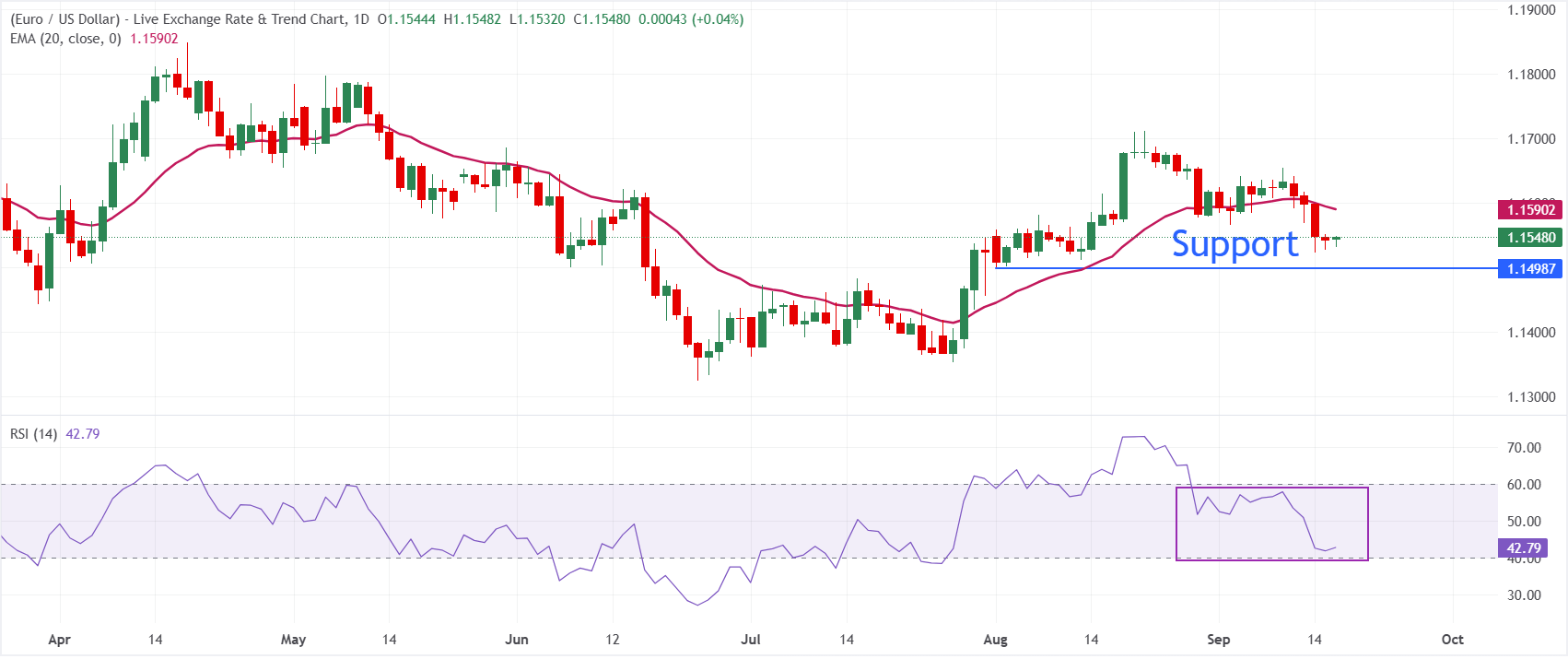
EUR/USD trades at 1.1548, keeping a mildly bearish near-term tone as it holds beneath the 20-day exponential moving average (EMA) at 1.1590.
The failure to reclaim this dynamic barrier hints that recent rebounds are being sold into, while the Relative Strength Index (RSI) around 43 sits in neutral-to-soft territory, suggesting downside pressure persists but without oversold extremes.
Strategists at Scotiabank also see the current setup as “neutral/bearish” with the “RSI has swiftly fallen into bearish territory following a brief push above the overbought threshold at 70—reached in late August.”
On the topside, initial resistance is defined by the 20-day EMA at 1.1590, and a daily close above this level would be needed to ease the current downside bias and open the door to a more sustained recovery. Looking down, the psychologcial level of 1.1500 is the key support zone.
(The technical analysis of this story was written with the help of an AI tool. Know more.)
Economic Indicator
Fed Interest Rate Decision
The Federal Reserve (Fed) deliberates on monetary policy and makes a decision on interest rates at eight pre-scheduled meetings per year. It has two mandates: to keep inflation at 2%, and to maintain full employment. Its main tool for achieving this is by setting interest rates – both at which it lends to banks and banks lend to each other. If it decides to hike rates, the US Dollar (USD) tends to strengthen as it attracts more foreign capital inflows. If it cuts rates, it tends to weaken the USD as capital drains out to countries offering higher returns. If rates are left unchanged, attention turns to the tone of the Federal Open Market Committee (FOMC) statement, and whether it is hawkish (expectant of higher future interest rates), or dovish (expectant of lower future rates).
Read more.Next release: Wed Sep 16, 2026 18:00
Frequency: Irregular
Consensus: 4%
Previous: 3.75%
Source: Federal Reserve
Author

Sagar Dua
FXStreet
Sagar Dua is associated with the financial markets from his college days. Along with pursuing post-graduation in Commerce in 2014, he started his markets training with chart analysis.