The Dow Jones' 30 corporate borrowers eat a Fed rate hike
- DJIA slips under 52,000 after the Fed, 152 points off its pre-release level
- Fed's rate rises to 3.75-4.00%, lifting what all 30 members pay to borrow

The Fed has raised its rate to 3.75-4.00%, its first increase since 2023 and its first move of any kind since the cut in December 2025. The rate it sets is what banks pay to borrow from each other overnight, and it reaches this index in two places. It lifts what the 30 companies pay on floating-rate debt, and it widens what JPMorgan (JPM) and Goldman Sachs (GS) earn between what they lend at and what they pay depositors. The vote was 12-0, and the statement described activity as solid, spending as resilient and capital investment as robust. The overnight rate is the one the Fed sets. The 10-year Treasury yield near 5% is the one that prices the mortgage, the corporate bond and most of what the index is worth, and the committee does not set that one.
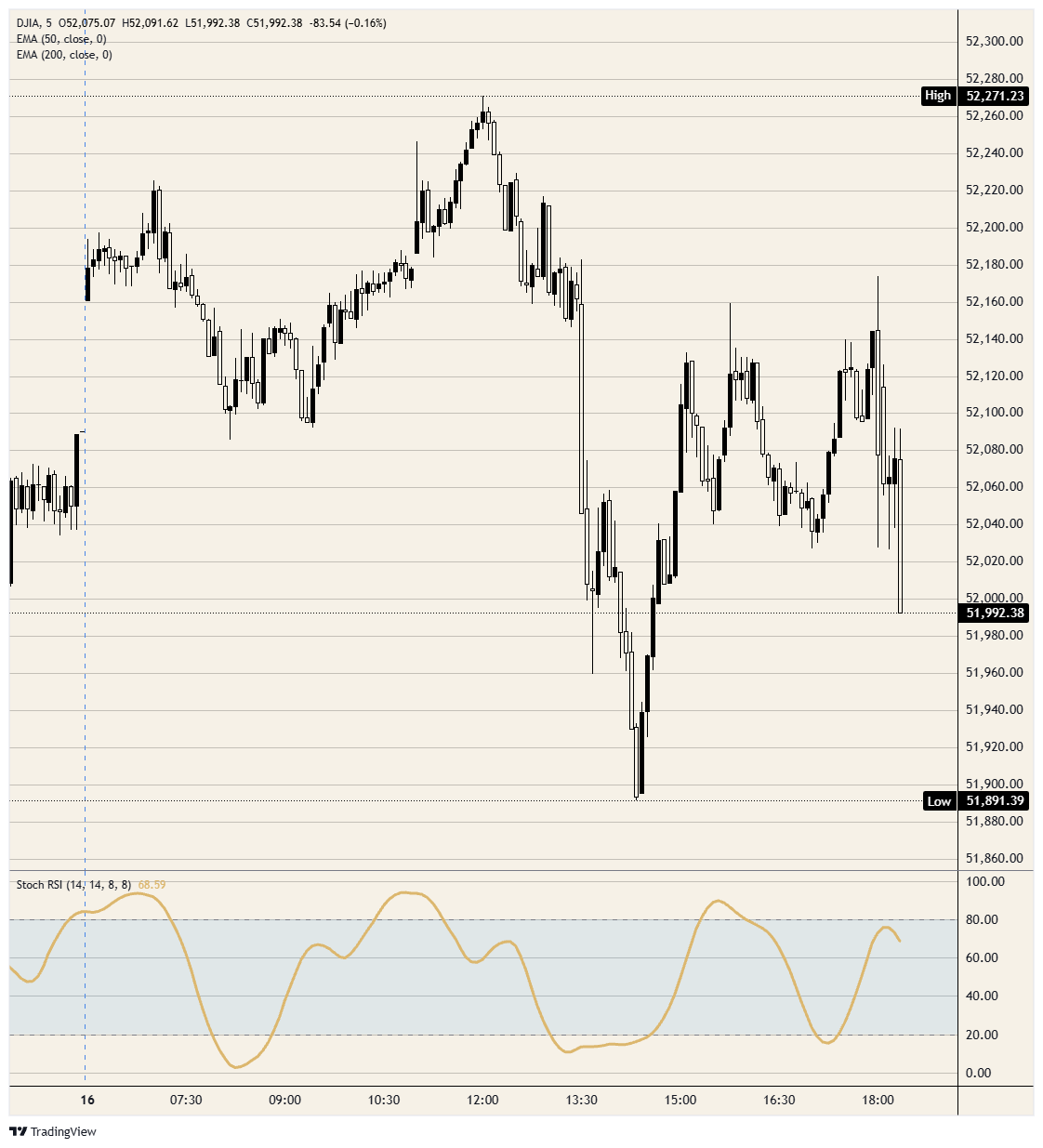
The index covered 146 points inside the five-minute bar that carried the decision and has given up another 85 since. It changes hands just under 52,000, about 152 points below where it sat going into 18:00 GMT, and roughly 100 points above the day's low just under 51,900. That low was made in the New York mid-morning and has not been tested again. The high just above 52,250 was set around midday and sits 279 points overhead. The five-minute momentum gauge reads near 69, which is elevated, because it is still measuring the climb into the release rather than the fall out of it.
Dow Jones 5-minute chart
Dow Jones FAQs
The Dow Jones Industrial Average, one of the oldest stock market indices in the world, is compiled of the 30 most traded stocks in the US. The index is price-weighted rather than weighted by capitalization. It is calculated by summing the prices of the constituent stocks and dividing them by a factor, currently 0.152. The index was founded by Charles Dow, who also founded the Wall Street Journal. In later years it has been criticized for not being broadly representative enough because it only tracks 30 conglomerates, unlike broader indices such as the S&P 500.
Many different factors drive the Dow Jones Industrial Average (DJIA). The aggregate performance of the component companies revealed in quarterly company earnings reports is the main one. US and global macroeconomic data also contributes as it impacts on investor sentiment. The level of interest rates, set by the Federal Reserve (Fed), also influences the DJIA as it affects the cost of credit, on which many corporations are heavily reliant. Therefore, inflation can be a major driver as well as other metrics which impact the Fed decisions.
Dow Theory is a method for identifying the primary trend of the stock market developed by Charles Dow. A key step is to compare the direction of the Dow Jones Industrial Average (DJIA) and the Dow Jones Transportation Average (DJTA) and only follow trends where both are moving in the same direction. Volume is a confirmatory criteria. The theory uses elements of peak and trough analysis. Dow’s theory posits three trend phases: accumulation, when smart money starts buying or selling; public participation, when the wider public joins in; and distribution, when the smart money exits.
There are a number of ways to trade the DJIA. One is to use ETFs which allow investors to trade the DJIA as a single security, rather than having to buy shares in all 30 constituent companies. A leading example is the SPDR Dow Jones Industrial Average ETF (DIA). DJIA futures contracts enable traders to speculate on the future value of the index and Options provide the right, but not the obligation, to buy or sell the index at a predetermined price in the future. Mutual funds enable investors to buy a share of a diversified portfolio of DJIA stocks thus providing exposure to the overall index.
Author

Joshua Gibson
FXStreet
Joshua joins the FXStreet team as an Economics and Finance double major from Vancouver Island University with twelve years' experience as an independent trader focusing on technical analysis.