|

Australian Dollar slides below 0.7100 as Warsh strikes hawkish tone

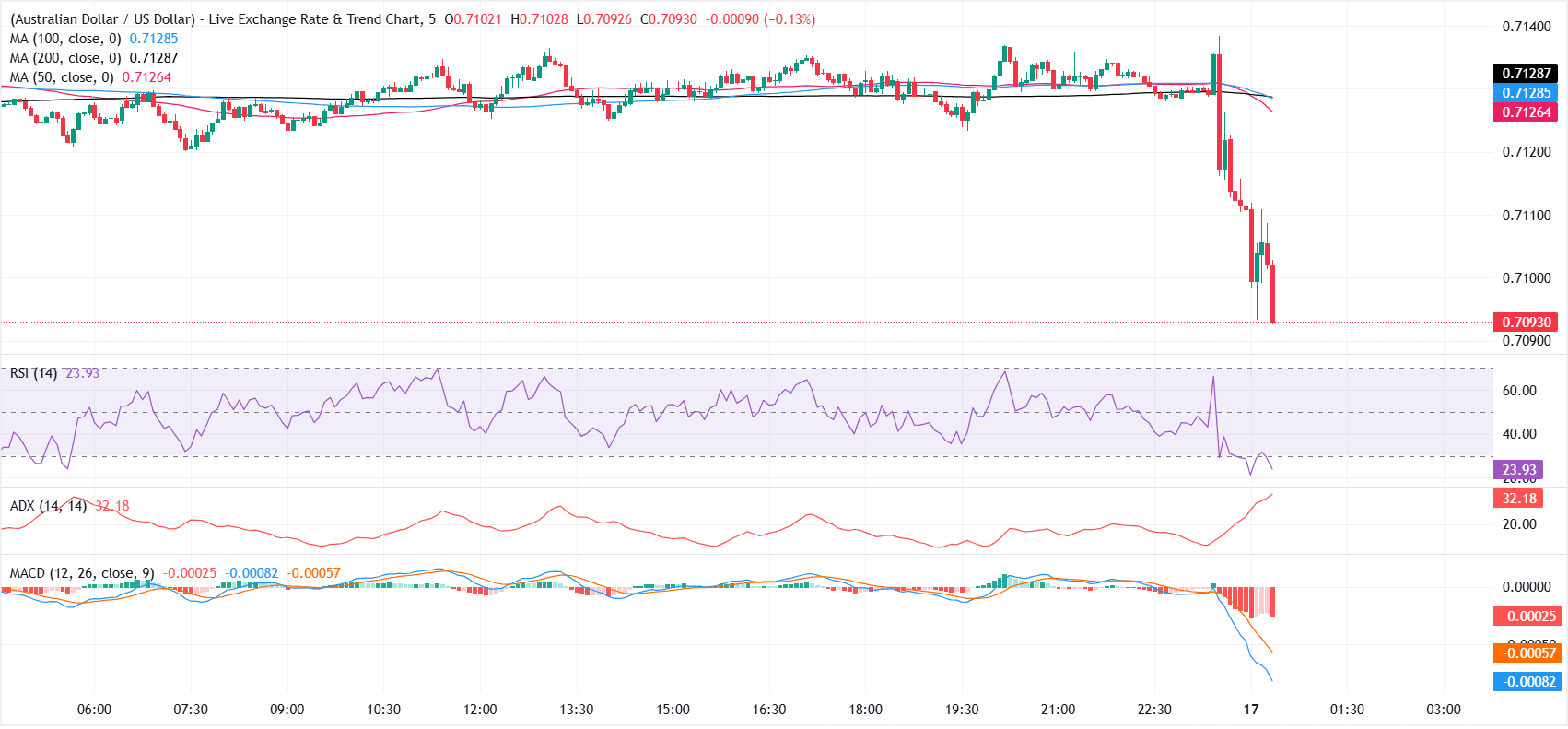
  • AUD/USD drops over 20 pips in the immediate reaction to the Fed decision.
  • The Fed raises rates by 25 basis points and signals that more tightening is likely.
  • The US Dollar Index extends its advance toward the psychological 100.00 mark.

AUD/USD extends losses on Wednesday after the Federal Reserve (Fed) raised interest rates and released a hawkish set of policy projections. The pair slides more than 20 pips in the immediate reaction and trades around 0.7093 at the time of writing.

The Fed raised the federal funds target range by 25 basis points to 3.75%-4.00% in a unanimous 12-0 decision, marking its first rate increase since July 2023. The US Dollar Index (DXY) extends its gains above the psychological 100.00 mark following the announcement.

Speaking after the decision, Fed Chairman Kevin Warsh said, “Inflation is too high, and has been for too long.” He added, “Because of the underlying strength of the economy, we can afford to focus on price stability.” “We must be confident that underlying inflation must be moving to 2% on a timely basis, and the FOMC decided this has not been met,” Warsh said. He noted that inflation risks are tilted to the upside, while risks to the labor market are balanced.

The updated dot plot shows that 16 of 18 Fed officials expect at least one more rate hike this year. Twelve policymakers project one additional quarter-point increase, four expect two more hikes and two see no further moves.

The median year-end rate projection rose to 4.1% from 3.8% in June. The 2027 projection also climbed to 4.1% from 3.6%. The Fed raised its 2026 GDP growth forecast to 2.3% from 2.2% in June and lifted its headline PCE inflation projection to 3.7% from 3.6%. The core PCE inflation forecast also increased to 3.4% from 3.3%, while the Unemployment Rate projection fell to 4.1% from 4.3%.
Author

Vishal Chaturvedi

I am a macro-focused research analyst with over four years of experience covering forex and commodities market. I enjoy breaking down complex economic trends and turning them into clear, actionable insights that help traders stay ahead of the curve.


More from Vishal Chaturvedi
Share:

Editor's Picks

AUD/USD edges higher as hot CPI inflation and hawkish RBA lift rate hike bets

The AUD/USD pair gathers strength to near 0.7035 during the Asian trading hours on Friday. The Australian Dollar edges higher against the US Dollar as hotter Australian CPI inflation data has bolstered expectations of Reserve Bank of Australia rate hikes.

USD/JPY meets support near 157.00

USD/JPY retreats for the third consecutive day on Friday, revisiting the 157.00 region before attempting some recovery as investors continue to assess the latest BoJ meeting, where the central bank left rates unchanged, as widely anticipated.

Gold sinks to fresh yearly lows despite risk-off mood as Fed rate hike bets weigh

Gold slips to fresh year-to-date lows on Friday. The metal struggles despite a risk-off mood across markets, as expectations of further Federal Reserve (Fed) interest rate hikes continue to dominate price action, leaving Gold on track to end the month in negative territory.


Ripple Price Forecast: XRP bulls defend $1.20 as sell-side pressure triggers liquidations
Ripple (XRP) trades around $1.25 on Friday, rising from a short-term support level established at $1.20. This minor upward correction follows a sharp sell-off, triggered amid reports of a hack attack on the Binance exchange that impacted approximately $6.3 billion. The attack drove the broader crypto market on edge, as Binance suspended both deposits and withdrawals to contain the situation.
BoJ recap: A pause for now... but Japan has entered a new inflation phase
The Bank of Japan left its short-term policy rate unchanged at 1.25% but delivered a distinctly hawkish message on the risk of an inflation overshoot. The decision passed by 8-1, with board member Takata dissenting in favour of an increase to 1.5%, while Governor Kazuo Ueda stressed that the Bank would continue adjusting policy as needed.
The 2% inflation target came from a throwaway remark. It now moves trillions
The Federal Reserve's 2% inflation goal grew out of an off-the-cuff remark by a New Zealand politician in 1988. Bond investors still price long-term US debt as if 2% holds, so a change in how the Fed measures inflation would move markets.















