The Canadian Dollar slips to a summer low on the Fed's rate hike
- USD/CAD rises to a six-week peak, testing 1.4000, a 0.51% rise on the Fed.
- Canada's rate has not moved in seven meetings while the Fed's just did.
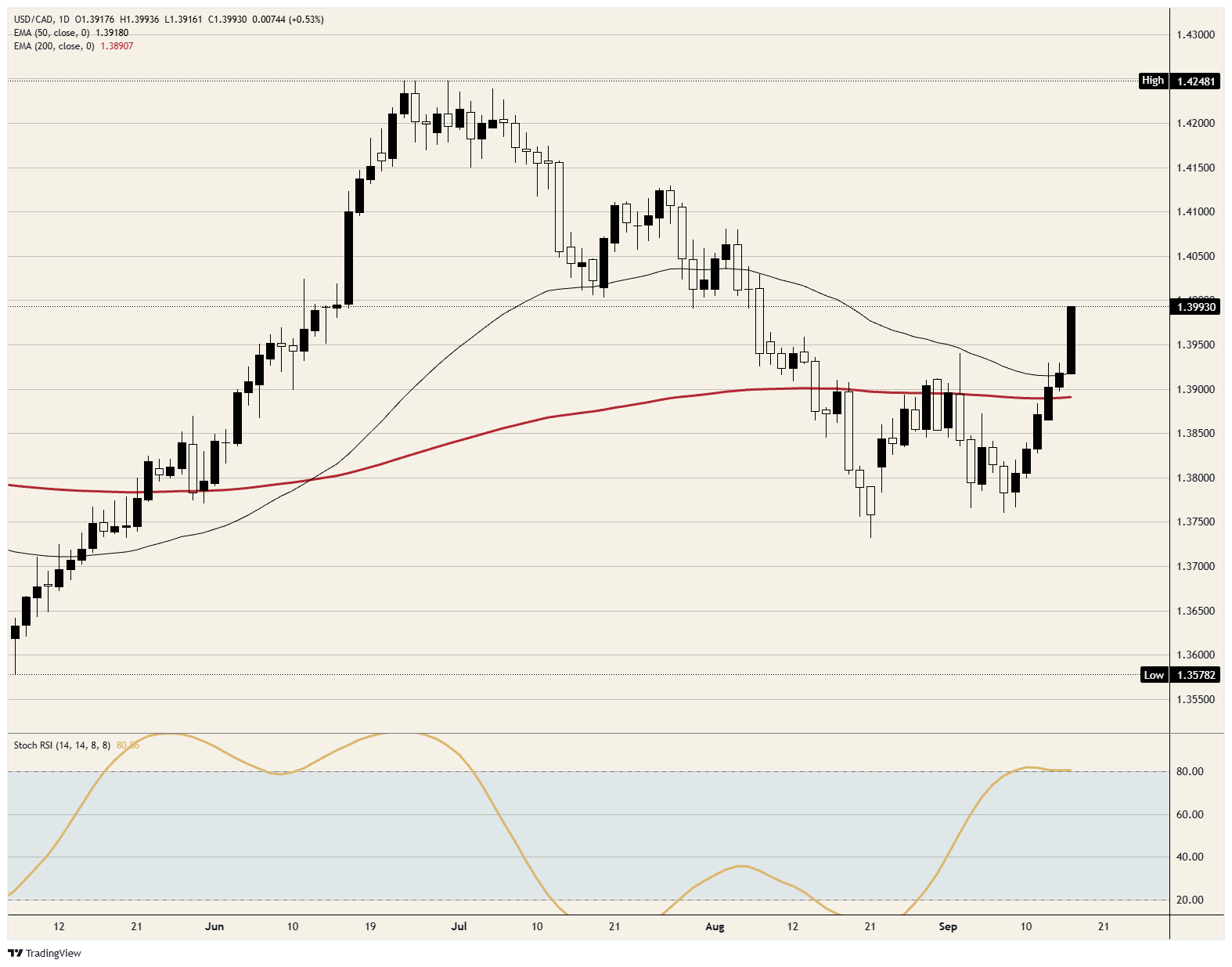
- Pair clears its 50-day and 200-day averages, both clustered near 1.3900.
The Loonie trades at its weakest since early August, with USD/CAD just under 1.4000 after a 71-pip rise and a 0.51% gain. The Fed raised its rate a quarter-point to 3.75-4.00% and the Bank of Canada did not, which takes the distance between them from 1.375 points to 1.625. That is most of the story. A currency that sells oil at more than $100 a barrel lost ground anyway.
One of them moved, and it was not the near one
The Bank of Canada (BoC) has held its overnight rate at 2.25% through seven consecutive meetings, the most recent on September 2, and does not decide again until October 28. American money now pays 1.625 points more than Canadian money overnight, where this morning it paid 1.375 more. The Fed's projections widen that further on paper, carrying the American rate to 4.1% by December and holding it there through 2027, while Canada's own market prices no change at all before the year is out. The Bank of Canada spent this afternoon publishing its account of the September 2 decision, thirty minutes before the Fed made a different one.
Oil did not save it
The barrel above $100 normally lifts this currency, and on any other afternoon it would have. The rate gap moved today and the barrel did not. The chair supplied the rest, describing a committee that still needs to see underlying inflation heading to 2% clearly and quickly and does not yet, which is a central bank with more to do. Canada's has nothing scheduled for six weeks.
Levels and bias
Resistance: 1.4000 is directly overhead and today's high stopped ten pips beneath it. Above that sit 1.4050 and 1.4100.
Support: The 50-day and 200-day Exponential Moving Averages (EMA) are clustered near 1.3900, about 70 pips below the market, and the pair opened on top of them this morning. Beneath that cluster, 1.3850.
Bias: Bullish while the average cluster near 1.3900 holds, with 1.4000 the first objective and 1.4050 behind it. The Stochastic Relative Strength Index (Stoch RSI), the daily momentum gauge, is up at 81 at the top of its range, so the move is stretched and a pullback toward 1.3950 would not change the reading. A daily close back below 1.3850 voids the case.
USD/CAD daily chart
Interest rates FAQs
Interest rates are charged by financial institutions on loans to borrowers and are paid as interest to savers and depositors. They are influenced by base lending rates, which are set by central banks in response to changes in the economy. Central banks normally have a mandate to ensure price stability, which in most cases means targeting a core inflation rate of around 2%. If inflation falls below target the central bank may cut base lending rates, with a view to stimulating lending and boosting the economy. If inflation rises substantially above 2% it normally results in the central bank raising base lending rates in an attempt to lower inflation.
Higher interest rates generally help strengthen a country’s currency as they make it a more attractive place for global investors to park their money.
Higher interest rates overall weigh on the price of Gold because they increase the opportunity cost of holding Gold instead of investing in an interest-bearing asset or placing cash in the bank. If interest rates are high that usually pushes up the price of the US Dollar (USD), and since Gold is priced in Dollars, this has the effect of lowering the price of Gold.
The Fed funds rate is the overnight rate at which US banks lend to each other. It is the oft-quoted headline rate set by the Federal Reserve at its FOMC meetings. It is set as a range, for example 4.75%-5.00%, though the upper limit (in that case 5.00%) is the quoted figure. Market expectations for future Fed funds rate are tracked by the CME FedWatch tool, which shapes how many financial markets behave in anticipation of future Federal Reserve monetary policy decisions.
Author

Joshua Gibson
FXStreet
Joshua joins the FXStreet team as an Economics and Finance double major from Vancouver Island University with twelve years' experience as an independent trader focusing on technical analysis.