XRP slide deepens amid Fed uncertainty
- XRP decline deepens for the second consecutive day, with the 50-day EMA holding as immediate support.
- US Senate fails to advance the CLARITY Act, further delaying clear crypto regulation.
- XRP bears tighten their grip, reinforced by deteriorating momentum indicators and a firmly capped upside.


Ripple (XRP) trades lower around $1.28 on Wednesday, as investors broadly assess the impact of the failed United States (US) Senate vote on the CLARITY Act and the upcoming Federal Reserve (Fed) monetary decision.
The remittance token has trimmed early-week gains that tagged highs around $1.50 on Monday and now holds key moving-average support. Further declines could stretch the down leg toward the critical $1.20 demand area.
CLARITY Act fails to advance
The US Senate failed 49-50 to advance the CLARITY Act, a comprehensive market-structure regulation framework, on Tuesday. All 49 supporting votes were from the Republicans. With the bill now stalled in Congress, attention is shifting to key agencies, including the Commodity Futures Trading Commission (CFTC) and the Securities and Exchange Commission (SEC), to provide the much-needed oversight. Both agencies have indicated they are ready to continue pursuing clearer guidelines within their existing authority.
“The cloture vote not passing does not slow the digital asset market down. Stablecoin adoption and real-world use cases are already moving faster than the legislative process, and the SEC and CFTC can still provide greater clarity through rulemaking and regulatory guidance, even without legislation,” Wayne Huang, the Co-founder and Group CEO of XREX Group, said in an emailed comment.
Meanwhile, the immediate path to passing the bill is in disarray as lawmakers head into the November mid-term elections. The odds of the bill becoming law in 2026 have further dwindled, suggesting that the process could require a new bill next year.
Cryptocurrency prices remain lethargic as market participants are reluctant to increase exposure, perhaps until after the Fed's monetary policy decision. A stricter monetary policy could squeeze liquidity out of risk assets as investors seek stable assets such as US Treasuries and higher borrowing costs become a pain point.
Technical Analysis: XRP sellers retain control
XRP trades around $1.28, keeping a bearish near-term tone as it holds below the 50-day Exponential Moving Average (EMA) at $1.28 and the 200-day EMA near $1.36. The spot price remains trapped under the long-running downward resistance trendline, while the 100-day EMA at $1.25 offers underlying support, suggesting a consolidative pullback rather than an outright collapse.
Momentum is soft, with the RSI hovering around 45 and the MACD in negative territory, hinting that upside attempts could continue to fade beneath overhead supply.
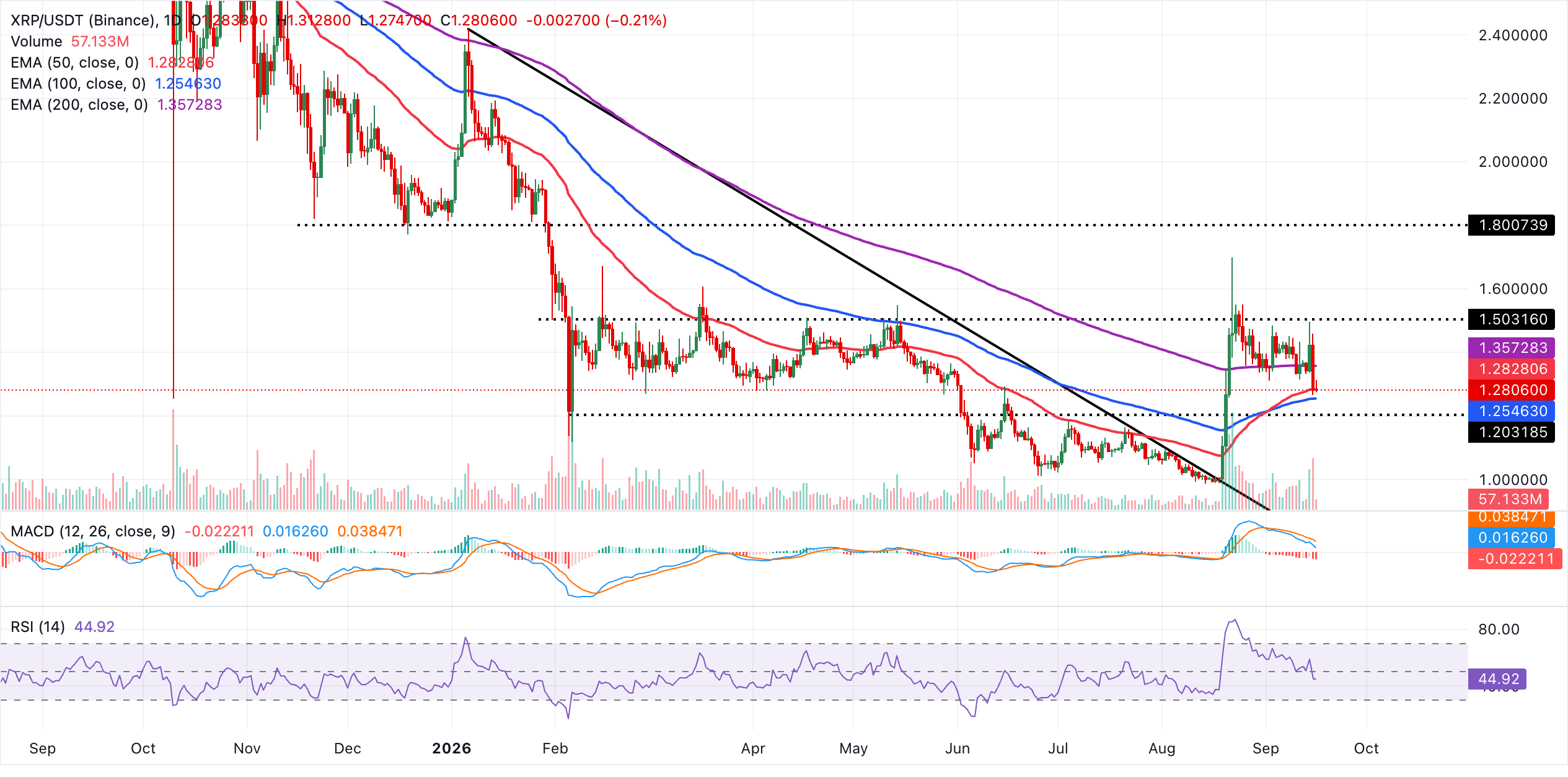
On the topside, immediate resistance is seen at the 50-day EMA around $1.28, with the 200-day EMA near $1.36 acting as a stronger cap in line with the descending trendline structure. On the downside, initial support is aligned with the 100-day EMA at $1.25. A clear break below this level would open the door to a deeper correction, while holding above it would keep the pair confined in a range beneath the clustered moving-average resistance.
(The technical analysis of this story was written with the help of an AI tool. Know more.)
Cryptocurrency prices FAQs
Token launches influence demand and adoption among market participants. Listings on crypto exchanges deepen the liquidity for an asset and add new participants to an asset’s network. This is typically bullish for a digital asset.
A hack is an event in which an attacker captures a large volume of the asset from a DeFi bridge or hot wallet of an exchange or any other crypto platform via exploits, bugs or other methods. The exploiter then transfers these tokens out of the exchange platforms to ultimately sell or swap the assets for other cryptocurrencies or stablecoins. Such events often involve an en masse panic triggering a sell-off in the affected assets.
Macroeconomic events like the US Federal Reserve’s decision on interest rates influence crypto assets mainly through the direct impact they have on the US Dollar. An increase in interest rate typically negatively influences Bitcoin and altcoin prices, and vice versa. If the US Dollar index declines, risk assets and associated leverage for trading gets cheaper, in turn driving crypto prices higher.
Halvings are typically considered bullish events as they slash the block reward in half for miners, constricting the supply of the asset. At consistent demand if the supply reduces, the asset’s price climbs.
Author
John Isige
FXStreet
John Isige is a seasoned cryptocurrency journalist and markets analyst committed to delivering high-quality, actionable insights tailored to traders, investors, and crypto enthusiasts. He enjoys deep dives into emerging Web3 tren