Dollar Index Cracks 100 as Fed delivers hawkish hike
- DXY reaches 100.00 after the Fed decision, up 0.30 from pre-release levels
- Fed's rate rises to 3.75-4.00%, six days after the ECB went to 2.50%

The Fed has raised its rate to 3.75-4.00%, its first increase since 2023. This index measures the Dollar against six currencies, and it is not a broad measure. The Euro alone is 57.6% of it. Add the Yen and the Pound and three currencies account for roughly four-fifths of the whole thing, and two of those three central banks are raising rates as well. The European Central Bank (ECB) took its deposit rate to 2.50% six days ago, and the Bank of England answers at 11:00 GMT tomorrow. The vote was 12-0, and the statement offered nothing at all about what comes next. What the index measures is not whether American rates went up, but whether they went up by more than everyone else's. The weights it uses to answer that were last changed in 1999.
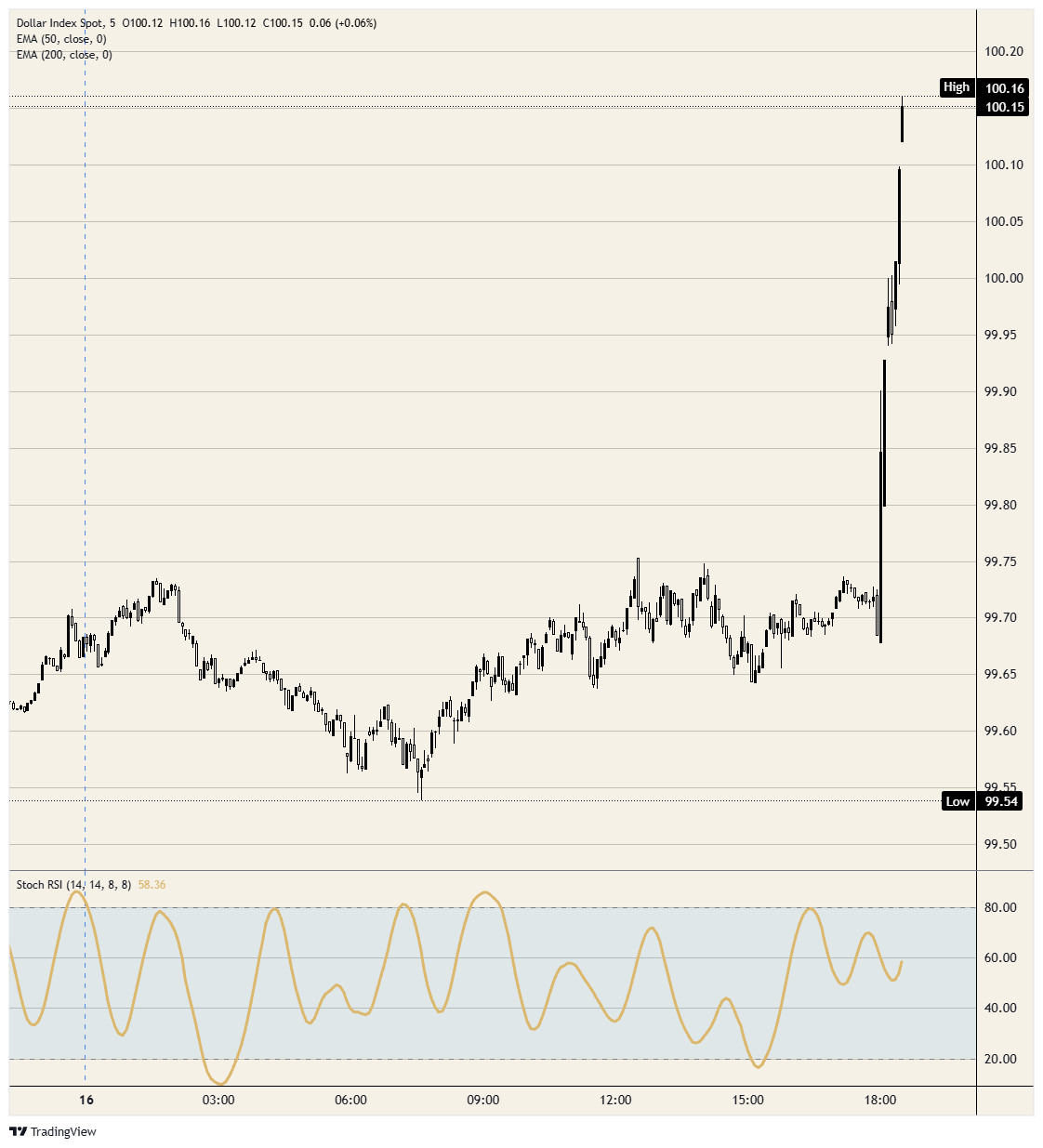
The index dipped to near 99.70 on the release and then ran the other way, reaching 100.00 exactly and trading there. That is 0.30 above where it sat going into 18:00 GMT and the high of the day, made in two pushes with a shallow pause between them. The day's low near 99.55 was set in the European morning, so the session spans 0.46 and the move since the decision is roughly two-thirds of it. The five-minute momentum gauge reads near 51, which is mid-range, because the spike and the pause inside the same half hour have left it in the middle.
DXY 5-minute chart
US Dollar FAQs
The US Dollar (USD) is the official currency of the United States of America, and the ‘de facto’ currency of a significant number of other countries where it is found in circulation alongside local notes. It is the most heavily traded currency in the world, accounting for over 88% of all global foreign exchange turnover, or an average of $6.6 trillion in transactions per day, according to data from 2022. Following the second world war, the USD took over from the British Pound as the world’s reserve currency. For most of its history, the US Dollar was backed by Gold, until the Bretton Woods Agreement in 1971 when the Gold Standard went away.
The most important single factor impacting on the value of the US Dollar is monetary policy, which is shaped by the Federal Reserve (Fed). The Fed has two mandates: to achieve price stability (control inflation) and foster full employment. Its primary tool to achieve these two goals is by adjusting interest rates. When prices are rising too quickly and inflation is above the Fed’s 2% target, the Fed will raise rates, which helps the USD value. When inflation falls below 2% or the Unemployment Rate is too high, the Fed may lower interest rates, which weighs on the Greenback.
In extreme situations, the Federal Reserve can also print more Dollars and enact quantitative easing (QE). QE is the process by which the Fed substantially increases the flow of credit in a stuck financial system. It is a non-standard policy measure used when credit has dried up because banks will not lend to each other (out of the fear of counterparty default). It is a last resort when simply lowering interest rates is unlikely to achieve the necessary result. It was the Fed’s weapon of choice to combat the credit crunch that occurred during the Great Financial Crisis in 2008. It involves the Fed printing more Dollars and using them to buy US government bonds predominantly from financial institutions. QE usually leads to a weaker US Dollar.
Quantitative tightening (QT) is the reverse process whereby the Federal Reserve stops buying bonds from financial institutions and does not reinvest the principal from the bonds it holds maturing in new purchases. It is usually positive for the US Dollar.
Author

Joshua Gibson
FXStreet
Joshua joins the FXStreet team as an Economics and Finance double major from Vancouver Island University with twelve years' experience as an independent trader focusing on technical analysis.