|

Spanish elections exit polls show hung Parliament with no clear majority - Center-left PSOE will need support from regional parties

Exit polls by the primary television channels in Spain show the center-left PSOE will the largest party with 116-121 seats, followed by the center-right PP with 69-73, the right-wing Ciudadanos with around 48, left-wing Podemos with 42-45, and radical left Vox with 32-36. The rest of the seats go to the regional parties.

The general picture is that both the right-wing and left-wing blocs are quite balanced without an absolute majority. 

This division between the blocs seems similar to the one in the outgoing parliament. PM Sánchez will need to join forces with both the left-wing Podemos and regional parties, including pro-independence parties in Catalonia. 

Real results are due in the next few hours.
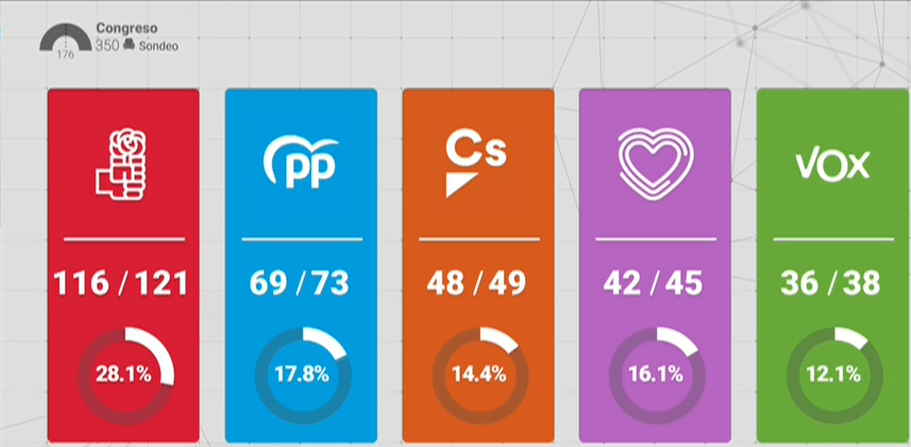
Spanish elections 2019 exit polls

Background

Spaniards voted in masses in polls that were considered too hard to predict. Turnout during the day easily surpassed the levels seen in the previous three elections. Turnout stood at 60.75% at 18:00 local time, 16:00 GMT, around 11 percentage points more than the previous elections in 2016. In Catalonia, turnout was over 17 points higher than three years ago.

The center-left PSOE led by incumbent PM Pedro Sánchez was expected to come out as the biggest party in the new Congreso de Diputados, or parliament. However, the socialists were not expected to get close to a majority. The PSOE and the left-leaning Podemos hoped to reach a majority.

The right-wing block comprised of the previous ruling PP, the relatively new party Ciudadanos, and the ultra-right Vox also seemed short of a majority in the opinion polls leading to the vote. The balance of power may be held by regional parties from Catalonia and the Basque Country.

See: Spanish elections preview: 5 scenarios, mostly EUR/USD positive, at least at some point

Author

Yohay Elam

Yohay Elam

FXStreet

Yohay is in Forex since 2008 when he founded Forex Crunch, a blog crafted in his free time that turned into a fully-fledged currency website later sold to Finixio.


More from Yohay Elam
Share:

Editor's Picks

AUD/USD bulls seem hesitant below 0.7050 ahead of RBA on Tuesday

AUD/USD reverses an Asian session dip on Monday as renewed optimism over Iran diplomacy boosts investor confidence, keeping a lid on the safe-haven US Dollar and supporting the risk-sensitive Aussie. Spot prices, however, remain below the one-month high, touched last Thursday, as bulls wait for the crucial RBA decision before taking fresh positions.


USD/JPY climbs to 158.00 neighborhood as BoJ uncertainty weighs on the JPY

The USD/JPY pair gains some positive traction at the start of a new week, recovering further from Friday's post-Bank of Japan (BoJ) swing low to sub-157.00 levels. The momentum lifts spot prices to the 158.00 neighborhood during the Asian session and seems unaffected by fresh intervention warning from Japan's Finance Minister Satsuki Katayama.

Gold rebounds to near $3,900 as Fed hike bets cap upside

Gold price edges at the start of a new week, reclaiming $3,900 during the Asian session and reversing a part of Friday's heavy losses to its lowest level since October 2025. The upside potential, however, seems limited as elevated oil prices and inflation concerns keep Fed rate hike bets firmly on the table.

Zcash rebounds as ZODL founder now supports ending community grants
Zcash (ZEC) shows signs of recovery on Monday, extending gains above $1,250 as the Zcash Open Development Lab (ZODL) founder, Josh Swihart, now supports the compromise proposal to end the 8% block reward share directed to Zcash Community Grants (ZCG).
Middle East War updates: Iran warns of expanded strikes against US despite progress in talks

Here’s a brief recap of the key developments in the Middle East war that occurred over the weekend, which are expected to have a significant impact on markets in the upcoming week.

The 2% inflation target came from a throwaway remark. It now moves trillions
The Federal Reserve's 2% inflation goal grew out of an off-the-cuff remark by a New Zealand politician in 1988. Bond investors still price long-term US debt as if 2% holds, so a change in how the Fed measures inflation would move markets.