SpaceX slumps 10% in largest sell-off to date
- SpaceX sees the largest one-day drawdown to date on Monday.
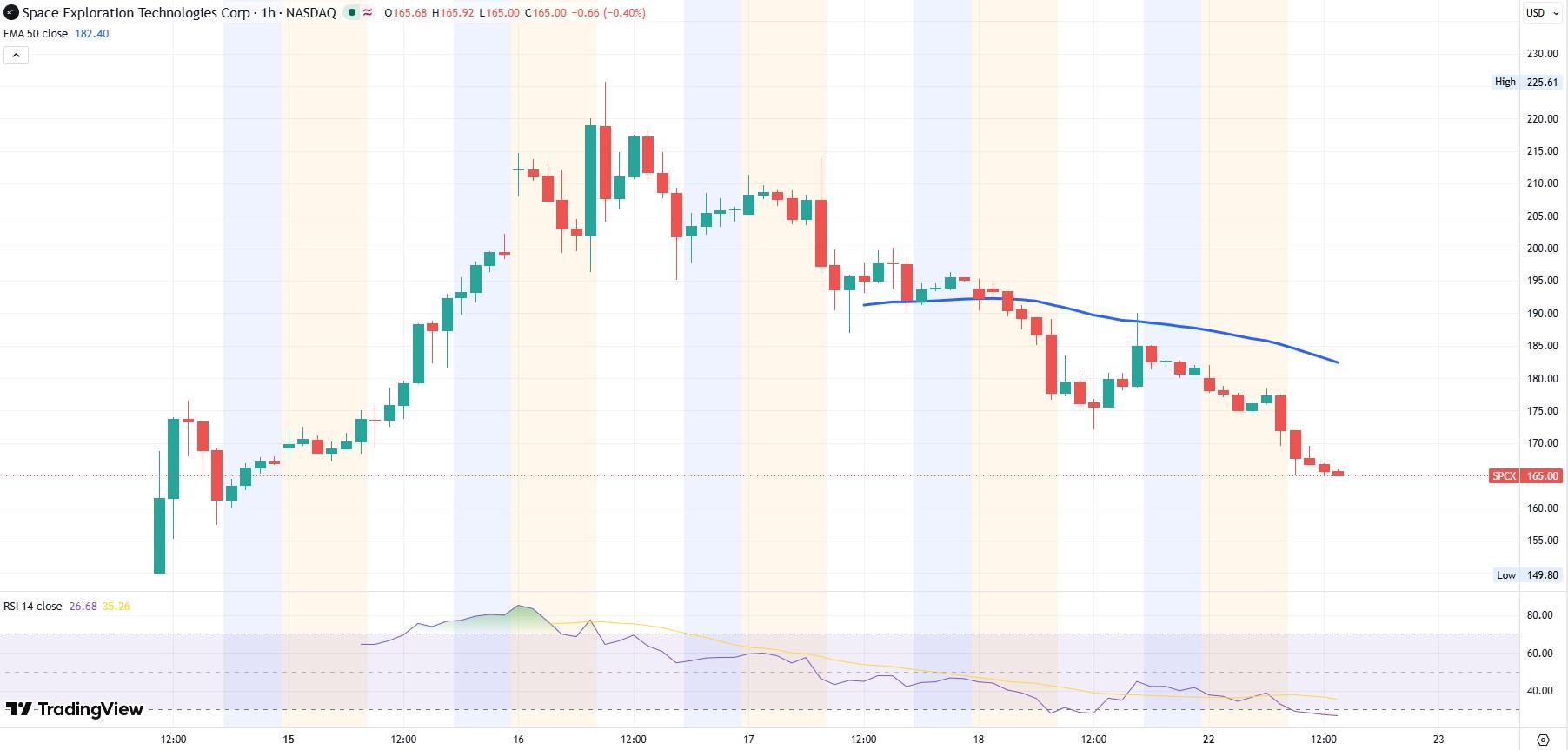
- SPCX trades as low as $165 on Monday afternoon.
- Torsten Slok sees heavy buying of downside protection for tech stocks.
- SpaceX unlocks will expand the float from about 4% to 44% by September.

SpaceX (SPCX) stock slumps 10% on Monday, its third straight down session after starting off its public career with three straight green sessions. After reaching an all-time high of $225.64 last Tuesday, SPCX reached an intraday low at $165.00 on Monday.
Without a clear catalyst, some market watchers blamed the growing awareness that SpaceX's float will grow by about 1,000% over the next three months. But others simply blamed volatility in technology stocks.
The NASDAQ Composite lost about 1.2% by early Monday afternoon, while the S&P 500 was down a more subdued 0.3%, and the Dow Jones Industrial Average (DJIA) gained 0.3%.
SpaceX lands $6 billion AI contract
On Monday, SpaceX announced it had landed a new contract for xAI, its artificial intelligence division. Start-up Reflection AI will pay up to $150 million per month to rent Nvidia's GB300 chips from xAI. The contract could last through 2029 and provide SpaceX with up to $6.3 billion in revenue.
Most recently valued at $25 billion, Reflection AI was founded by Misha Laskin and Ioannis Antonoglou, two former researchers at Google DeepMind, and is focused on building open-source frontier AI models.
SpaceX stock continues volatile post-IPO saga
SpaceX has been quite volatile since going public on Friday, June 12, at $135. The rocket, satellite, social media and AI conglomerate surged more than 19% in each of the first two sessions.
Apollo’s chief economist, Torsten Slok, said that stocks tied to the AI rally are showing signs of instability. The well-known thought leader said that the options market demonstrates that investors are beginning to hedge more of their tech positions that they did earlier in the cycle. By comparing volatility in the NASDAQ Composite to that of the S&P500, Slok argues that investors are less worried about the broad market but have grown less complacent about high-flying tech stocks that have led the rally this year.
Because of this, Slok said there is heavier purchasing of downside protection for tech stocks and indices.
However, as it pertains to SpaceX, investors might just be reducing exposure to Elon Musk's newest public vehicle since a large amount of insider holdings get unlocked over the next 80 days.
About 20% of total shares held by insiders get unlocked in mid-August after SpaceX releases its first earnings announcement as a public company. If the stock remains above $175, then another 10% of shares get unlocked.
Then 7% of shares get unlocked on August 21 and once again on September 10. In total, SpaceX's float will rise from about 4% of total shares to about 44% by September, heavily increasing the supply of shares and allowing investors who have held shares for more than decade to finally take profit. It's quite possible that this leads to a wave of selling and lower share prices.
One analyst who is sticking to his bullish case on SpaceX is Tim Horan of Oppenheimer. Horan has a $250 price target on SPCX and argues that SpaceX is the only vertically-integrated AI company that can individually disrupt a number of industries on its own.
If SpaceX can meet Musk's goal of $1 trillion in revenue by 2030, Horan thinks it will trade for approximately ten times that figure or $10 trillion.
Author

Clay Webster
FXStreet
Clay Webster grew up in the US outside Buffalo, New York and Lancaster, Pennsylvania. He began investing after college following the 2008 financial crisis.

















