Silver Price Forecast: XAG/USD starts US CPI week on flat note around $63.50
- Silver price trades flat at the start of the US CPI data week.
- Traders trim hawkish Fed bets due to soft US NFP data.
- Fed officials signaled in the July meeting that they are committed to bringing inflation down to the 2% target.

Silver price (XAG/USD) trades in a tight range at around $63.50 during the Asian trading session at the start of the week. The white metal struggles for direction but is close to an almost seven-week high of $65.16 posted on Friday.
Bullions are expected to face heightened volatility, with the United States (US) Consumer Price Index (CPI) data for July on the radar, releasing on Wednesday.
The impact of the US CPI data will likely be significant on the Federal Reserve (Fed) interest rate expectations, as comments in the July monetary policy statement signaled that officials are heavily concerned about high inflation and are committed to bringing price pressures down to the 2% target.
Higher US inflationary pressures prompt Fed interest rate hike risks, a scenario that bodes poorly for non-yielding assets, such as Silver.
On Friday, the Silver price gained sharply as traders scaled back hawkish Fed bets for the September policy meeting after the release of the US Nonfarm Payrolls (NFP) data for July, which showed a reduction in the overall labor force.
According to the CME FedWatch tool, the odds of the Fed raising policy rates in the September meeting are 46%, a sharp decline from 67% seen a week ago.
The US NFP report showed employers fired 23K workers, while they were anticipated to create 80K fresh jobs. Also, June’s NFP print was revised lower to 20K from 57K.
Silver Technical Analysis
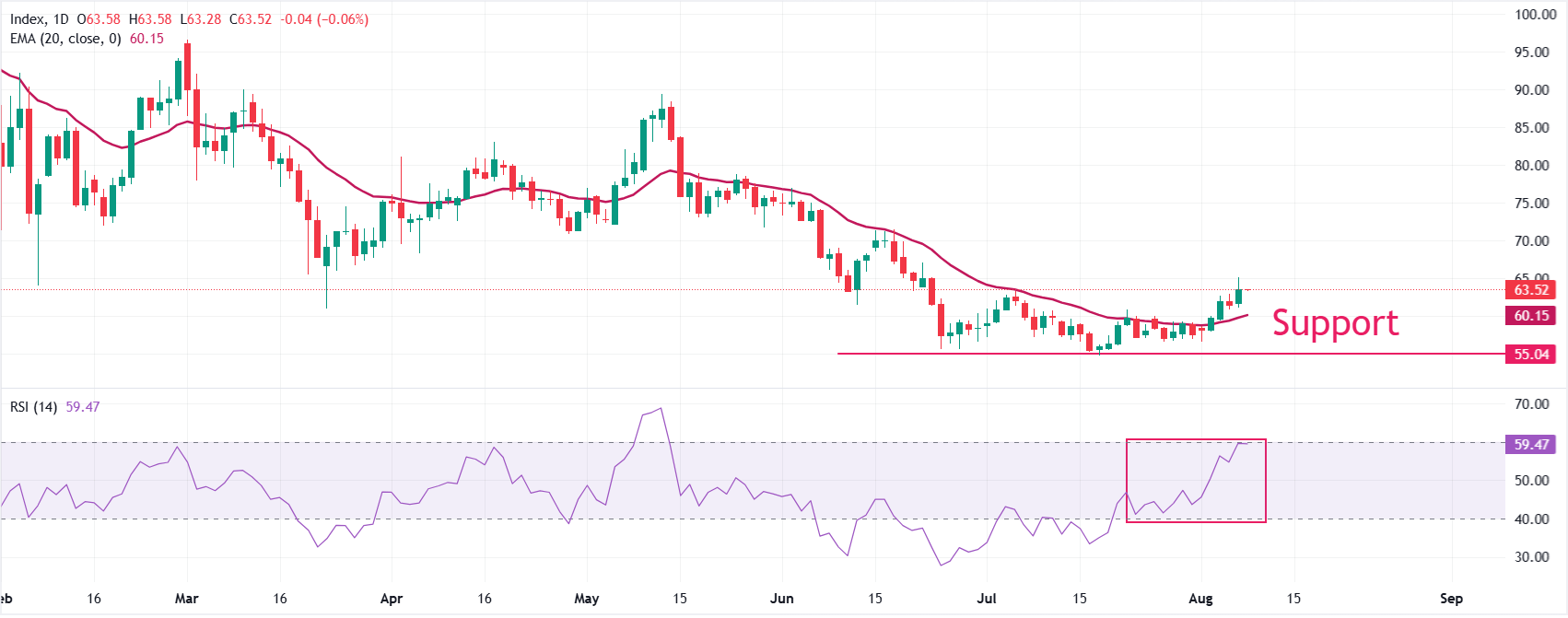
XAG/USD trades at around $63.50, maintaining a bullish near-term bias as spot silver holds above the 20-day Exponential Moving Average (EMA) at $60.14. The pair has rebounded sharply from recent lows, and holds above this key dynamic barrier, while the Relative Strength Index (RSI) at 59.28 suggests improving but not yet overbought momentum.
On the topside, initial resistance is last week's high at $65.16; a break above that level would open the way for further upside towards $70.00. Looking down, the 20-day EMA at $60.14 is the key support level. The Silver price could return to its lowest low at $54.77 in the Year-To-Date (YTD) if it fails to hold the dynamic barrier.
(The technical analysis of this story was written with the help of an AI tool. Know more.)
Economic Indicator
Nonfarm Payrolls
The Nonfarm Payrolls release presents the number of new jobs created in the US during the previous month in all non-agricultural businesses; it is released by the US Bureau of Labor Statistics (BLS). The monthly changes in payrolls can be extremely volatile. The number is also subject to strong reviews, which can also trigger volatility in the Forex board. Generally speaking, a high reading is seen as bullish for the US Dollar (USD), while a low reading is seen as bearish, although previous months' reviews and the Unemployment Rate are as relevant as the headline figure. The market's reaction, therefore, depends on how the market assesses all the data contained in the BLS report as a whole.
Read more.Last release: Fri Aug 07, 2026 12:30
Frequency: Monthly
Actual: -23K
Consensus: 80K
Previous: 57K
Source: US Bureau of Labor Statistics
America’s monthly jobs report is considered the most important economic indicator for forex traders. Released on the first Friday following the reported month, the change in the number of positions is closely correlated with the overall performance of the economy and is monitored by policymakers. Full employment is one of the Federal Reserve’s mandates and it considers developments in the labor market when setting its policies, thus impacting currencies. Despite several leading indicators shaping estimates, Nonfarm Payrolls tend to surprise markets and trigger substantial volatility. Actual figures beating the consensus tend to be USD bullish.
Author

Sagar Dua
FXStreet
Sagar Dua is associated with the financial markets from his college days. Along with pursuing post-graduation in Commerce in 2014, he started his markets training with chart analysis.