Silver Price Forecast: XAG/USD rallies 4% as trade war fears drive safe-haven flows
- Silver rallies 4% as US Supreme Court tariff ruling and fresh trade war fears drive flight to precious metals
- A US Supreme Court ruling struck down emergency tariffs, prompting the administration to pivot toward a new 15% global levy under Section 122 of the Trade Act.
- Stalled US-Iran nuclear talks, stagflation concerns after Q4 GDP of 1.4% and elevated PCE at 3.4%, and a sixth consecutive annual silver supply deficit are reinforcing safe-haven flows.

Silver (XAG/USD) surged alongside Gold on Monday as a confluence of trade policy upheaval and geopolitical risk sent investors into hard assets. The US Supreme Court struck down existing emergency-power tariffs on Friday, but US President Donald Trump responded by invoking Section 122 of the Trade Act of 1974 and threatened to impose a 15% flat global tariff in the coming months. The move blindsided markets that had briefly anticipated a return to more conventional trade norms. Stalled nuclear talks with Iran added a geopolitical risk premium, while last week's weak Q4 Gross Domestic Product (GDP) print and sticky inflation data reinforced a stagflationary backdrop that historically favours precious metals. Silver's sixth consecutive year of supply deficit, with a projected 67 million ounce shortfall in 2026, continues to underpin structural demand from industrial buyers in solar, electric vehicle, and semiconductor sectors.
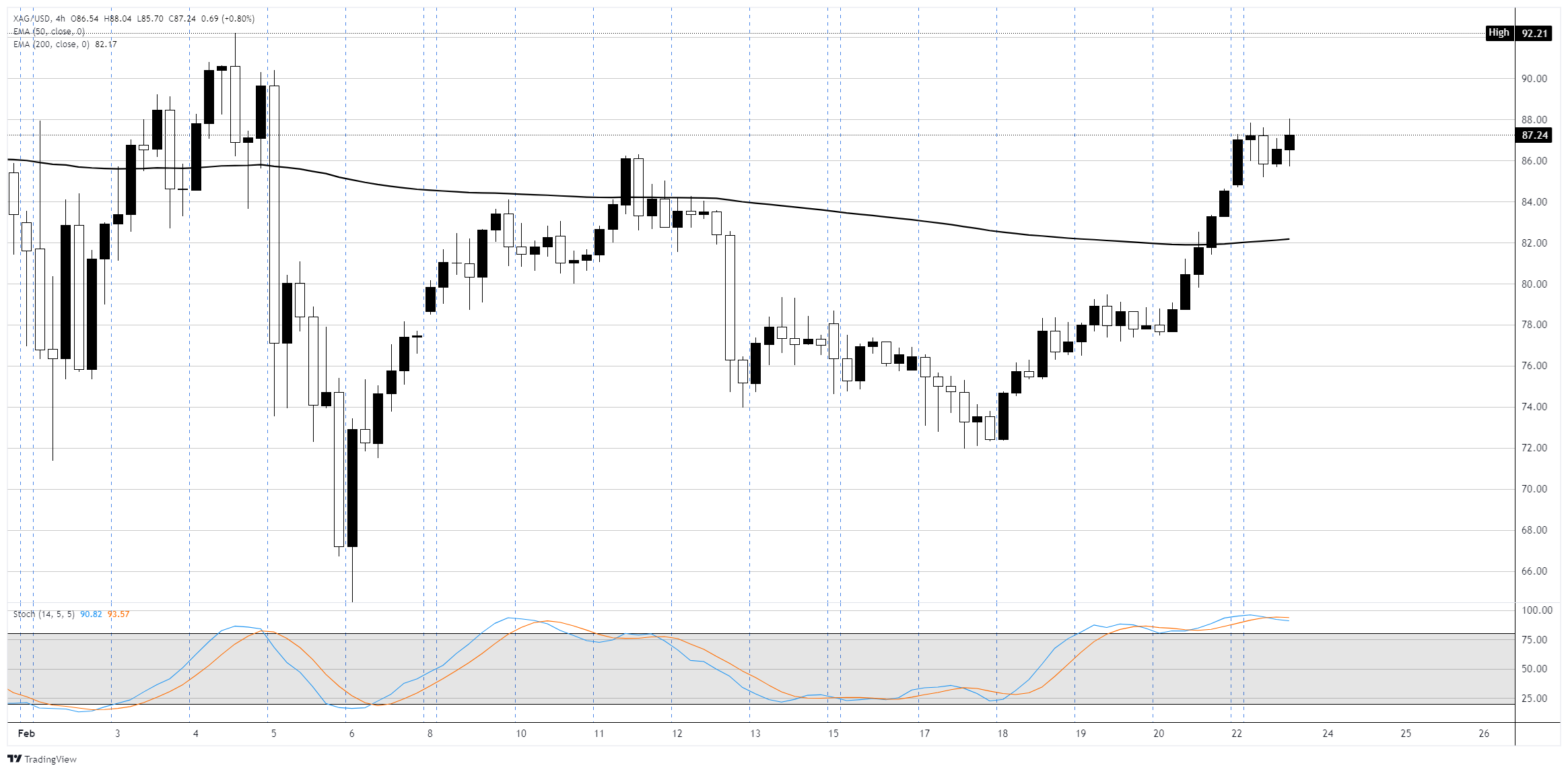
Sharp rally reclaims February highs as Stochastic pushes deep into overbought
On the daily chart, XAG/USD opened Monday with a quick dip-and-rally to tap $88/ounce for the first time in three weeks, climbing around 4% bottom-to-top on the day. Price has now reclaimed territory well above the 200-period EMA at $82.17, confirming a bullish structure following the sharp V-shaped recovery from the $72.00 low printed in mid-February. The Stochastic Oscillator has pushed deep into overbought territory with both lines above 90, signalling strong upside momentum but also flagging the potential for a near-term pullback or consolidation. The rally from $72.00 to current levels has been driven by a series of strong-bodied bullish candles with minimal upper wicks, pointing to sustained buying pressure. Immediate resistance sits at the early February highs near $90.00, with $92.00 as the next significant level above; support on any pullback should be found around $84.00, with the $82.00 zone (200 EMA) acting as deeper structural support. A sustained break above $90.00 would open the door toward the psychologically significant $100.00 level.
XAG/USD 4-hour chart
Tariffs FAQs
Tariffs are customs duties levied on certain merchandise imports or a category of products. Tariffs are designed to help local producers and manufacturers be more competitive in the market by providing a price advantage over similar goods that can be imported. Tariffs are widely used as tools of protectionism, along with trade barriers and import quotas.
Although tariffs and taxes both generate government revenue to fund public goods and services, they have several distinctions. Tariffs are prepaid at the port of entry, while taxes are paid at the time of purchase. Taxes are imposed on individual taxpayers and businesses, while tariffs are paid by importers.
There are two schools of thought among economists regarding the usage of tariffs. While some argue that tariffs are necessary to protect domestic industries and address trade imbalances, others see them as a harmful tool that could potentially drive prices higher over the long term and lead to a damaging trade war by encouraging tit-for-tat tariffs.
During the run-up to the presidential election in November 2024, Donald Trump made it clear that he intends to use tariffs to support the US economy and American producers. In 2024, Mexico, China and Canada accounted for 42% of total US imports. In this period, Mexico stood out as the top exporter with $466.6 billion, according to the US Census Bureau. Hence, Trump wants to focus on these three nations when imposing tariffs. He also plans to use the revenue generated through tariffs to lower personal income taxes.
Author

Sagar Dua
FXStreet
Sagar Dua is associated with the financial markets from his college days. Along with pursuing post-graduation in Commerce in 2014, he started his markets training with chart analysis.