Silver Price Forecast: XAG/USD edges higher as Moody’s downgrade forces USD lower
- Silver prices edge higher as US Dollar weakness lifts alternative safe-haven assets.
- Credit risk clouds US outlook, lifting demand for alternative assets.
- XAG/USD consolidates below $33.00 as a tight range caps upside momentum.
Silver (XAG/USD) is trading slightly higher on Monday, holding above the $32.00 level during the US session, as broader weakness in the US Dollar (USD) fuels demand for alternative safe-haven assets. The move comes in response to Moody’s downgrade of US sovereign credit, which has added to market concerns over fiscal sustainability and long-term growth prospects.
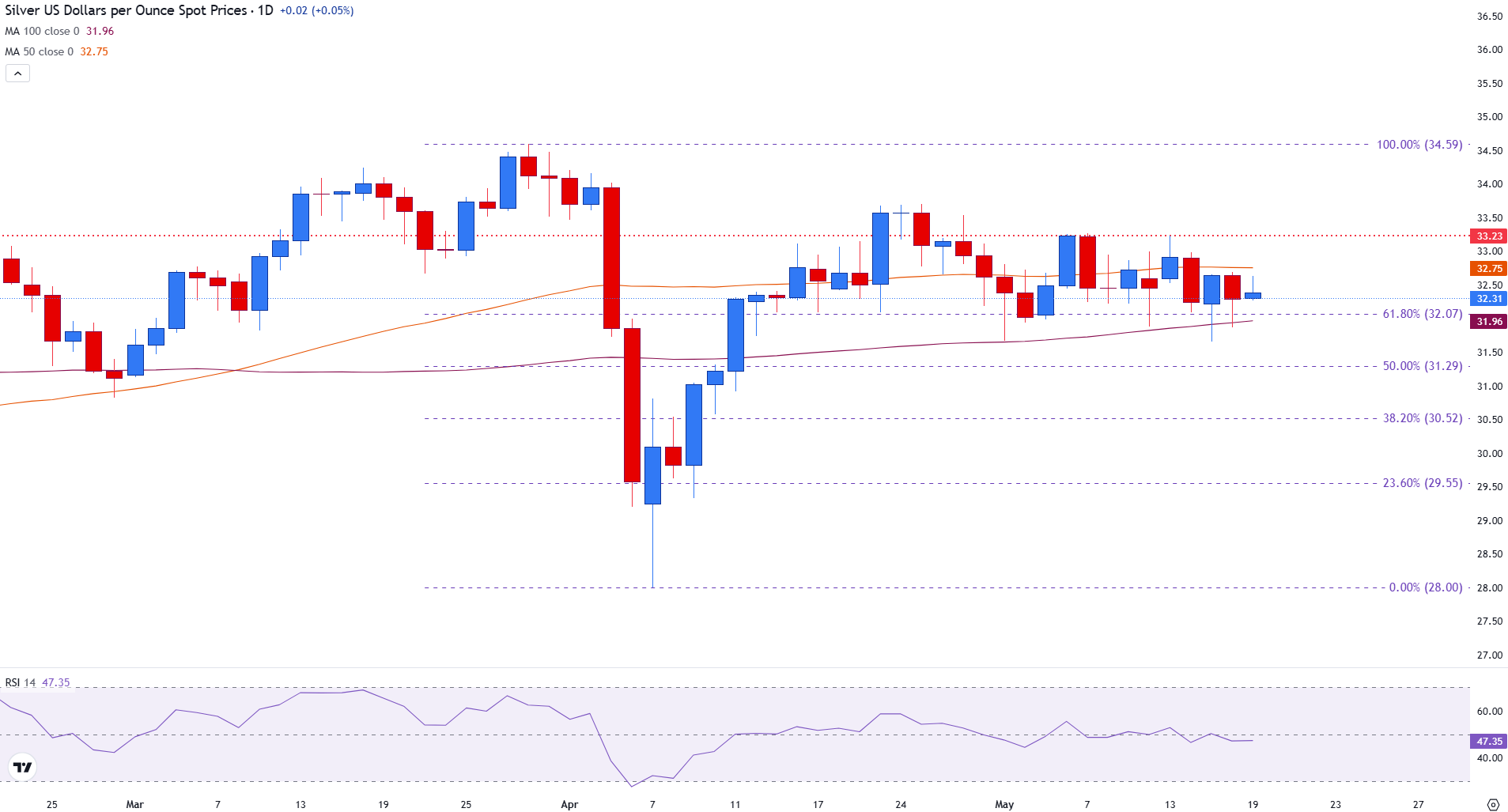
At the time of writing, Silver prices are up 0.05% on the day, with spot XAG/USD last seen around $32.30. The metal is attempting to reclaim the 50-day Simple Moving Average near $32.75, which has capped gains in recent sessions.
US sovereign downgrade by Moody’s triggers Dollar retreat
On Friday, Moody’s Investors Service downgraded the United States' sovereign credit rating from AAA to AA1, citing growing concerns over ballooning debt levels, policy uncertainty and the long-term impact of high interest rates. This marks the final major agency to strip the US of its top-tier credit rating, raising alarm over its fiscal path and potential long-term drag on economic growth.
In the aftermath, the US Dollar has come under renewed pressure, with the US Dollar index (DXY) slipping as investors reassess the Greenback's standing as the world’s preeminent safe-haven currency.
With Silver priced in US Dollars, the relative weakness of the USD has bolstered the appeal of precious metals.
Tariff threats, trade uncertainty and Fed policy shifts keep Silver in focus
Ongoing geopolitical tensions and tariff threats from the Trump administration are also weighing on sentiment.
The White House reiterated over the weekend that elevated tariffs could be reinstated on countries not negotiating in “good faith”, sparking concerns over trade friction and global supply chains.
Meanwhile, the market’s focus shifts to this week's barrage of Federal Reserve (Fed) speakers.
Five Fed officials are scheduled to speak on Monday, and traders are watching closely for clues on the trajectory of interest rates and whether the Fed will maintain its restrictive stance amid mounting fiscal and political uncertainty.
XAG/USD range-bound below key Moving Averages as momentum stalls
Silver (XAG/USD) is trading slightly higher near $32.33 on Monday, but remains confined within a tight consolidation range below the 50-day Simple Moving Average (SMA) at $32.75.
The metal has struggled to gain sustained momentum, with resistance forming around the $33.00 to $33.23 zone, an area defined by recent swing highs and horizontal barriers.
On the downside, immediate support lies at the 61.8% Fibonacci retracement of the March to April range at $32.07, followed by the 100-day SMA at $31.96.
Further weakness could expose the mid-point of the above-mentioned move at $31.29.
Momentum remains neutral, as reflected by the Relative Strength Index (RSI) holding near 47.57, offering no clear directional signal.
Unless XAG/USD breaks decisively above $33.23 or below $31.96, the pair is likely to remain range-bound in the short term, with traders awaiting a fundamental catalyst to drive the next move.
Silver (XAG/USD) daily chart
Silver FAQs
Silver is a precious metal highly traded among investors. It has been historically used as a store of value and a medium of exchange. Although less popular than Gold, traders may turn to Silver to diversify their investment portfolio, for its intrinsic value or as a potential hedge during high-inflation periods. Investors can buy physical Silver, in coins or in bars, or trade it through vehicles such as Exchange Traded Funds, which track its price on international markets.
Silver prices can move due to a wide range of factors. Geopolitical instability or fears of a deep recession can make Silver price escalate due to its safe-haven status, although to a lesser extent than Gold's. As a yieldless asset, Silver tends to rise with lower interest rates. Its moves also depend on how the US Dollar (USD) behaves as the asset is priced in dollars (XAG/USD). A strong Dollar tends to keep the price of Silver at bay, whereas a weaker Dollar is likely to propel prices up. Other factors such as investment demand, mining supply – Silver is much more abundant than Gold – and recycling rates can also affect prices.
Silver is widely used in industry, particularly in sectors such as electronics or solar energy, as it has one of the highest electric conductivity of all metals – more than Copper and Gold. A surge in demand can increase prices, while a decline tends to lower them. Dynamics in the US, Chinese and Indian economies can also contribute to price swings: for the US and particularly China, their big industrial sectors use Silver in various processes; in India, consumers’ demand for the precious metal for jewellery also plays a key role in setting prices.
Silver prices tend to follow Gold's moves. When Gold prices rise, Silver typically follows suit, as their status as safe-haven assets is similar. The Gold/Silver ratio, which shows the number of ounces of Silver needed to equal the value of one ounce of Gold, may help to determine the relative valuation between both metals. Some investors may consider a high ratio as an indicator that Silver is undervalued, or Gold is overvalued. On the contrary, a low ratio might suggest that Gold is undervalued relative to Silver.
Author

Tammy Da Costa, CFTe®
FXStreet
Tammy is an economist and market analyst with a deep passion for financial markets, particularly commodities and geopolitics.