|

Silver Price Analysis: XAG/USD tanks over 3%, breaks key support levels as bears eye $23.00

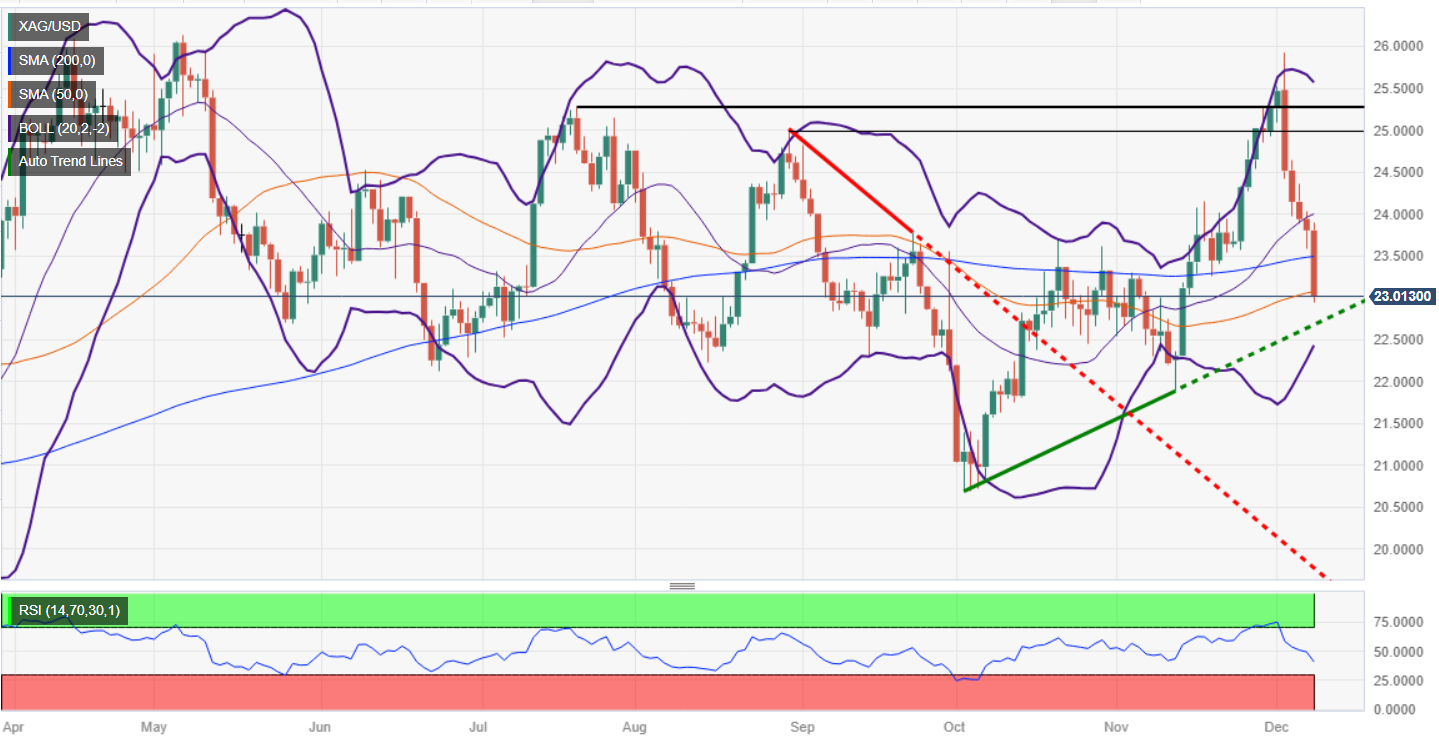
  • XAG/USD confirms a downtrend by breaking below 200, 100, and 50-day moving averages.
  • Downtrend signals potential testing of November 13 swing low at $21.88 unless buyers intervene to lift the spot price.
  • On the upside, buyers must reclaim $23.00 to challenge and surpass broken DMAs, potentially targeting $24.00.

Silver price is collapsing more than 3% in the day, breaking key support levels on its way south, set to finish the week with losses of more than 9.50%. At the time of writing, XAG/USD is trading at $22.97 after hitting a daily high of $23.89.

XAG/USD’s daily chart confirms the grey metal’s downtrend after breaching the 200, 100, and 50-day moving averages (DMAs), each at $23,49, $23.24, and $23.06. That said unless buyers lift the spot price, that would set the stage for a test of the November 13 swing low of $21.88.

Firstly, XAG/USD sellers must drag prices below a support trendline that passes at around $22.69. Once cleared, the next stop would be $22.00, ahead of the November 13 daily low mentioned above.

Conversely, if Silver buyers reclaim the $23.00 figure, that could pave the way for reclaiming each DMA previously broken. Once those levels are cleared, up next would bet the $24.00 mark.

XAG/USD Price Analysis – Daily Chart
XAG/USD Technical Levels

XAG/USD

Overview
Today last price22.99
Today Daily Change-0.81
Today Daily Change %-3.40
Today daily open23.8
 
Trends
Daily SMA2023.96
Daily SMA5023.05
Daily SMA10023.27
Daily SMA20023.48
 
Levels
Previous Daily High24.03
Previous Daily Low23.58
Previous Weekly High25.52
Previous Weekly Low24.26
Previous Monthly High25.27
Previous Monthly Low21.88
Daily Fibonacci 38.2%23.75
Daily Fibonacci 61.8%23.86
Daily Pivot Point S123.58
Daily Pivot Point S223.36
Daily Pivot Point S323.14
Daily Pivot Point R124.03
Daily Pivot Point R224.25
Daily Pivot Point R324.47

Author

Christian Borjon Valencia

Markets analyst, news editor, and trading instructor with over 14 years of experience across FX, commodities, US equity indices, and global macro markets.


More from Christian Borjon Valencia
Share:

Editor's Picks

USD/JPY stays below 160.50 as markets assess BoJ decision

USD/JPY fluctuates in a relatively narrow range above 160.00 on Tuesday as markets assess the Bank of Japan's (BoJ) decision to raise the policy rate by 25 at the June meeting. Meanwhile, investors keep a close eye on news coming out of the Middle East, while preparing for the critical Fed meeting.

AUD/USD trades in tight channel near 0.7050 despite hawkish RBA message

AUD/USD trades modestly lower on the day at around 0.7050 on Tuesday as markets adopt a cautious stance amid a lack of details surrounding the US-Iran peace agreement. The Reserve Bank of Australia (RBA) left the door open for possible policy tightening after leaving the interest rate unchanged, as expected, at the June meeting but failed to boost the Australian Dollar.

Gold trims gains, approaches $4,300

Gold now surrenders part of its initial advance and recedes to the vicinity of the $4,350 mark per troy ounce on Tuesday. The early enthusiasm sparked by the US-Iran peace deal has faded somewhat, prompting investors to adopt a more prudent stance as they await further details of the agreement and key guidance from the Fed.

Why a hawkish RBA is no longer enough to lift the Australian Dollar

The Reserve Bank of Australia delivered more than what markets expected: a hawkish hold that should have supported the Aussie. But markets widely ignored it.

BoJ just hiked and US-Iran deal is on the table: Why Japanese Yen is still around 160.00

The Bank of Japan lifted interest rates from 0.75% to 1.00%, its highest level in more than three decades. The landmark move aims to stabilize a sharply weakening Japanese Yen, but by looking at the immediate market reaction, it doesn’t look like it’s going to work.

Why a hawkish RBA is no longer enough to lift the Australian Dollar

The Reserve Bank of Australia delivered more than what markets expected: a hawkish hold that should have supported the Aussie. But markets widely ignored it, focusing instead on slowing economic growth and proving that central bank messaging alone isn’t always enough to drive currencies.














