|

Silver Price Analysis: Upside momentum fizzles above $25.00

  • Silver bulls catch a breather around one-month high.
  • 50-day SMA offers immediate support, bulls to have a bumpy road ahead.

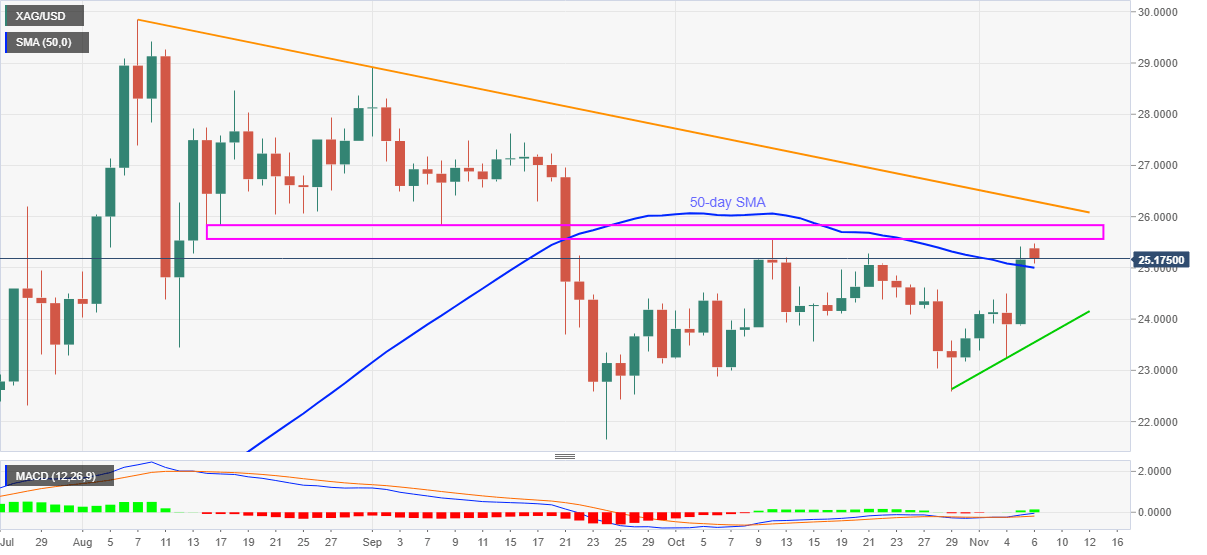
Silver prices drop to $25.14, down 0.98% intraday, as markets in Tokyo open for Friday’s trading. The white metal surged to the highest since October 12 the previous day while crossing 50-day SMA.

However, the inability to cross a broad horizontal resistance area comprising the lows marked during the mid-August and early-September, as well as October high, seems to drag the quote off-late.

Should the bullion declines below the nearby rest-point of 50-day SMA, at $25.00 now, multiple stops around $24.55/50 can please the silver sellers ahead of highlighting the one-week-old support line, at $23.55 now.

Meanwhile, a clear break of the $25.55/85 resistance region will escalate the commodity’s rise towards a falling trend line from September 01, currently around $26.30.

During the silver bulls’ reign past-$26.30, the mid-September peak surrounding $27.60 will gain market attention.

Silver daily chart
Trend: Pullback expected

Additional important levels

Overview
Today last price25.16
Today Daily Change-0.22
Today Daily Change %-0.87%
Today daily open25.38
 
Trends
Daily SMA2024.35
Daily SMA5025.05
Daily SMA10023.8
Daily SMA20020.04
 
Levels
Previous Daily High25.42
Previous Daily Low23.87
Previous Weekly High24.68
Previous Weekly Low22.59
Previous Monthly High25.56
Previous Monthly Low22.59
Daily Fibonacci 38.2%24.83
Daily Fibonacci 61.8%24.47
Daily Pivot Point S124.36
Daily Pivot Point S223.34
Daily Pivot Point S322.81
Daily Pivot Point R125.91
Daily Pivot Point R226.44
Daily Pivot Point R327.46

Author

Anil Panchal

Anil Panchal

FXStreet

Anil Panchal has nearly 15 years of experience in tracking financial markets. With a keen interest in macroeconomics, Anil aptly tracks global news/updates and stays well-informed about the global financial moves and their implications.


More from Anil Panchal
Share:

Editor's Picks

GBP/USD slips toward 1.3350 after soft UK CPI data

GBP/USD erases recovery gains and slips toward 1.3350 in the European session on Wednesday. The UK annual Consumer Price Index (CPI) inflation cooled to 2.6% in June against the market forecast of 2.7%, tempering the British Pound's rebound from weekly troughs. Traders also assess the ongoing Mideast tensions amid a pause in the US Dollar uptrend.

EUR/USD holds above 1.1400 amid US Dollar retreat

EUR/USD holds positive ground above 1.1400 in European trading on Wednesday, helped by hawkish ECB expectations and a broad US Dollar retreat. However, persisting Middle East tensions and surging Oil prices keep the pair's upside elusive.

Gold holds gains above $4,100 undaunted by risk-off markets

Gold extends gains for the fourth consecutive day, standing comfortably above $4,100, unfazed by the risk-off market amid rising tensions in Iran and higher Oil prices. The pair has rallied nearly 2.5% so far this week and is on track for its best weekly performance in more than three months.

Cardano: Short-term recovery lacks retail support

Cardano price edges lower after the 50-day Exponential Moving Average at $1.770 capped two consecutive days of recovery seen earlier this week. ADA futures point to waning retail traction as Open Interest and trading volume decline amid elevated long liquidations. The technical outlook for ADA is bearish, as momentum remains subdued below a resistance trendline near $0.1782.

Chip stocks are more volatile than Oil

I continue to start the day by looking at these two charts: US crude & Kospi. The former is extending gains, trading above $86 per barrel for WTI and $92 per barrel for Brent, while the Kospi is up more than 4.5%, led higher by Korean chipmakers following a similar jump in VanEck's Semiconductor ETF yesterday.

US Dollar mid-year outlook: Exceptional currency, exceptional risks?
The US Dollar enters the second half of 2026 in a markedly different position from a year ago. The King currency has recovered, reflecting persistent US inflation, changing expectations for Fed policy, geopolitical tensions and renewed demand for defensive assets.