Semiconductor stocks rejoice after CoreWeave hikes guidance
- SOX rises 4% on the back of CoreWeave results.
- CoreWeave CEO Intrator says that the Democratic sweep won't affect data center buildout.
- Goldman Sachs analyst highlights value in Nvidia, AMD and Broadcom.
- SOX is now 15% above its post-election lows from last Thursday.

CoreWeave (CRWV) has upended the bearish sentiment on Wednesday after beating Wall Street consensus for Q3 and hiking full-year guidance late Tuesday. The so-called neocloud posted third-quarter GAAP earnings per share (EPS) of $-1.27, or 18% better than the average forecast. Revenue of $3.66 billion bested the average analyst estimate by $120 million.
The most recent quarter, however, was far from the main focus. CoreWeave raised its full-year 2026 revenue guidance from the $12.88 billion consensus to $13.15 billion at the midpoint of its range. What's more, the company managed by CEO Michael Intrator said he expects the firm to exit 2026 with an annual run-rate between $20 and $21 billion, setting up expectations of major growth for next year.
The Philadelphia Semiconductor Index (SOX) jumped 4% on the news, and other top semiconductor stocks like Nvidia (NVDA) gained strength near the open. The semiconductor-heavy NASDAQ Composite rose 1.2% at the start of trading.
CoreWeave results show that semis are still very much in play
This could be the start of a turnaround for semis as the SOX index was more than 28% off its June highs before the CoreWeave release. Some uplift was expected after last Thursday's historic dump on the heels of the Democratic Party's broad sweep of Congress and statehouses sparked worries over a data center moratorium.
In the November 3 midterm elections, US voters favored heavier restrictions on data centers in 40 out of 41 ballot measures across 10 states, according to Ballotpedia. Democrats won control of both houses of Congress and won the governorships in critical AI infrastructure states like Texas, Ohio and Georgia.
But Intrator tamped down some of those concerns during the CoreWeave earnings call late Tuesday.
“We do not anticipate any impact from the seismic regulatory shift that’s occurred,” Intrator said. “We believe that what has occurred is a statement around how you build. We want to build responsibly.”
But even before CoreWeave earnings, Goldman Sachs was saying loud and clear that semis were oversold.
"Even in a 'no growth' scenario for 2028 (which we see as relatively unlikely), NVDA/AVGO are trading 12X/13X this baseline — which we believe valuations are compelling at current levels," Goldman analyst James Schneider wrote in a client note. "We find AMD to be very attractive given the growth we believe it can achieve, albeit at a less compelling valuation."
Indeed, while Nvidia has been weakened by the weekend revelation that its CEO and co-founder Jensen Huang was in a relationship with an alleged Chinese spy, few on Wall Street expect him to be shown the door. And any trader in search of bargain bin deals can see that NVDA is trading at less than eight times fiscal 2029 EPS.
For its part, Bank of America said earlier in the week that negativity surrounding memory chip makers was overblown. Analysts at BofA now see the memory chip supercycle extending through 2028. Micron (MU) and Sandisk (SNDK) have risen 7% and 10%, respectively, in the early going on Wednesday.
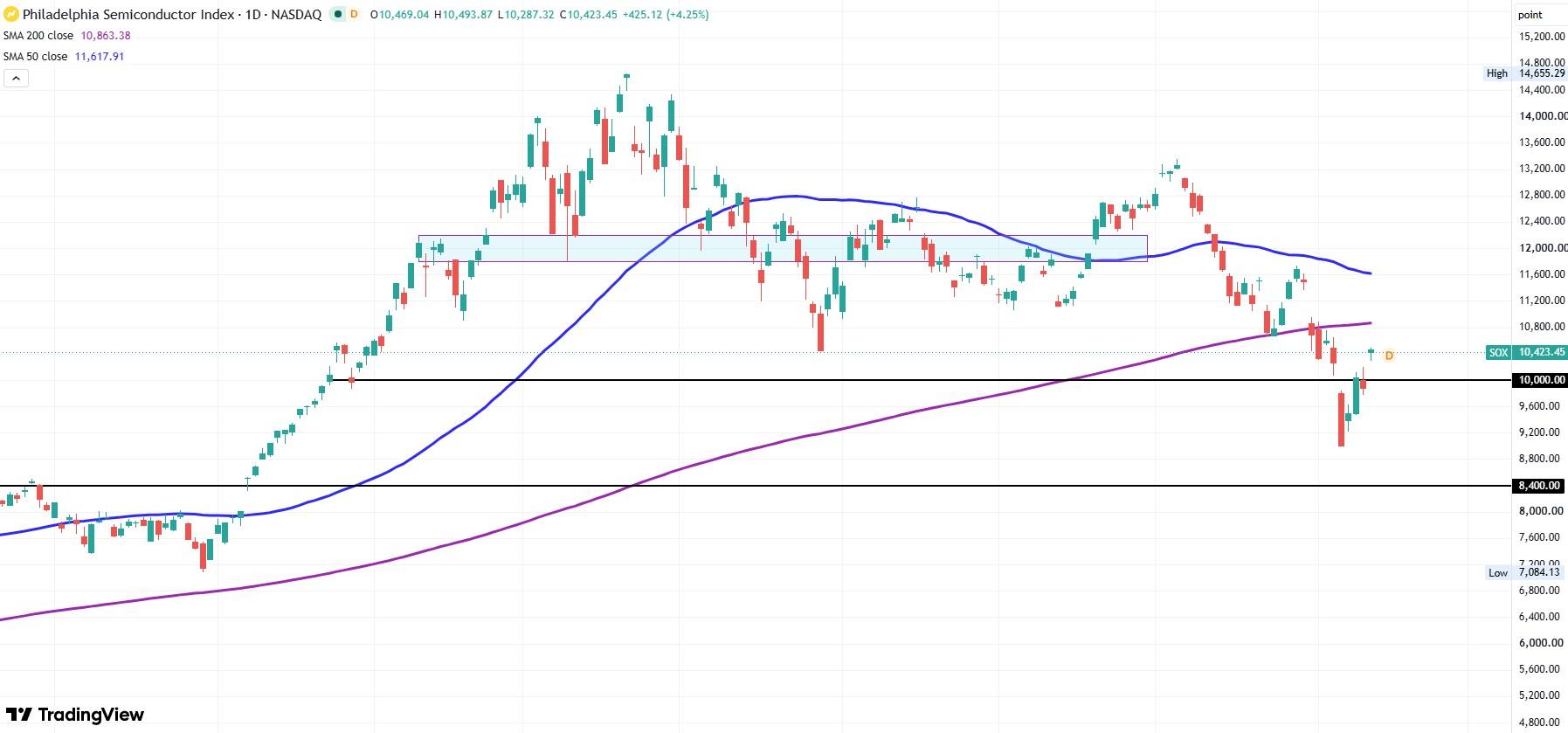
Philadelphia Semiconductor Index daily chart
The Philadelphia Semiconductor Index has been in a downtrend since the June 22 all-time high at 14,655. While the chart doesn't look promising, the index has already recovered 15% from the new range low put in last Thursday. Another 3%-4% gain would allow the SOX to overtake its 200-day Simple Moving Average near 10,800, which would be the second bullish event after gapping above the 10,000 psychological level on Wednesday.
Now there could be resistance at the prior July 29 range low at 10,445, but a close above that 200-day SMA would put the 50-day SMA near 11,600 in play as the next focus for bulls. All the index needs now is a sizable beat and raise from Nvidia next Tuesday when it unveils its Q3 fiscal 2027 results. Jensen Huang's company hasn't missed the consensus in the prior 15 quarters.
Author

Clay Webster
FXStreet
Clay Webster grew up in the US outside Buffalo, New York and Lancaster, Pennsylvania. He began investing after college following the 2008 financial crisis.