Gold struggles near $4,050 as Fed rate-hike bets intensify
- Gold steadies but struggles to build momentum as expectations of more Fed rate hikes weigh on sentiment.
- Markets fully price in a December Fed rate hike, with a larger 50 bps move also on the table.
- XAU/USD struggles below its 21-day SMA, keeping the near-term technical outlook tilted to the downside.
Gold (XAU/USD) holds firm on Wednesday after falling 2.67% the previous day, in the aftermath of hotter-than-expected US consumer inflation data and hawkish remarks from Federal Reserve (Fed) officials that fueled expectations of a more aggressive interest rate-hike path. At the time of writing, XAU/USD trades around $4,050, up 0.47% on the day.
The US Consumer Price Index (CPI) rose 0.4% MoM in October, above the 0.3% forecast but down from 0.6% in September. Core CPI, which excludes food and energy, rose 0.3%, matching September’s pace and beating the 0.2% forecast.
Economists at Commerzbank caution that “prices are still rising too quickly, even though the increase was somewhat smaller than in September.” They highlight that “core inflation, a key gauge of the underlying trend, thus remains (too) high and is no longer trending downward,”. In their assessment, “the strong economy and the ongoing conflict in the Middle East suggest that inflation is unlikely to ease in the near term.”
Hawkish Fed signals boost expectations of a 50 bps hike
Before the CPI release, Fed Governor Christopher Waller said a half-point rate hike may be needed in December if October core CPI comes in “around 0.3% or higher.” With inflation meeting that threshold, traders have started pricing in the possibility of a larger move at the December meeting.
Other Fed officials, including Dallas Fed President Lorie Logan and Philadelphia Fed President Anna Paulson, also backed further monetary tightening, while Fed Vice Chair for Supervision Michelle Bowman stressed the need to bring inflation under control.
Markets now fully price in a rate hike in December, with an 88.5% chance of a 25-basis-point (bps) increase and an 11.5% chance of a 50 bps move, according to the CME FedWatch Tool. Traders also expect more rate hikes next year, with three additional quarter-point increases priced in by mid-2027.
US Dollar and Treasury yields rise as traders price in more rate hikes
The shift in rate expectations boosted demand for the US Dollar (USD) and triggered a sharp sell-off in US government bonds, particularly at the short end of the yield curve. The policy-sensitive 2-year Treasury yield jumped around 19 bps on Tuesday, while the benchmark 10-year yield climbed roughly 14 bps during the day, briefly moving back above 5%.
The US bond market is closed on Wednesday in observance of Veterans Day. Meanwhile, the Greenback extends its gains, with the US Dollar Index (DXY) trading around 102.50, approaching the year-to-date high of 102.94 reached in October.
The combination of a stronger US Dollar, elevated Treasury yields and growing expectations of further Fed tightening is likely to keep Gold under pressure. However, robust central bank buying and sustained inflows into Gold-backed exchange-traded funds (ETFs) could continue to provide a structural floor over the longer term.
Technical Analysis: Bears retain control below key daily SMAs
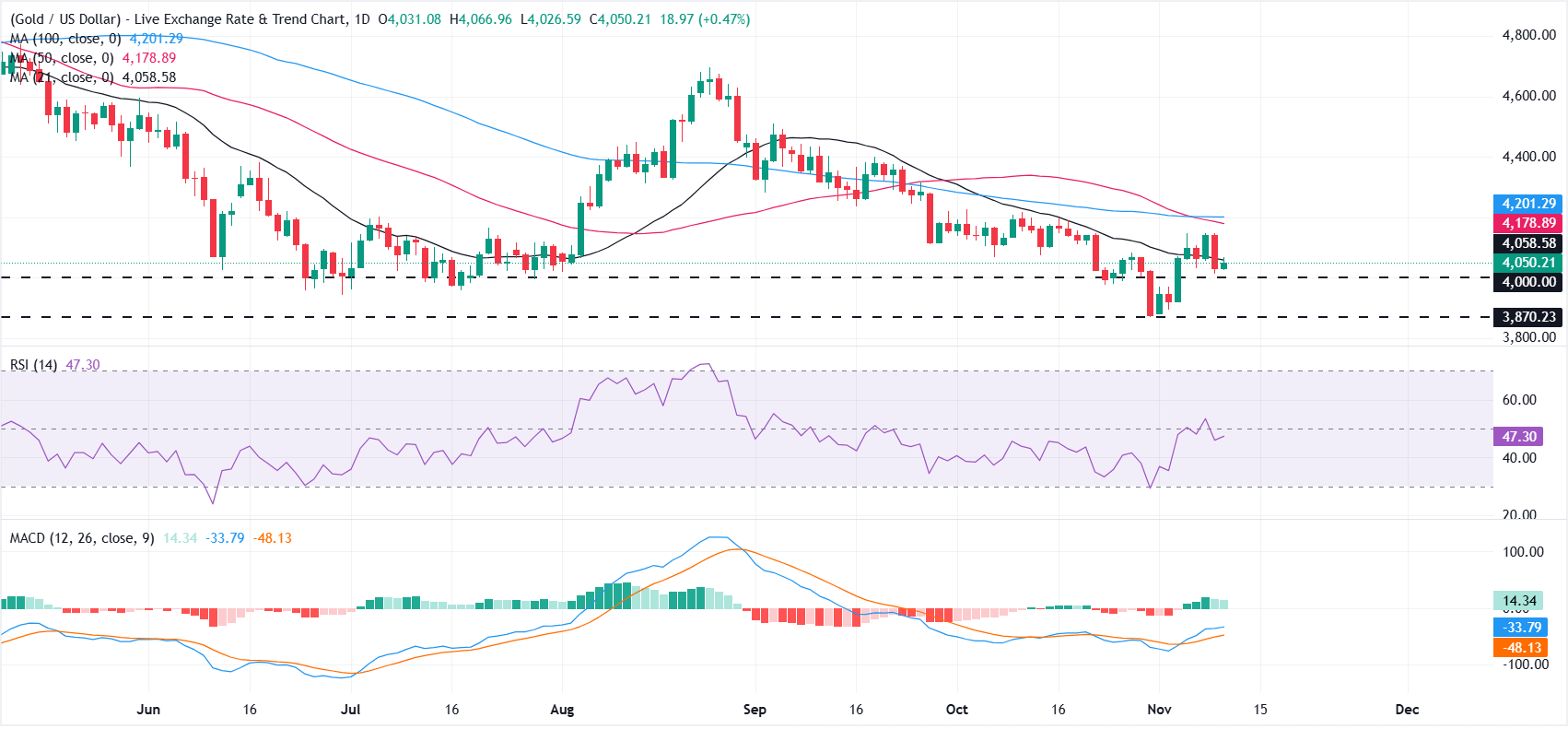
On the daily chart, XAU/USD maintains a bearish bias as it trades below the 21-day Simple Moving Average (SMA) at $4,058, as well as the 50-day and 100-day SMAs. The Relative Strength Index (RSI) hovers around 47, indicating neutral momentum, while the Moving Average Convergence Divergence (MACD) remains in positive territory, although fading green histogram bars suggest weakening bullish momentum.
On the topside, immediate resistance is at the 21-day SMA near $4,058, with further barriers at the 50-day SMA at $4,178 and the 100-day SMA at $4,201, where sellers are likely to defend the recent range highs. On the downside, the psychological $4,000 level acts as immediate support, followed by the yearly low of $3,870.23. A decisive break below the latter could expose Gold to further selling pressure.
(The technical analysis of this story was written with the help of an AI tool. Know more.)
Gold FAQs
Gold has played a key role in human’s history as it has been widely used as a store of value and medium of exchange. Currently, apart from its shine and usage for jewelry, the precious metal is widely seen as a safe-haven asset, meaning that it is considered a good investment during turbulent times. Gold is also widely seen as a hedge against inflation and against depreciating currencies as it doesn’t rely on any specific issuer or government.
Central banks are the biggest Gold holders. In their aim to support their currencies in turbulent times, central banks tend to diversify their reserves and buy Gold to improve the perceived strength of the economy and the currency. High Gold reserves can be a source of trust for a country’s solvency. Central banks added 1,136 tonnes of Gold worth around $70 billion to their reserves in 2022, according to data from the World Gold Council. This is the highest yearly purchase since records began. Central banks from emerging economies such as China, India and Turkey are quickly increasing their Gold reserves.
Gold has an inverse correlation with the US Dollar and US Treasuries, which are both major reserve and safe-haven assets. When the Dollar depreciates, Gold tends to rise, enabling investors and central banks to diversify their assets in turbulent times. Gold is also inversely correlated with risk assets. A rally in the stock market tends to weaken Gold price, while sell-offs in riskier markets tend to favor the precious metal.
The price can move due to a wide range of factors. Geopolitical instability or fears of a deep recession can quickly make Gold price escalate due to its safe-haven status. As a yield-less asset, Gold tends to rise with lower interest rates, while higher cost of money usually weighs down on the yellow metal. Still, most moves depend on how the US Dollar (USD) behaves as the asset is priced in dollars (XAU/USD). A strong Dollar tends to keep the price of Gold controlled, whereas a weaker Dollar is likely to push Gold prices up.
Author

Vishal Chaturvedi
FXStreet
I am a macro-focused research analyst with over four years of experience covering forex and commodities market. I enjoy breaking down complex economic trends and turning them into clear, actionable insights that help traders stay ahead of the curve.