Ten questions for China in 2027
2026 has been a year of slowing growth and increasing divergence within China's economy. We saw the gap between external and domestic demand, as well as between the new economy and the old economy, widen significantly. Here, we look ahead to the key questions facing China in 2027
1) Will China’s growth target be lowered again?
Despite a growing emphasis on the quality of growth rather than just the pace, China’s annual economic target-setting exercise in March remains one of the year's most important events. The GDP growth target and fiscal quotas tend to determine the level of policy support needed in the year ahead.
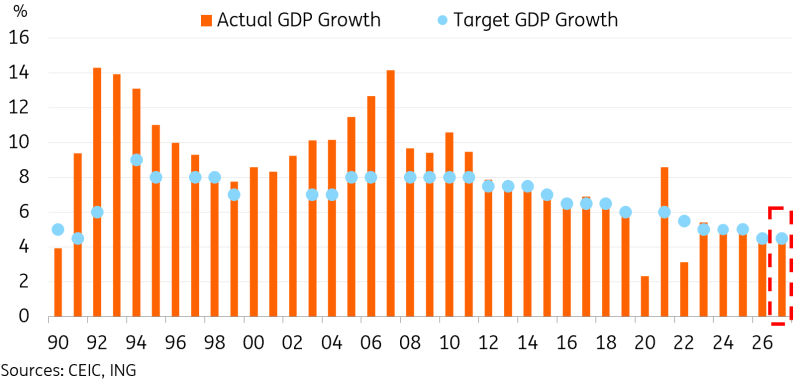
China very rarely misses its growth target. Since 1991, it has fallen significantly short of target only once – after the widespread pandemic lockdowns in 2022.
In 2026, lowering the growth target from “around 5%” to 4.5-5.0% set the stage for slower activity and less urgency for stimulus than in previous years. We expect the target to be achieved, but growth will likely be toward the low end of the range.
The key question for 2027 is whether we’ll see the growth target soften further. China’s economy has seen growing imbalances over the past year. Next year’s growth will rely heavily on external demand and new-economy drivers. Uncertainty about whether external demand and the AI-driven tech capex boom can continue could affect overall growth.
We expect a slight softening of the growth target to “around 4.5%”. This would allow for decent policy flexibility while keeping the long-term challenges in mind. Our calculations show China will need to grow at an average of around 4% per year to achieve the 2030 (RMB170tr) and 2035 (RMB207tr) targets set by Premier Li Qiang and President Xi Jinping, respectively. A target of “around 4.5%” gives China some buffer room if growth slows more significantly going forward.
Accordingly, we expect growth to come in at 4.5% year-on-year in 2027, broadly in line with our 4.6% forecast for 2026. This will maintain China’s role as a key driver of global growth. China is expected to contribute somewhere between a fifth and a quarter of global growth over the next five years.
China's growth target may be adjusted to "around 4.5%" in 2027
2) Will external demand and tech drive growth again?
We observed two major K-shaped trends in 2026: the divergence between strong external demand and weak domestic demand, and the split between the tech-led new economy and the old economy.
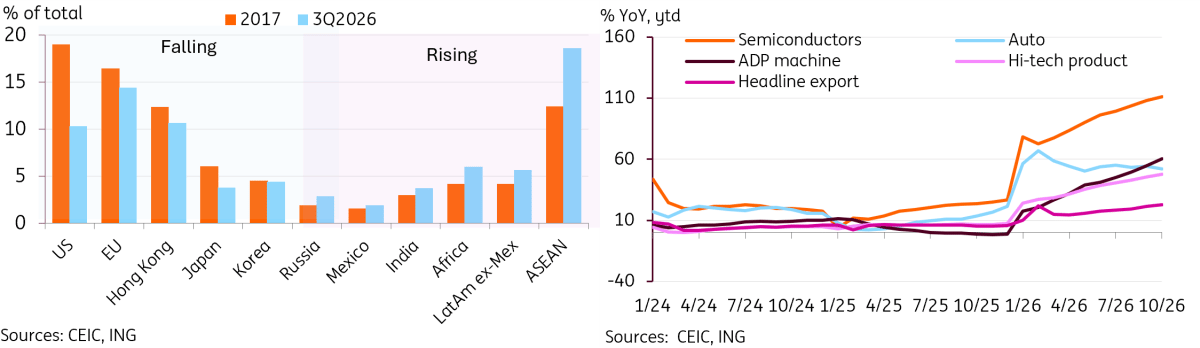
We expect export growth to moderate but remain relatively strong next year, with high-single-digit increases in exports. While things are likely to normalise a bit after an extraordinarily strong year in 2026, external demand will still remain one of China's key growth engines.
First, strong export performance in 2026 will create a challenging base effect to follow in 2027. The run-up in energy and technology prices that underpinned growth is also unlikely to be repeated, reducing the scope for a similar boost next year.
Second, uncertainty could return in 2027 after what has been a relatively calm year in terms of trade developments following a roller-coaster 2025.
- The China-US trade truce at the time of writing is set to expire in January 2027. While our base case is a further extension of this agreement, risks of re-escalation can’t be ruled out, particularly as China’s trade surplus widened 12% YoY to $233.8bn through the first three quarters of 2026. The ‘blue wave’ election outcome in the US could lead to gridlock and prompt US President Donald Trump to focus on areas where he can exercise executive power, such as trade policy.
- Possible trade tensions with the EU are also worth considering. ASEAN has overtaken the US as China’s largest export destination. The EU remains second, representing 14-15% of China’s total exports. China’s trade surplus with the EU surged 26.1% YoY to $277.4bn in the first three quarters of 2026. After trade talks in October, China and the EU agreed to a 16-point plan to improve trade ties. The plan includes a cap on exports of hybrid vehicles into the EU at 2025 levels. Almost immediately, calls emerged to extend the quotas to other industries. Almost immediately after, there were additional calls to extend these quotas to other industries. While we believe there’s plenty of room for win-win cooperation, there’s also risk of trade friction increasing in the year ahead.
On the tech side, 2026 marked an acceleration of the capex cycle and AI boom. Hi-tech investment was one of the few areas that saw positive investment growth in 2026, and tech-related exports and industrial production also outperformed on the year.
However, we also saw several notable market pullbacks along with rising fears of an AI bubble bursting. One of the biggest questions for not just China but the global economy at large is whether impressive tech growth continues into 2027.
At this juncture, the AI-driven investment boom looks likely to continue into 2027, with many companies still reporting order books full through 2027. We think the current engines of growth will moderate but continue to drive growth into 2027. To achieve stable growth, other parts of the economy might need to pick up the slack. Our next question deals with whether domestic demand can step up to the plate.
Technology products and export diversification continue to support external demand
3) Can domestic demand carry more of the load?
Anyone following Chinese policymakers' messaging will have noticed a recurring theme in recent years: the need to increase the role of domestic demand in driving growth.
China’s 15th Five-Year Plan places building a strong domestic market among its top priorities, alongside industrial modernisation, tech self-reliance, and the digital economy. Yet while the latter three have been obvious recipients of policy backing and resources, the push to strengthen domestic demand has often appeared less tangible. These categories are clearly policy favourites and receive more resources.
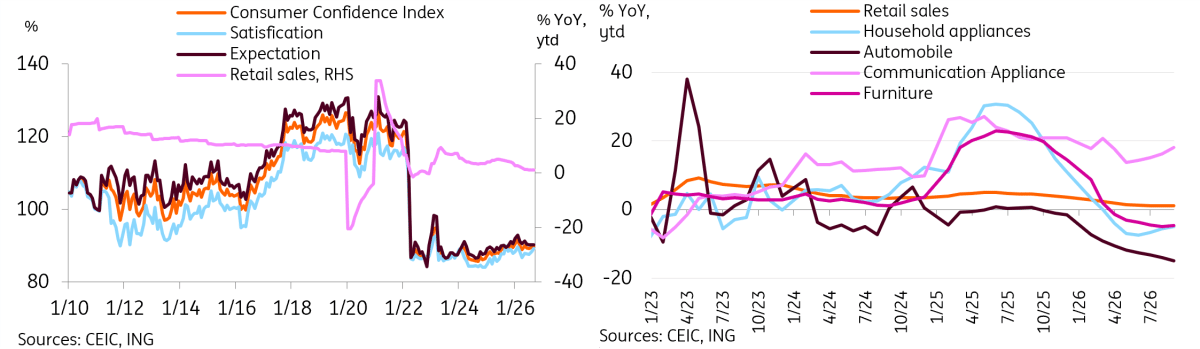
However, 2026 was one of the weakest years for domestic demand in recent history. Over the first three quarters, China’s retail sales grew just 1.1% YoY ytd.
In our view, several factors played a major role in weak consumption growth in 2026:
- Trade-in programme turned from tailwind into headwind. China’s flagship policy to boost consumption was the trade-in programme. It front-loaded consumption by offering consumer subsidies for targeted products across categories including autos, household appliances, furniture, and communication devices. The programme's scale fell slightly in 2026, which along with previous front-loading clearly dragged retail sales growth, with household appliance, furniture, and auto sales down year on year.
- Consumer confidence flatlined after a modest recovery in 2025. Confidence peaked in February 2026, but pulled back afterwards. Low wage growth, combined with a negative wealth effect from falling equity and property prices, was the main culprit for soft confidence. Weak confidence continued to reduce discretionary consumption categories for most of the year.
- The peak and subsequent drop of gold prices dragged gold & jewellery sales. Gold prices peaked in January. The subsequent bust significantly reduced retail interest in buying gold.
Heading into 2027, we expect a modest recovery in consumption, with potential upside for a larger recovery.
- Drag from trade-in programme should be smaller. The pullback we saw from the household appliances, furniture, and auto categories should be smaller in 2027. It’s too early to expect significant replacement demand for appliances and furniture, but auto sales could begin to see some replacement demand from the first wave of EV sales. This could reduce the category's drag. However, given the strength of communication appliance sales in 2026, this category is ripe for a 2027 pullback.
- Policy support for domestic demand could pick up, especially if the external demand picture worsens. While it seems reasonable to expect resources to remain concentrated toward tech thanks to the AI race, supporting domestic demand could become more important if we see signs of the external demand engine slowing in 2027. Longer term, increasing domestic demand is necessary to achieve more sustainable growth.
The big wildcard is how consumer confidence fares next year. The main factors will likely be wage growth and asset price performance. We’ve seen some encouraging signs that property prices are beginning to bottom out in tier 1 and a few tier 2 cities. This could start to translate into a confidence recovery. While wage growth has remained slow amid a weak job market, a recovery of corporate profits could potentially translate into a recovery if the trend holds.
Weak consumer confidence remains the main constraint on domestic demand
4) Has China successfully escaped deflation?
China’s struggle with deflation in the past few years triggered significant debate about whether China was headed down the same path as Japan’s Lost Decades. Wealth destruction from the property market bust, aggressive price competition, and poor domestic demand contributed to three straight years of near-zero inflation. It also threatened to put China into a negative feedback loop of falling prices and profitability, lower wage growth, and weaker consumption and investment.
However, in 2026 we finally saw a more convincing uptick in inflation, ending the year above 0% for the first time since 2022. We think the worst of the deflationary pressure may be behind us.
Looking ahead to 2027, several factors are likely to continue shaping the inflation outlook.
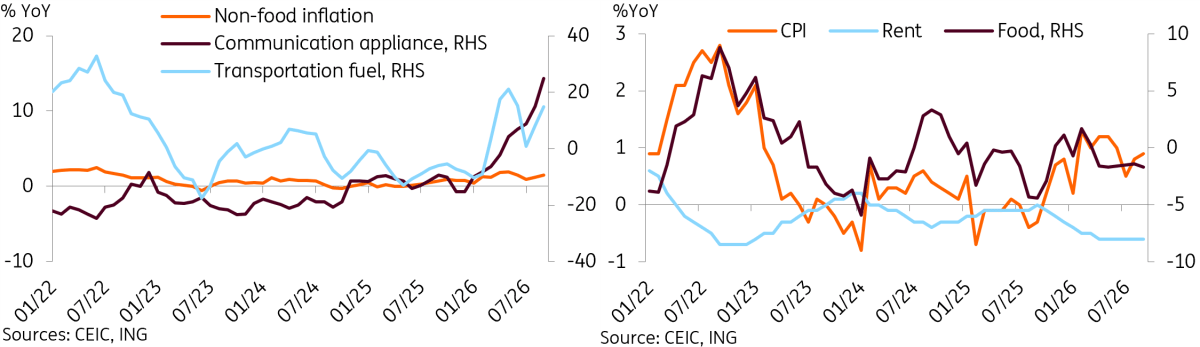
Food and housing have been the two biggest drags on inflation over the past year, together accounting for more than half of China's CPI basket. The drag from food should gradually fade as pork prices eventually stabilise. Pork has started to see sequential increases starting in the second half of 2026. Abundant domestic supplies of fresh vegetables and fruits should continue thanks to greenhouse expansion, but likely won't repeat the same deflationary impact next year.
Rent may continue to drag on inflation until we see a broader bottom in the property market. Rent has been at -0.6% YoY since April 2026.
This year’s primary inflation driver was energy prices, as fallout from the Iran war hit the global economy. Energy costs are a wildcard in 2027. Our house forecasts Brent averaging $81/bbl in 2027, which should keep inflation elevated after higher prices in 2026.
Tech prices, by contrast, surged in 2026 as the AI boom drove heavy demand and price hikes across many tech supply chains. This was most evident in the communication appliances component of China's CPI basket, where prices rose 6.3% YoY in the first three quarters.
Furthermore, China’s PPI inflation surged in 2026. Producer prices rose amid higher raw material and other input prices. Companies have been reluctant to pass higher costs on to consumers amid subdued confidence. But if input costs remain elevated into next year, maintaining that restraint may become increasingly difficult.
Overall, we expect China’s CPI inflation to move a little higher next year, to 1.1% YoY. This level is a sweet spot for China, staying a comfortable distance from deflation while avoiding the high inflation pressure many other economies are currently facing. At this level, we don’t expect inflation to constrain monetary easing if needed.
Inflation has turned higher, but the recovery remains uneven
5) Will the drag from the property market finally fade?
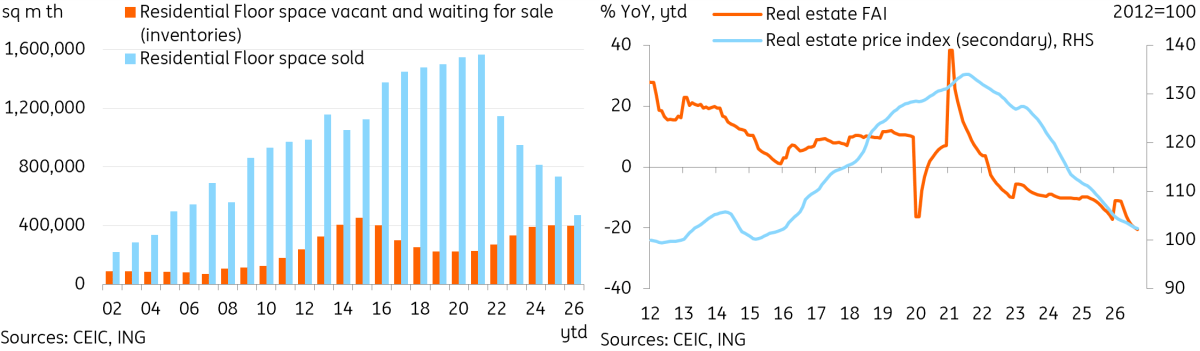
Barring an astounding end-of-year turnaround, property prices will have fallen for a fifth consecutive year by the time 2026 wraps up.
China's property downturn has evolved considerably over the past few years. Fears of a catastrophic systemic crisis have largely faded, and developer defaults have become less frequent. Yet home prices still haven’t found a clear floor, and the pessimism unleashed by the housing slump remains deeply embedded in household sentiment. The property market remains a major overhang on the economy.
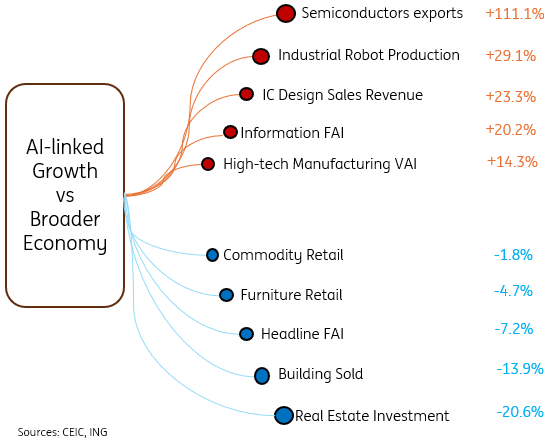
Building sales and real estate fixed-asset investment continued to see steep declines, down -13.9% YoY and -20.6%, respectively.
The indirect impact of the property bust is harder to measure, but it’s widespread and arguably even more significant.
- Consumer confidence has been weak since the property downturn began, and the recovery has been slow and uneven since.
- Adjacent industries have been impacted. Retail sales of furniture (-4.7%), household appliance sales (-4.9%), and building & decoration materials (-9.7%) are in contraction this year. Industrial production data shows significant weakness in property-related categories such as cement (-8.6%), flat glass (-7.0%), and steel (-2.0%) through the third quarter.
- Land sales traditionally have been a major source of local government revenue. This dried up as demand plummeted amid the property bust. Local-government revenue from transfers of state-owned land-use rights fell from CNY8.7tn in 2021 to CNY4.15tn in 2025, and looks to have fallen further in 2026. The consequence of this is that local governments are also tightening their belts in terms of spending.
- Falling home and rental prices are contributing to deflationary pressure.
Is the drag from the property sector going to fade in 2027?
In our view, two things need to happen before we see a property sector turnaround. First, we need to see signs that price stabilisation is becoming more entrenched. This year has delivered the most encouraging evidence since the property downturn began, with prices in tier-one cities broadly stabilising or rising for much of the year. If that trend persists and spreads to more tier-two and tier-three cities, it could mark the bottom of the current cycle. For now, the 70-city average property price index has yet to establish a bottom.
Second, property inventories remain elevated, reaching a new record high in early 2026 before dropping later in the year. Until these return to more normal levels, it's difficult to expect significant new property investment.
Policy support for the property market has expanded modestly in 2026, including a mortgage subsidy for first-time buyers, further loosening of purchase restrictions across the country, and continuing with urban renewal projects.
We also saw some structural reforms. These include tightening restrictions on the property pre-sale model, such as requiring developers to reach a certain stage of completion before pre-sales and requiring funds to enter a supervised account. These steps make the operating environment more challenging for developers but should boost buyer confidence.
With further support for the property market, we think we could see a smaller drag from the sector in 2027. If price stabilisation continues, it would be a big step, removing a major weight on household and investment confidence. That said, with inventories still high and developers limiting new projects, real estate investment will likely remain a headwind next year.
High inventories and falling prices continue to weigh on the property market
6) What can we expect from policymakers in 2027?
With the 2026 growth target lowered and attention consumed by the AI race, it is perhaps unsurprising that policy support for the broader economy has been underwhelming this year. We expect a generally supportive policy environment for the year ahead, with the possibility for more aggressive policy rollout to bolster the domestic economy if we see trade tensions pick back up next year.
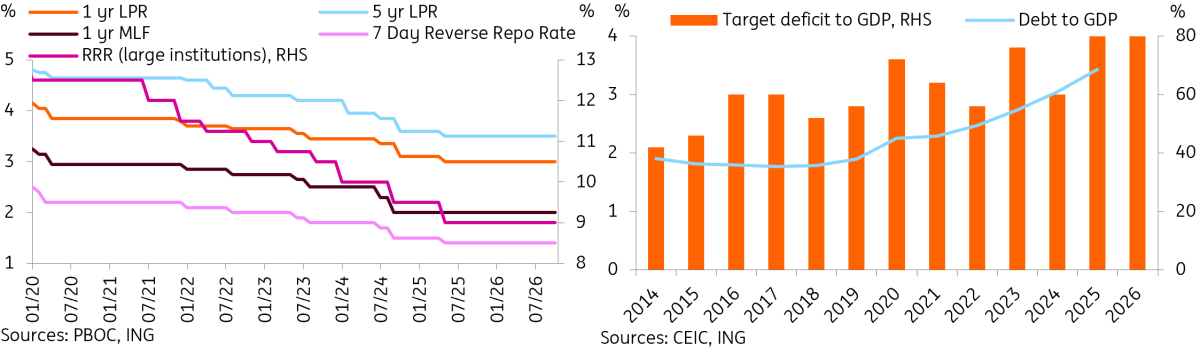
On fiscal policy, we expect the key fiscal targets to remain fairly stable in 2027.
- The fiscal deficit target is likely to remain around 4% of GDP for a third straight year. Adjustments to this target would be primarily for signalling purposes rather than to actively constrain policy.
- Our base case for bond issuance targets is that they remain little changed, around RMB 4.4tn for special local government bonds and RMB 1.3tn for ultra-long-term bonds. Given the limited appetite for using approved quotas in 2026 amid the drop in investment, it's possible that targets could be lowered. Our base case is for targets to stay high to increase flexibility.
On monetary policy, we expect the People’s Bank of China to buck global trends and maintain an easing bias. Inflation remains well below target, the labour market remains fairly soft, growth has been decelerating, and the CNY has been strengthening. Conditions are mostly suitable for further easing, with the key exception being bank net interest margins are already at historical lows, and policymakers have thus far preferred targeted easing instead.
Below are our key calls for the PBOC next year:
- We look for a single 10bp rate cut to the benchmark rate. The PBOC has resisted broad-based rate cuts, mindful of low banking-sector margins and the fact that many major central banks have remained in hiking mode.
- Targeted measures to support selected industries look likely to continue. Re-lending programmes, interest rate subsidies, and risk-sharing facilities may remain the main tools for allocating money to areas of need.
- PBOC benchmark rate shift will improve monetary policy transmission. The PBOC formalised a shift away from the 7-day reverse repo rate to the overnight reverse repo rate starting 2 November 2026. We expect this shift to improve monetary policy transmission, enable more precise day-to-day liquidity management, and move China’s framework closer to global peers.
At the sector level, we expect policy priorities in 2027 to remain closely aligned with those laid out in the Five-Year Plan, with industrial modernisation and technological self-reliance continuing to attract the lion's share of attention and resources.
Given recent communications, we may also see more concerted efforts to build out domestic demand. An October National Development and Reform Commission (NDRC) news conference offered some food for thought, promising to “strengthen inclusive policies that reach consumers directly” alongside existing strategies to expand and upgrade goods such as new energy vehicles and smart products. One limitation of recent consumption-support measures is that, while trade-in programmes have successfully brought forward spending, they have done little to lift household confidence. The next step may be to recalibrate policy to make consumers feel genuinely better off.
Support for the property market should also continue to spread the initial recovery seen in the core cities nationwide.
Policy will remain supportive, but broad stimulus is unlikely
7) Will CNY two-way moves return after 2026's gains?
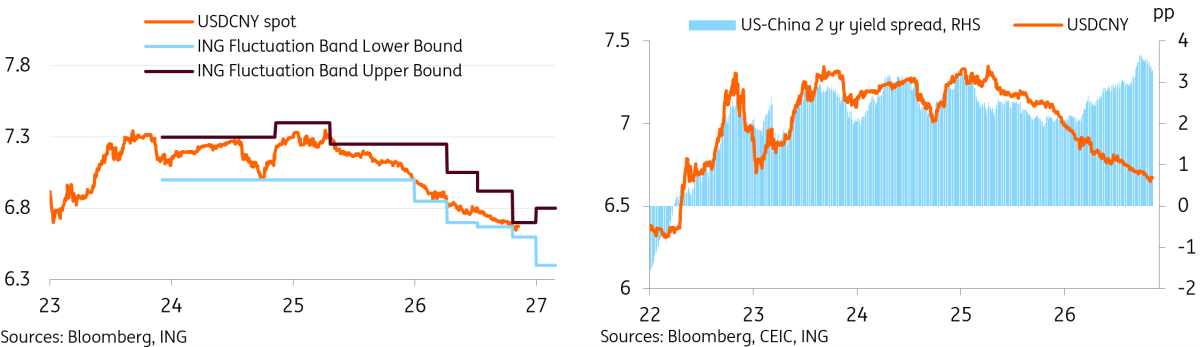
We set an initial forecast band for the USD/CNY in 2027 of 6.40-6.80, and our 2027 year-end forecast set at 6.50.
2026 marked another strong year for the CNY, as the appreciation momentum started in 2025 and continued into 2026 despite what has largely been a strong dollar backdrop. Generally, appreciation has been stronger than what most market participants had expected at the start of the year.
As the numbers above imply, our base case has appreciation continuing. Our key reasons are listed below:
- We continue to hear a very strong consensus among market participants for a moderate pace of appreciation to continue. While this raises risks of a sharper reversal, it also remains difficult to bet against.
- Exporters continue to sell into upticks of the USDCNY, creating a convincing environment for CNY appreciation to continue. Considering the foreign currency left abroad over the past few years, and incoming foreign currency receivables with China’s trade surplus set to hit a new record high in 2026 and remain strong in 2027, the stage is set for further CNY appreciation.
- PBOC has signalled it has neither the need nor intention to use currency depreciation to gain advantages in trade. This suggests that there won't be a push to depreciate the currency even if the current trade boom cools off.
- CNY strength has thus far been without the support of equity market inflows. Chinese markets have been an underperformer. But if there's some mean reversion or a bull market reversal, this could further support CNY strength.
However, we don't think 2027 will see a repeat of this relatively simple straight line appreciation from April 2025 to the time of writing. Two-way fluctuation looks likely to return, and the recent CNY appreciation bias in markets raises the risk for a stronger reversal, even if the PBOC acts to limit excessive volatility.
- US-China yield spreads remain near-record highs. This correlation weakened in 2026 as investors became worried about missing out on further appreciation, and as the spread narrowed to start the year. However, a hawkish shift as the Iran war broke out has widened the yield spread to new highs. This should eventually tempt investors.
- PBOC could step in if the appreciation trend goes too far. In an October policy statement, the PBOC warned against one-sided and procyclical behaviour in the FX market, reflecting concern that market participants can reinforce an exchange-rate move through a herding effect. In early November, the PBOC raised the foreign-exchange deposit reserve requirement from 4% to 6%. It was widely seen as a warning against excessive yuan appreciation and one-sided speculative positioning, discouraging this behaviour by draining foreign-currency liquidity from the banking system.
- Outward direct investment looks to be closing a year with an uncharacteristic year-on-year decline after seeing double-digit growth for 5 of the past 6 years. A recovery of ODI demand could add selling pressure to the CNY.
CNY appreciation should continue, but with greater two-way volatility
8) Are CGBs the biggest asymmetric risk to Chinese markets?
China’s government bond yields bucked global trends in 2026, falling despite a surge in yields elsewhere in the world amid rising inflation and debt.
The falling yields have been a double-edged sword. On one hand, low yields have allowed the government to issue debt cheaply, an important benefit as China brings shadow-banking debt onto official balance sheets, and as debt levels remain high. However, the low yields have also become a symbol of weak investor confidence and a factor cited by those arguing that China is seeing entrenched pessimism and on a path of “Japanisation.”
China’s government bond yields have generally trended downward since 2020, with pockets of volatility throughout. Several key factors have contributed to this long bull market:
- Investor risk appetite remains abnormally soft. Although we would argue that China exited “peak pessimism” in 2024, many market participants still maintain very conservative asset allocations. Equity and property markets continue to underperform, and demand for risk-free assets remains huge.
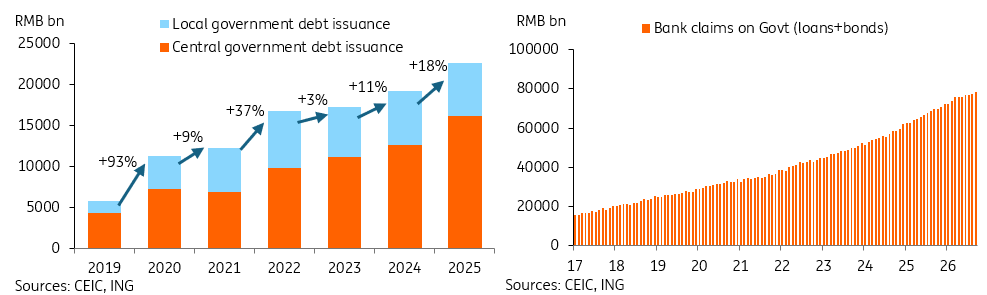
- Limited credit demand has led to rising bank holdings of CGBs. Bank holdings of CGBs have nearly quadrupled over the past decade and stood at RMB 78.6tn at the end of 3Q26.
- Many remain trapped in a deflationary mindset. China has taken steps to move out of deflation in 2026, thanks to higher energy prices that boosted core inflation. Yet the deflationary mindset persists for many, contributing to a willingness to accept such low yields.
- Tighter restrictions on outbound investment may be preventing investors from investing in higher-yielding bonds abroad. China’s yields are now significantly lower than most major economies, but domestic investors still face limitations on how much they can move abroad to capitalise on this spread. Capital controls remain a major factor in how yields can stay so low.
We think there’s a solid case for bond yields to turn around in 2027.
- A slight normalisation of risk appetite would be sufficient to cause a major shift. A return to a more balanced asset allocation would be a catalyst for risk asset rallies and a bond market pullback. Banks are investing in bonds instead of lending thanks to unusually weak investment appetite. A reversion to the mean would be the biggest catalyst for a bond selloff.
- China’s long-term growth and inflation outlook don’t match the current yields. Current yields imply a deflationary, stagnant environment, while most economists expect moderating but still solid growth and low but positive inflation. Time will tell which side is right, but bond yields suggest markets are pricing in a significantly more downbeat outlook than what the data is showing.
- Bond issuance is expected to remain high, and debt levels remain elevated. As we discussed earlier in this report, China’s fiscal policy stance is likely to remain accommodative. Another year of high bond issuance should add some supply pressure on the CGB market.
- Higher global yields make Chinese yields even less attractive by comparison. China’s bond yields are now among the lowest of major economies. Capital controls will limit how far investors can chase higher yields, but an asset allocation shift from domestic to global bonds could still play a role.
- Policymakers may start to worry about the implications of low long-end yields, and push back if the bull market continues. Recall that back in 2024, the PBOC had repeatedly intervened to keep the 10-year CGB yield above 2%. While these efforts were discontinued, market rumours at the end of October suggested that policymakers had asked Chinese financial institutions not to add duration in the bond market.
We look for 10-year CGB yields to rise to 1.9% by the end of 2027. The key risks to this outlook are further worsening sentiment, a return of deflation, more aggressive-than-expected rate cuts, or tighter capital controls that keep domestic money locked up in the CGB market.
Heavy bond issuance has been absorbed by rising bank demand
9) How is the AI boom impacting China?
AI has become one of China’s more important growth engines, supporting exports, manufacturing, investment and productivity. At the same time, the heavy focus on the AI race means it is also a major driver of the K-shaped divergence in China. It's likely to continue to widen the gap between industries and companies.
China’s strong trade growth on both the export and import sides were in large part tied to AI-related demand. Over 6,000 Chinese AI firms across AI infrastructure, framework, and applications contributed to heavy demand. We saw categories such as automatic data processing machines, semiconductors, and general computer & electronics with high double-digit and even triple-digit export and import growth.
A similar pattern was observed in China’s manufacturing industry. Technology-intensive manufacturing significantly outperformed the broader industrial in 2026, led by electronic equipment and semiconductors. Chinese companies across a broad range of industries are integrating AI into quality control, from precision electronics manufacturing to chilli oil. AI is already playing a role in China’s industrial upgrading process.
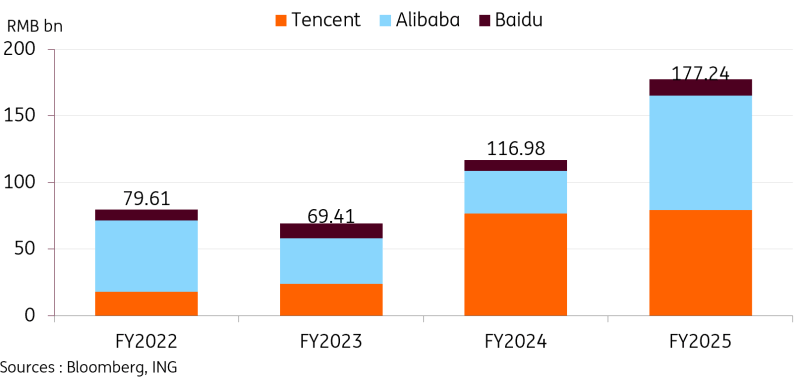
Hi-tech investment has been the lone bright spot in an otherwise down year for investment, with hi-tech FAI up 4.9% YoY but headline FAI down -7.2% YoY through 3Q26. Despite an equity market selloff as investors start to question valuations, the AI capex cycle itself looks to have further room to run. Spending by major Chinese tech companies has doubled from their 2022 levels, with continued investment in computing capacity, data centres and AI infrastructure. China’s grid investment data has been volatile but has generally shown strong growth for the last few years as well.
The impact of AI on the labour market is a hot topic globally. In China, aggregate employment data have yet to show a broad AI-driven shock, but firm-level evidence already points to higher output per worker and lower labour requirements in selected tasks. The initial impact is therefore more likely to appear through slower hiring and job redesign than immediate mass layoffs.
We think two factors could make this adjustment particularly important for China in 2027:
- AI adoption could move faster in China. China’s AI strategy places greater emphasis on industrial deployment and applications, while public trust and workplace usage are relatively high compared to global peers. An ageing population also gives firms a stronger incentive to automate in response to further labour shortages. Faster AI adoption has shown signs of supporting labour productivity growth. It has accelerated for two straight years to reach 6.3% in 2025 after dropping as low as 4.4% in 2023. But it could also accelerate the displacement of substitutable roles and increase downward occupational mobility.
- Entry-level employment will face the greatest pressure. China is expected to have 12.7 million university graduates in 2026, 480,000 more than in 2025, adding to an already competitive youth labour market. At the same time, AI is increasingly able to perform the information intensive and administrative work which traditionally assigned to junior employees. Firms may therefore reduce entry-level hiring without cutting their existing workforce, narrowing the career ladder through which young workers acquire skills and experience.
The government has rolled out policies to address the potential impact of AI on employment, focusing on displacement risk assessment, digital skills training, worker transitions and the creation of new occupations. We expect these measures to moderate, but not prevent, pressure on junior and routine white-collar employment. The key issue for next year is whether new service-sector and AI-complementary jobs can be created quickly enough to absorb affected workers.
Overall, we expect AI to support productivity growth and industrial upgrading in 2027, but the gains will remain uneven. If commercial returns disappoint the market’s high expectations, a reassessment of the global AI cycle could weaken related demand. This could leave China with stronger productive capacity but divergence across industries and labour markets.
The other scenario worth considering is if we see a widespread AI bust. Increasingly, market participants may increasingly shift their focus to commercial returns of AI, where there is arguably still a lot of froth in the markets. Given China’s heavy investment in the AI race, and its prominent role in the outperforming areas of the economy, a reversal of this trend would naturally have significant implications. We’ve already seen a significant selloff in equities, which does not help the already soft confidence. A moderate pullback may not necessarily be bad news, as it could allow for more balanced resource allocation elsewhere, but a crash would pose larger risks to the growth outlook.
China's AI capex cycle accelerated sharply after 2023
AI-linked activity is pulling further ahead of the broader economy
10) How is China faring in its Great Transition?
Our key long-term call back when first joining ING’s research department in 2024 was that China was not in a Great Decline, but a Great Transition. At that time, discourse on China was arguably at its most pessimistic, with many investors deeming China uninvestable and amid worries over systemic risks. China’s reopening after the pandemic fell short of expectations, and many worried its outlook was doomed.
Almost three years later, China is in a significantly different place. While a cloud of pessimism still hangs over the economy at large, the narrative has become a lot more balanced. Within China’s widening K-shaped trajectories, pockets of extremely strong growth remain.
We outlined four main directions for China’s Great Transition:
- Developing domestic demand and consumption as a growth driver.
- Moving up the value-added ladder.
- Strengthening the green transition.
- Advancing tech and digitalisation.
We’ve since seen progress across all four fronts, though the speed has been uneven.
Developing domestic demand is arguably the most disappointing of the four key transitions so far. Chinese households’ willingness to save has hit a new high, and weak confidence continues to weigh on this effort. Retail sales slowed to a post-pandemic low in 2026. Critics of China often cite weak domestic demand as a main factor behind growing trade imbalances.
Policymakers have said all the right things. But for now, efforts to buoy domestic demand seem to have taken a backseat to industrial modernisation and the tech race. We do, however, see progress in the right direction. For example, trade-in programmes helped front-load consumption, and policymakers have vowed to “strengthen inclusive policies that reach consumers directly.”
China has already made great progress in moving up the value-added ladder. The evolution of China’s industrial production and exports shows its manufacturing backbone moving from the low end toward the high end.
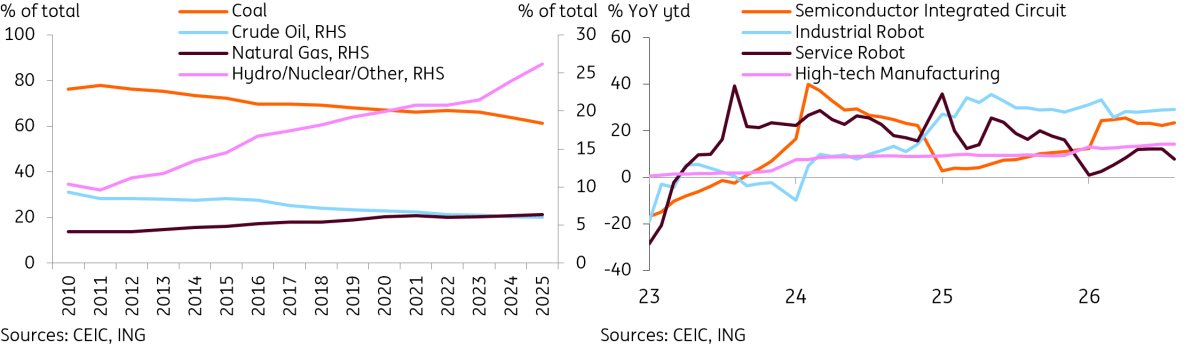
Exports show that the share of machinery and transport equipment in total exports rose from 48.6% in 2023 to 56.0% in 3Q26. Traditionally low-end miscellaneous manufacturing, including clothing and footwear, has dropped from 22.8% in 2023 to 18.6% in 3Q26.
This transition has major global implications, prompting discussion of a so-called “China Shock 2.0” as the economy produces increasingly high-end products. China's auto industry has rapidly risen to global prominence, capitalising on the accelerating worldwide adoption of electric vehicles.
China’s green transition has continued its great progress. China has undergone a remarkable green transition over the past decade-plus. Various indicators point to continued success in this green transition in recent years. China’s PM 2.5 levels across 168 cities hit a record low of 15 in July 2026. Renewable and nuclear power generation as a percentage of total energy production rose from 21.5% at the end of 2023 to 26.2% at the end of 2025.
The green transition remains an important medium- and long-term goal. As such, it will likely continue to outperform in terms of growth. In 2025, President Xi pledged to lower emissions by 7-10% by 2035 while “striving to do better”, building on 2020 comments aiming to achieve peak carbon by 2030 and reach carbon neutralisation by 2060.
Heavy investment continues in green industries. China is a leading player in key sectors such as EVs, solar, and wind power generation. This shift is clearly affecting the global economy through trade and investment.
China’s efforts to advance technological development and digitalisation have exceeded our expectations. Chinese firms have proven to be competitive in the AI race. China has taken major steps to improve self-reliance, including strengthening the domestic semiconductor industry and developing the robotics industry.
Digitalisation of the economy continues to build on existing strength. According to China’s National Data Administration, the core industries of China’s digital economy accounted for over 10.5% of total GDP in 2025.
There’s also a firm commitment to continue heavy investment in research and development. China’s 15th Five-Year Plan committed to setting an R&D expenditure growth target of at least 7% per year through 2026-2030. R&D spending reached RMB 3.92tn in 2025, equivalent to 2.8% of GDP.
In conclusion, China has made good but uneven progress in its key economic transitions over the past few years. Strong progress in the tech and green transitions, along with China’s aggressive move up the value-added ladder, laid a foundation for future growth. However, domestic demand must be strengthened to drive more sustainable long-term growth. This is particularly true as we see increasing pushback from trading partners about China’s growing trade surplus. In China’s “dual circulation” strategy, the internal circulation side must be strengthened in the coming months and years.
Technology upgrading continues to lead China's great transition
Author

ING Global Economics Team
ING Economic and Financial Analysis
From Trump to trade, FX to Brexit, ING’s global economists have it covered. Go to ING.com/THINK to stay a step ahead.