Pound Sterling weakens as US stubborn PPI improves safe-haven appeal
- The Pound Sterling drops as hot US PPI data dampens appeal for risk-sensitive assets.
- The UK economy returns to growth after contracting in the second half of 2023.
- Investors seek fresh guidance for BoE interest rates.

The Pound Sterling (GBP) falls sharply against the US Dollar in Thursday’s early New York session as the United States Producer Price Index (PPI) data for February came in hotter than expected. The GBP/USD pair drops as investors' risk appetite eases on expectations that stubborn US PPI will reinforce fears that the Federal Reserve (Fed) could delay plans to reduce interest rates. Currently, markets broadly expect that the Fed will make this move in June.
The US Dollar Index (DXY) rises to 103.00 as easing expectations for the Federal Reserve (Fed) to reduce interest rates in the June policy meeting has improved the safe-haven appeal. Meanwhile, Retail Sales data for February failed to meet expectations. The Retail Sales grew moderately by 0.6% in February from expectations of 0.8%. In January, the Retail Sales data significantly contracted by 1.1%.
Daily digest market movers: Pound Sterling falls vertically as US PPI turns out stubborn than expectations
- The Pound Sterling falls below 1.2800 against the US Dollar due to the stubborn United States PPI data for February. The pace at which the monthly headline PPI grew was double the expectations and the prior reading of 0.3%. The annual headline PPI accelerated to 1.6% from the consensus of 1.1% and January's reading of 1.0%.
- The annual core PPI that excludes volatile food and energy prices rose steadily by 2.0% against expectations of 1.9%. Meanwhile, monthly core PPI rose at a higher pace of 0.3% vs. expectations of 0.2%. A stubborn PPI data indicates that consumer price inflation is expected to remain persistent, which could scale down expectations for the Federal Reserve to reduce interest rates in the June policy meeting.
- The Pound Sterling could rebound as Wednesday’s release of the UK monthly Gross Domestic Product (GDP) and factory data for January showed the economy grew by 0.2% as expected, boosted by higher demand at retailers and sales of house-building materials. Meanwhile, Industrial Production remained weak.
- The expected growth in the UK economy at the start of 2024 has brought some relief to UK Prime Minister Rishi Sunak ahead of elections, which must be held no later than the end of January 2025. Chancellor of the Exchequer Jeremy Hunt said: "While the last few years have been tough, today's numbers show we are making progress in growing the economy,” Reuters reported.
- The UK economy has returned to growth after falling into a technical recession in the second half of 2023. However, it is too early to say that the recession was shallow and the economy has come out of it until data for the first quarter as a whole shows an expansion. The Office for Budget Responsibility (OBR) forecasts the UK economy to grow by 0.8% in 2024.
- Going forward, market expectations for the Bank of England rate cuts will drive the Pound Sterling’s next moves. Investors’ bets for the BoE reducing interest rates in the August meeting have strengthened on slower-than-expected wage growth in three months ending January.
Technical Analysis: Pound Sterling falls below 1.2800
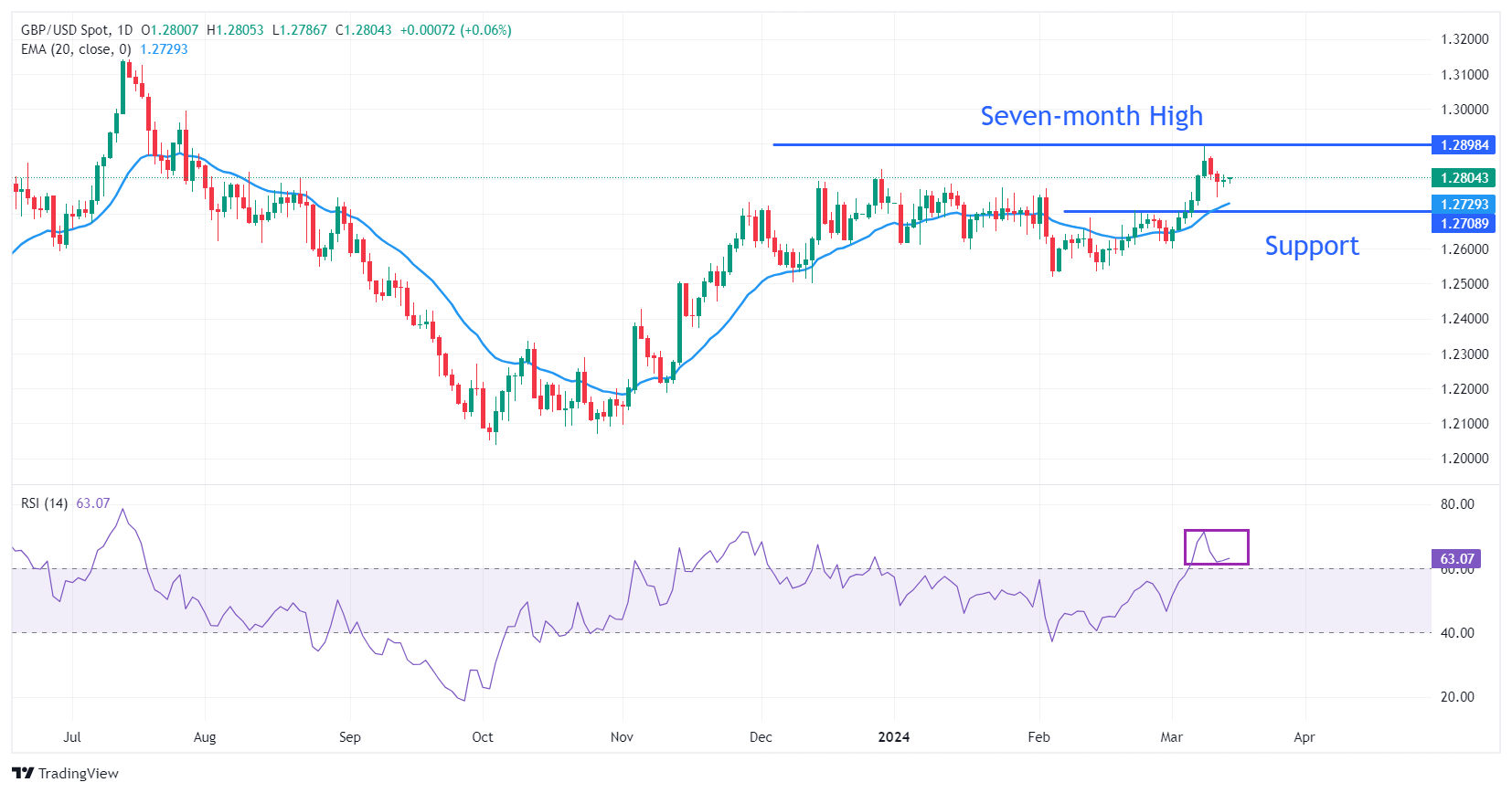
The Pound Sterling drops below 1.2800 on dismal market mood. The 20-day Exponential Moving Average (EMA) near 1.2730 continues to slope higher, indicating a moderate near-term demand. The 1.2700 round-level support would be a strong cushion for the Pound Sterling bulls.
The 14-period Relative Strength Index (RSI) oscillates in the 60.00-80.00 range, indicating that strong bullish momentum persists.
Inflation FAQs
Inflation measures the rise in the price of a representative basket of goods and services. Headline inflation is usually expressed as a percentage change on a month-on-month (MoM) and year-on-year (YoY) basis. Core inflation excludes more volatile elements such as food and fuel which can fluctuate because of geopolitical and seasonal factors. Core inflation is the figure economists focus on and is the level targeted by central banks, which are mandated to keep inflation at a manageable level, usually around 2%.
The Consumer Price Index (CPI) measures the change in prices of a basket of goods and services over a period of time. It is usually expressed as a percentage change on a month-on-month (MoM) and year-on-year (YoY) basis. Core CPI is the figure targeted by central banks as it excludes volatile food and fuel inputs. When Core CPI rises above 2% it usually results in higher interest rates and vice versa when it falls below 2%. Since higher interest rates are positive for a currency, higher inflation usually results in a stronger currency. The opposite is true when inflation falls.
Although it may seem counter-intuitive, high inflation in a country pushes up the value of its currency and vice versa for lower inflation. This is because the central bank will normally raise interest rates to combat the higher inflation, which attract more global capital inflows from investors looking for a lucrative place to park their money.
Formerly, Gold was the asset investors turned to in times of high inflation because it preserved its value, and whilst investors will often still buy Gold for its safe-haven properties in times of extreme market turmoil, this is not the case most of the time. This is because when inflation is high, central banks will put up interest rates to combat it. Higher interest rates are negative for Gold because they increase the opportunity-cost of holding Gold vis-a-vis an interest-bearing asset or placing the money in a cash deposit account. On the flipside, lower inflation tends to be positive for Gold as it brings interest rates down, making the bright metal a more viable investment alternative.
Author
Sagar Dua
FXStreet
Sagar Dua is associated with the financial markets from his college days. Along with pursuing post-graduation in Commerce in 2014, he started his markets training with chart analysis.