Pound Sterling consolidates some gains against USD as Trump reiterates reciprocal tariff threats
- The Pound Sterling rises as the UK GDP rose at a robust pace in December and surprisingly expanded in the last quarter.
- BoE's Greene and Pill have guided a gradual and cautious approach to interest rate cuts.
- Investors brace for volatility as US President Trump is poised to announce reciprocal tariffs.
The Pound Sterling (GBP) surrenders some of its intraday gains and falls back below the psychological level of 1.2500 against the US Dollar (USD) in North American trading hours on Thursday. The GBP/USD pair gives up some gains as the US Dollar (USD) recovers some losses after US President Donald Trump reiterated threats to impose reciprocal tariffs later in the day.
"Three great weeks, perhaps the best ever, but today is the big one: reciprocal tariffs!!! Make America great again!!!," Trump said on Truth Social.
Trump's reciprocal tariff threats have increased the safe-haven appeal of the US Dollar again.
Earlier in the day, the US Dollar was underperforming as positive developments in peace talks between Russia and Ukraine had overcome the impact of hotter-than-expected United States (US) Consumer Price Index (CPI) data for January released on Wednesday, which boosted expectations that the Federal Reserve (Fed) will keep interest rates at their current levels for longer.
Donald Trump confirmed on Wednesday that Russian leader Vladimir Putin and Ukrainian President Volodymyr Zelenskiy had expressed a desire for peace in separate phone calls. He also ordered his top officials to begin truce talks, Reuters reports. This scenario has increased investors' risk appetite and diminished demand for safe-haven assets, such as the US Dollar. The US Dollar Index (DXY), which gauges the Greenback’s value against six major currencies, slides to near 107.50.
Hotter-than-expected inflation data had forced trades to pare bets supporting an interest rate cut by the Fed in the June meeting. According to the CME FedWatch tool, there were a 36% chance that the Fed will cut interest rates in June, down from 50% on Tuesday.
Meanwhile, higher-than-expected growth in the US Producer Price Index (PPI) data for January has also prompted expectations that the Fed remain in a waiting mode for longer. Annual headline producer inflation rose at a faster pace of 3.5% from 3.3% growth in December, while economists expected it to have decelerated to 3.2%. The core PPI – which excludes volatile food and energy prices – grew at a faster-than-expected pace of 3.6% but slower than 3.7% growth in December, upwardly revised from 3.5%.
Daily digest market movers: Pound Sterling advances on upbeat UK GDP data
- The Pound Sterling strengthens in Thursday’s North American session due to multiple tailwinds, such as upbeat United Kingdom (UK) data and a risk-on market mood. The UK Office for National Statistics (ONS) reported that the UK Gross Domestic Product (GDP) rose at a faster pace of 1.4% YoY in the last quarter of 2024, compared to estimates of 1.1% and the 1% growth seen in the third quarter, upwardly revised from 0.9%.
- Quarterly, the UK economy surprisingly expanded by 0.1% after remaining flat in the July-September period, while it was expected to have contracted at a similar pace. Month-on-month, the UK economy grew at a robust pace of 0.4% in December, compared to estimates and the former reading of 0.1%.
- Though the UK GDP data had been better than expected in December and the last quarter of the previous year, it is unlikely to offer sustainable support to the British currency as the Bank of England (BoE) halved its GDP forecasts for the year to 0.75% in the last week’s monetary policy meeting, where the central bank reduced its borrowing rates by 25 basis points (bps) to 4.5% and guided caution on interest rate cuts.
- BoE officials have been guiding a cautious approach to interest rate cuts as they remain concerned about the mild persistence of inflationary pressures. BoE Chief Economist Huw Pill said earlier in the day that the central bank needs to move cautiously on further policy easing, as the battle against inflation is far from over.
- "We are able to remove some of the restriction we imposed because of the successful - but not yet complete - process of disinflation,” Pill said, Reuters report. Additionally, he stated that the BoE has to work more to “bring inflation down” and, therefore, we can’t “cut interest rates aggressively”.
- On Wednesday, BoE policymaker Megan Greene also favored a “cautious and gradual approach to interest rate cuts” as she believes that inflation persistence will less likely fade on its own, and therefore, the monetary policy will need to “remain restrictive.”
- Meanwhile, the UK factory data also remained stronger than expected in December. Month-on-month Industrial Production rose by 0.5%, faster than estimates of 0.2%. The Manufacturing Production grew by 0.7%, while it was expected to decline by 0.1%. In November, both Industrial and Manufacturing Production declined.
Technical Analysis: Pound Sterling strives to reclaim 50-day EMA
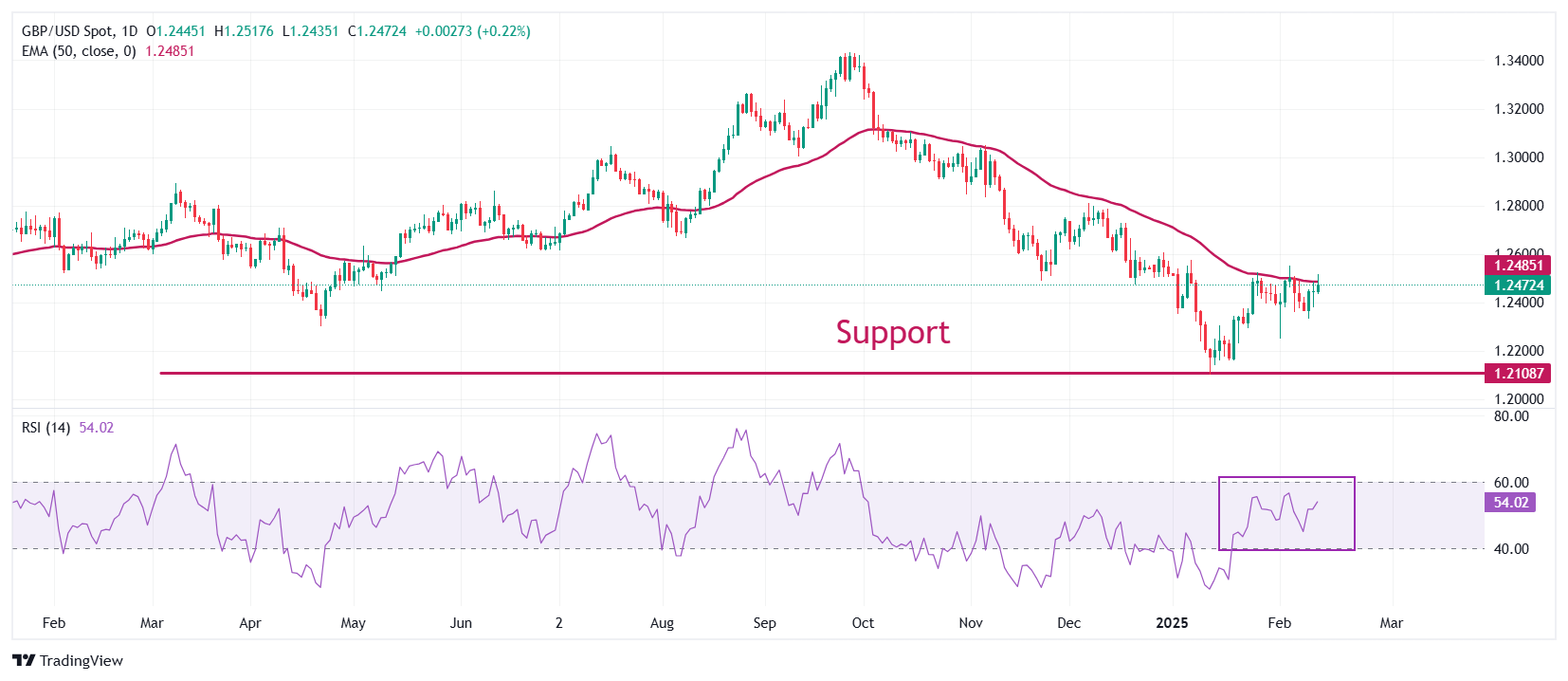
The Pound Sterling struggles to extend recovery above 1.2500 against the US Dollar as the 50-day Exponential Moving Average (EMA) coincides with the level. A daily close above the 50-day EMA would indicate that the near-term trend is not bearish anymore.
The 14-day Relative Strength Index (RSI) oscillates inside the 40.00-60.00 range, suggesting a sideways trend.
Looking down, the January 13 low of 1.2100 will act as a key support zone for the pair. On the upside, the December 30 high of 1.2607 will act as key resistance.
Tariffs FAQs
Tariffs are customs duties levied on certain merchandise imports or a category of products. Tariffs are designed to help local producers and manufacturers be more competitive in the market by providing a price advantage over similar goods that can be imported. Tariffs are widely used as tools of protectionism, along with trade barriers and import quotas.
Although tariffs and taxes both generate government revenue to fund public goods and services, they have several distinctions. Tariffs are prepaid at the port of entry, while taxes are paid at the time of purchase. Taxes are imposed on individual taxpayers and businesses, while tariffs are paid by importers.
There are two schools of thought among economists regarding the usage of tariffs. While some argue that tariffs are necessary to protect domestic industries and address trade imbalances, others see them as a harmful tool that could potentially drive prices higher over the long term and lead to a damaging trade war by encouraging tit-for-tat tariffs.
During the run-up to the presidential election in November 2024, Donald Trump made it clear that he intends to use tariffs to support the US economy and American producers. In 2024, Mexico, China and Canada accounted for 42% of total US imports. In this period, Mexico stood out as the top exporter with $466.6 billion, according to the US Census Bureau. Hence, Trump wants to focus on these three nations when imposing tariffs. He also plans to use the revenue generated through tariffs to lower personal income taxes.
Author

Sagar Dua
FXStreet
Sagar Dua is associated with the financial markets from his college days. Along with pursuing post-graduation in Commerce in 2014, he started his markets training with chart analysis.