Pound Sterling gains as US court dismisses Trump’s tariff policy
- The Pound Sterling recovers to 1.3500 against the US Dollar as investors reassess the impact of the US court’s decision against tariffs.
- The US court ruled out Trump’s tariff policy, citing it as a violation of constitutional limits.
- The IMF has slightly raised its forecast for UK GDP growth for the year to 1.2%
The Pound Sterling (GBP) recovers from early losses against the US Dollar (USD) and reclaims the key level of 1.3500 during North American trading hours on Thursday. The GBP/USD pair rebounds as the US Dollar surrenders a chunk of its initial gains, as the United States (US) Court of International Trade’s verdict against President Donald Trump’s tariffs increases economic uncertainty further.
The event also seems critical for business owners, who started designing their procurement strategies, considering Trump’s levies as the new normal for the global economy.
The US Dollar Index (DXY), which tracks the Greenback’s value against six major currencies, slides to near 99.70, which went around 100.50 earlier in the day.
Earlier in the day, the US Dollar (USD), bond yields, and US equities gained sharply after the Manhattan-based court blocked Donald Trump from sweeping most tariffs.
The court condemned Trump’s usage of the Carter-era International Emergency Economic Powers Act (IEEPA) to justify his international agenda, quoting it as exploitation of the president’s authority. The court has ruled out import duties announced by him on the so-called “Liberation Day”, while sector-specific tariffs such as automobiles, metals, and semiconductors are intact.
Meanwhile, a 10-day deadline has been issued by the court to the administration for a permanent injunction of Liberation Day tariffs, to which the White House appealed soon after the decision.
During North American trading hours. White House Economic Adviser Kevin Hassett has expressed confidence that the US court's verdict to ban Trump's tariffs will be overturned. "I am confident in the success of the tariff ruling appeal," Hassett said. He clarified that trade negotiations are still "ongoing" and three deals are basically done.
Daily digest market movers: Pound Sterling gains as traders pare BoE dovish bets
- The Pound Sterling trades higher against its major peers on Thursday, as the International Monetary Fund (IMF) has slightly raised the United Kingdom (UK) Gross Domestic Product (GDP) growth forecast for the current year to 1.2% from 1.1% in the wake of the upbeat economic performance seen in the first quarter.
- The Office for National Statistics (ONS) reported in the middle of the month that the economy expanded at a robust pace of 0.7%, compared to estimates of 0.6% and a nominal growth of 0.1% seen in the last quarter of 2024.
- Another reason behind the strength in the British currency is fading market expectations that the Bank of England (BoE) will reduce interest rates again in the June policy meeting. Traders have pared BoE dovish bets following hotter-than-expected UK Consumer Price Index (CPI) and a robust growth in the UK Retail Sales data for April.
- This week, investors will focus on the US Personal Consumption Expenditure Price Index (PCE) data for April, which will be released on Friday. The US core PCE inflation data, which is the Federal Reserve’s (Fed) preferred inflation gauge, is expected to have grown at a moderate pace of 2.5% on year, compared to the prior release of 2.6%.
- Meanwhile, the revised Q1 GDP data from the US Bureau of Economic Analysis (BEA) has shown that the economy declined at a slower pace of 0.2%, compared to the flash reading of 0.3%.
Technical Analysis: Pound Sterling recovers to near 1.3500
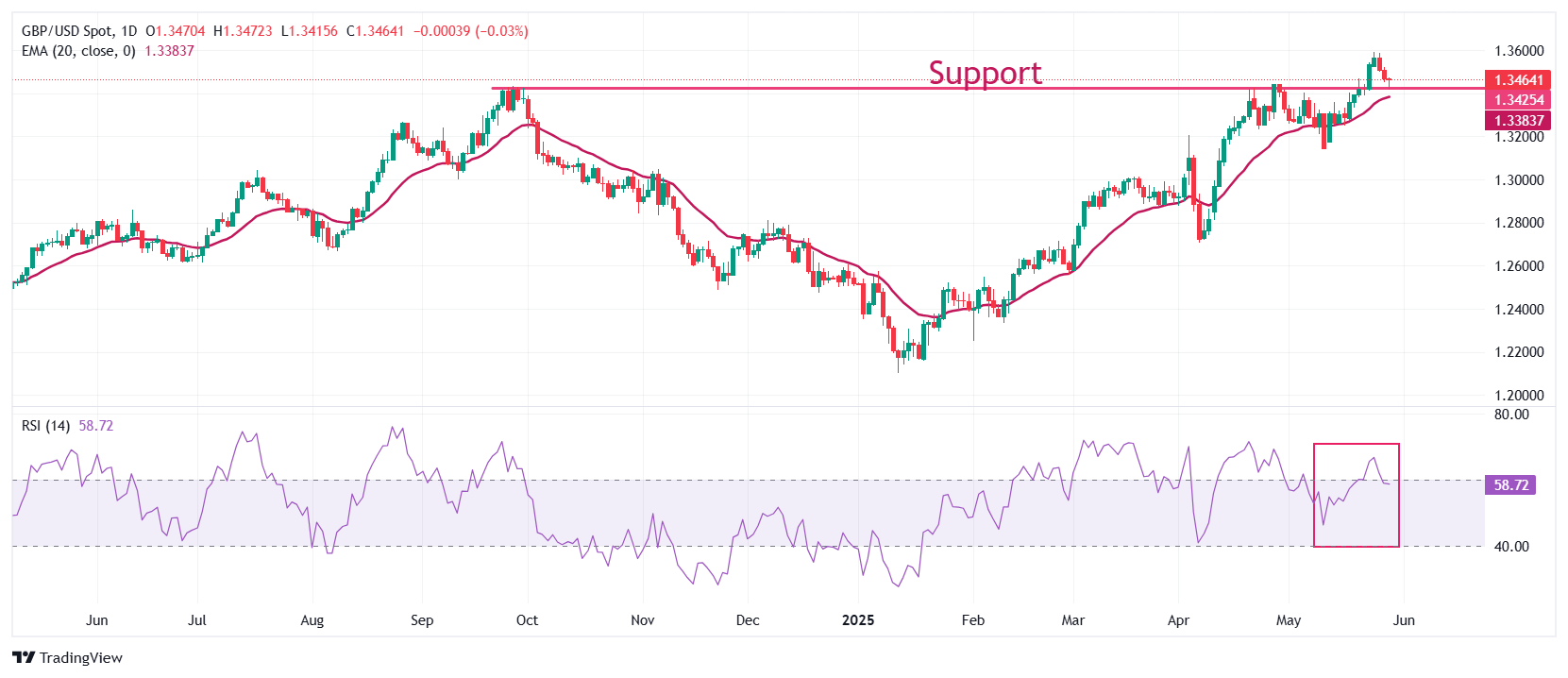
The Pound Sterling bounces back against the US Dollar on Thursday after attracting bids near the horizontal support plotted from the September 26 high of 1.3434 and rises to near 1.3500. The outlook of the pair remains firm as the 20-day Exponential Moving Average (EMA) slopes higher around 1.3385.
The 14-day Relative Strength Index (RSI) struggles to hold above 60.00. The bullish momentum would come to an end if the RSI slides into the 40.00-60.00 range.
On the upside, the 13 January 2022 high of 1.3750 will be a key hurdle for the pair. Looking down, the 20-day EMA will act as a major support area.
Tariffs FAQs
Tariffs are customs duties levied on certain merchandise imports or a category of products. Tariffs are designed to help local producers and manufacturers be more competitive in the market by providing a price advantage over similar goods that can be imported. Tariffs are widely used as tools of protectionism, along with trade barriers and import quotas.
Although tariffs and taxes both generate government revenue to fund public goods and services, they have several distinctions. Tariffs are prepaid at the port of entry, while taxes are paid at the time of purchase. Taxes are imposed on individual taxpayers and businesses, while tariffs are paid by importers.
There are two schools of thought among economists regarding the usage of tariffs. While some argue that tariffs are necessary to protect domestic industries and address trade imbalances, others see them as a harmful tool that could potentially drive prices higher over the long term and lead to a damaging trade war by encouraging tit-for-tat tariffs.
During the run-up to the presidential election in November 2024, Donald Trump made it clear that he intends to use tariffs to support the US economy and American producers. In 2024, Mexico, China and Canada accounted for 42% of total US imports. In this period, Mexico stood out as the top exporter with $466.6 billion, according to the US Census Bureau. Hence, Trump wants to focus on these three nations when imposing tariffs. He also plans to use the revenue generated through tariffs to lower personal income taxes.
Author

Sagar Dua
FXStreet
Sagar Dua is associated with the financial markets from his college days. Along with pursuing post-graduation in Commerce in 2014, he started his markets training with chart analysis.
















