|

Pound Sterling Price News and Forecast: GBP/USD Elliott Wave technical analysis [Video]

GBP/USD Elliott Wave technical analysis [Video]

The Elliott Wave analysis for the GBPUSD daily chart reflects a bullish trend, indicating upward market movement. The current price action is in an impulsive mode, which signals sustained upward momentum in line with the broader market trend. The wave being monitored is Gray Wave 3, a significant wave in Elliott Wave theory, usually associated with strong upward movement within the trend.

Currently, the market is in Orange Wave 3, which is part of the larger impulsive structure of Gray Wave 3. This suggests that the price is in a phase where sustained upward momentum is expected, aligning with the overall bullish framework. Read more...

GBP/USD Forecast: Pound Sterling could face next resistance near 1.3350

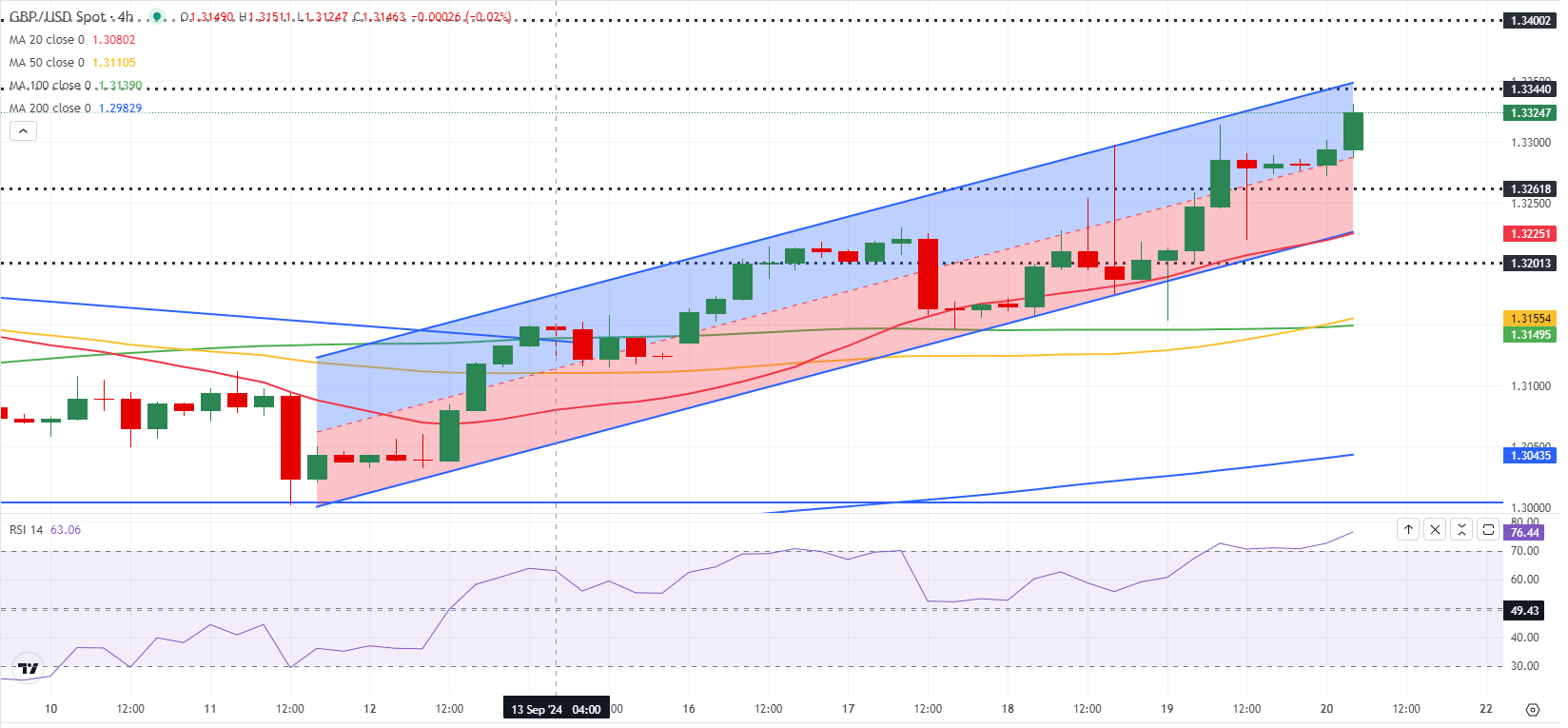
Following Thursday's volatile action, GBP/USD gathers bullish momentum and trades at its highest level since March 2022 above 1.3300 in the European morning on Friday. The pair's near-term technical outlook points to overbought conditions.

The Bank of England (BoE) announced on Thursday that it left the policy rate unchanged after the September meeting, as expected. In a hawkish surprise, only one policymaker voted in favor of a 25 basis points rate cut. Speaking later in the day, BoE Governor Andrew Bailey said that he is optimistic that interest rates in the UK will fall but added that they need to see more evidence of residual inflation pressure disappearing. Although GBP/USD retreated slightly after the BoE event, it closed in positive territory on Friday. Read more...
GBPUSD

Author

FXStreet Team

Composed of a group of economic journalists and FX experts, the FXStreet content team produces and oversees all content published on FXStreet. It provides a purely journalistic approach to the Forex market.


More from FXStreet Team
Share:

Editor's Picks

AUD/USD seems vulnerable near 0.6800, 10-month low amid bullish USD

AUD/USD languishes near a 10-month low during the Asian session on Friday, awaiting a break below 0.6800 before the next leg up amid a bullish US Dollar. Firming Fed rate-hike expectations, along with fading hopes for US-Iran diplomacy, help the USD hold gains at its highest level since April 2025. Moreover, the RBA’s dovish tilt undermines the Aussie and backs the case for further losses.

USD/JPY bulls turn cautious near 160.00 amid intervention risks

USD/JPY enters a bullish consolidation phase around its highest level since early September as bulls turn cautious amid intervention risk near 160.00. Meanwhile, the downside seems cushioned as the wide US-Japan interest rate gap keeps the Yen carry trade active. Furthermore, the possibility of a jumbo Fed rate hike and Middle East uncertainties hold the US Dollar near a 19-month top, supporting the currency pair.


Gold remains on the back foot below $3,900

Gold now alternates gains with losses below the $3,900 mark per troy ounce on Friday. The precious metal struggles to regain traction amid the firmer US Dollar, mixed US Treasury yields and expectations of further tightening by the Fed at its December meeting.

Bitcoin just posted five straight losing weeks, and the storm may not be over yet

Bitcoin is struggling to find support, slipping below $70,000 as multiple headwinds threaten to push the Crypto King lower. The much-anticipated “Uptober” rally failed to materialize, with persistent selling pressure and widespread liquidations instead reinforcing the “Rektober” narrative.

Week ahead – Fed Minutes, inflation data and Nvidia earnings to guide investors

Fed minutes may add to hawkish tone as bets of 50-bps hike grow. Nvidia to report earnings as bar to impress high after spy scandal. Trade and geopolitics to be focal point of Trump-Xi summit.

Gold hit its lowest level of 2026 near $3,850
Gold (XAU/USD) attempts to stabilize around $3,890 on Friday after falling to $3,852 on Thursday, its lowest level since October 2025. The precious metal has lost more than 4% this week, as investors increasingly anticipate further monetary tightening from the Federal Reserve (Fed). The latest decline reflects a sharp change in market expectations.