Pound Sterling shows strength against US Dollar as investors doubt US economic strength
- The Pound Sterling grips gains above 1.2900 against the US Dollar as investors expect Trump policies could slow down the US growth momentum.
- Fed Powell needs more clarity before adjusting the monetary policy.
- BoE Mann argues against the gradual and cautionary monetary policy easing approach.

The Pound Sterling (GBP) stays firm above 1.2900 against the US Dollar (USD) in Monday’s North American session. The GBP/USD pair strengthens as the US Dollar struggles to gain ground amid growing concerns over the United States (US) economic outlook. The US Dollar Index (DXY), which tracks the Greenback’s value against six major currencies, trades cautiously near the four-month low of 103.50.
Market participants have become increasingly worried over US economic prospects after comments from US President Donald Trump on Friday indicated that his “American First” policies could lead to economic turbulence in the near term.
US President Trump refrained from guiding the impact of his policies on the economy but said in the interview with Fox News that there is a “period of transition”, because what we are doing is very “big”. His comments came after being asked whether his policies could lead to a recession in the economy.
Donald Trump reiterated that reciprocal tariffs will be announced on April 2. Last week, Trump imposed 25% tariffs on imports from Canada and Mexico but exempted many products that come under the purview of the United States-Mexico-Canada Agreement (USMCA) for a month. He also increased surcharges on Chinese imports to 20% by imposing an additional 10%.
Market experts continue to believe that Trump’s tariff policies would be inflationary for the economy, but they have changed their perception of its impact on the economic outlook. At one point when Trump’s agenda was expected to accelerate economic expansion, it is now anticipated to fracture the economy. This has led to global brokerages revising their growth forecasts for the US economy. Goldman Sachs has downgraded its Q4 2025 Gross Domestic Product (GDP) growth forecast to 1.7%, from 2.2% previously anticipated, and raised its 12-month recession probability to 20% from 15%.
Investors also expect the Federal Reserve (Fed) would be forced to resume the policy-easing cycle as early as June. However, Fed Chair Jerome Powell reiterated in an economic forum at the University of Chicago Booth School on Friday that the interest rate policy is in “good shape” and the central bank wants clarity on Trump’s policies before making any monetary policy adjustment.
Daily digest market movers: Pound Sterling drops as BoE Mann supports swift policy-easing cycle
- The Pound Sterling underperforms its peers at the start of the week as Bank of England (BoE) Monetary Policy Committee (MPC) member Catherine Mann rebutted the need for a “gradual and cautious” monetary policy easing approach, as guided by a majority of BoE officials in the February monetary policy meeting and testimony before Parliament’s treasury committee on Wednesday, due to deepening economic volatility across the globe in her speech on Thursday.
- Mann argued against the moderate monetary expansion approach amid significant volatility in global markets. She also said that the founding premise for a gradualist approach to monetary policy is “no longer valid” due to “substantial volatility” coming from financial markets, especially from “cross-border spillovers”.
- A day before Mann’s speech, four BoE officials, including Governor Andrew Bailey, endorsed a gradual path for “removing monetary policy restrictiveness” as the inflation persistence is less likely to fade “on its own accord”.
- It is worth noting that Catherine Mann was one of two BoE officials who voted for a larger-than-usual rate cut of 50 basis points (bps) in the interest rate decision in February.
- This week, investors will keenly focus on the US JOLTS Job Openings and United Kingdom (UK) monthly GDP data for January, and the US Consumer Price Index (CPI) data for February, which will influence market speculation for the Fed and the BoE’s monetary policy outlook. At the moment, traders expect the BoE to cut interest rates two times more this year.
British Pound PRICE Today
The table below shows the percentage change of British Pound (GBP) against listed major currencies today. British Pound was the strongest against the Canadian Dollar.
| USD | EUR | GBP | JPY | CAD | AUD | NZD | CHF | |
|---|---|---|---|---|---|---|---|---|
| USD | -0.05% | 0.03% | -0.69% | 0.39% | -0.11% | -0.22% | -0.17% | |
| EUR | 0.05% | 0.05% | -0.64% | 0.45% | 0.04% | -0.20% | -0.25% | |
| GBP | -0.03% | -0.05% | -0.76% | 0.36% | -0.01% | -0.31% | -0.23% | |
| JPY | 0.69% | 0.64% | 0.76% | 1.08% | 0.65% | 0.39% | 0.59% | |
| CAD | -0.39% | -0.45% | -0.36% | -1.08% | -0.54% | -0.61% | -0.59% | |
| AUD | 0.11% | -0.04% | 0.01% | -0.65% | 0.54% | -0.23% | -0.18% | |
| NZD | 0.22% | 0.20% | 0.31% | -0.39% | 0.61% | 0.23% | 0.12% | |
| CHF | 0.17% | 0.25% | 0.23% | -0.59% | 0.59% | 0.18% | -0.12% |
The heat map shows percentage changes of major currencies against each other. The base currency is picked from the left column, while the quote currency is picked from the top row. For example, if you pick the British Pound from the left column and move along the horizontal line to the US Dollar, the percentage change displayed in the box will represent GBP (base)/USD (quote).
Technical Analysis: Pound Sterling aims to break above 61.8% Fibo retracement
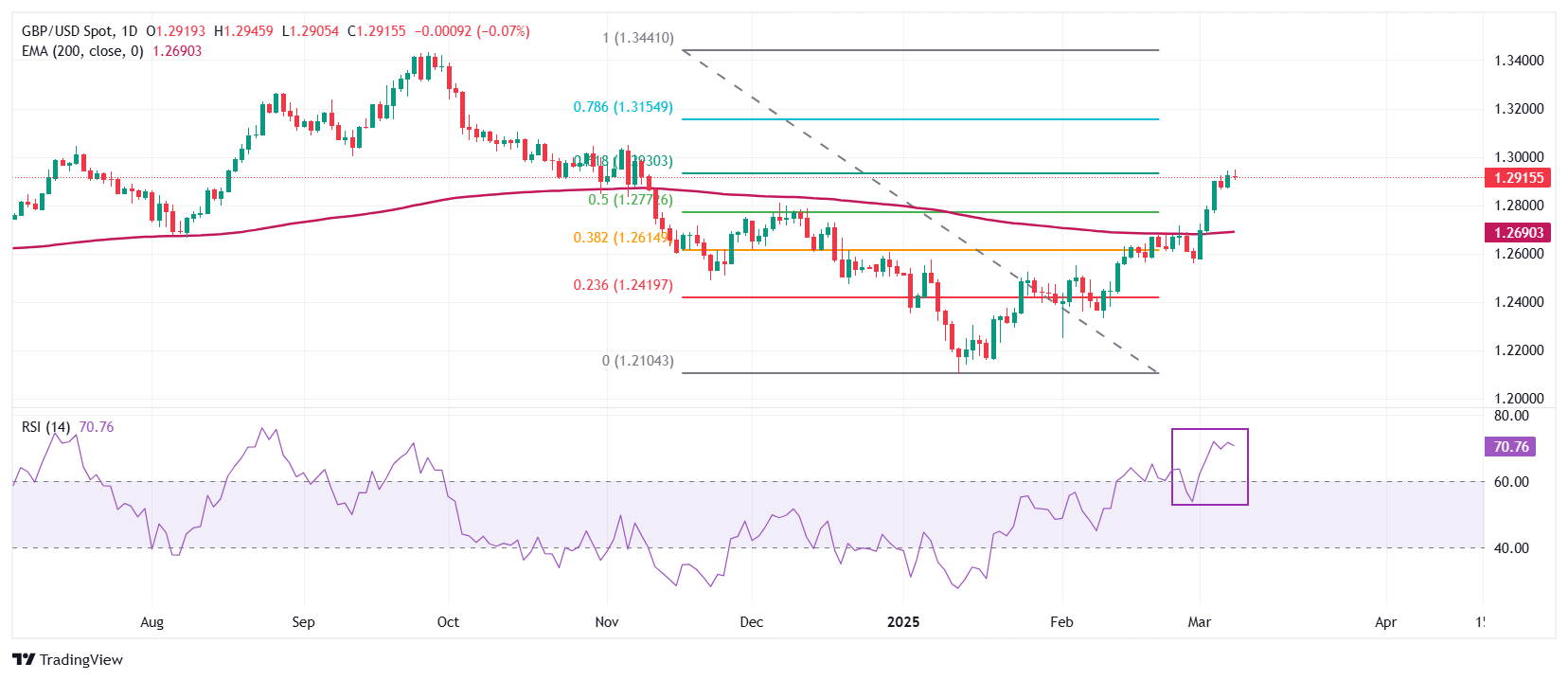
The Pound Sterling strives to break above the 61.8% Fibonacci retracement plotted from the late September high to mid-January low around 1.2930 on Friday. The long-term outlook of the GBP/USD pair has turned bullish as it holds above the 200-day Exponential Moving Average (EMA), which is around 1.2690.
The 14-day Relative Strength Index (RSI) climbs above 70.00, suggesting a strong bullish momentum.
Looking down, the 50% Fibo retracement at 1.2767 and the 38.2% Fibo retracement at 1.2608 will act as key support zones for the pair. On the upside, the psychological 1.3000 level will act as a key resistance zone.
Tariffs FAQs
Tariffs are customs duties levied on certain merchandise imports or a category of products. Tariffs are designed to help local producers and manufacturers be more competitive in the market by providing a price advantage over similar goods that can be imported. Tariffs are widely used as tools of protectionism, along with trade barriers and import quotas.
Although tariffs and taxes both generate government revenue to fund public goods and services, they have several distinctions. Tariffs are prepaid at the port of entry, while taxes are paid at the time of purchase. Taxes are imposed on individual taxpayers and businesses, while tariffs are paid by importers.
There are two schools of thought among economists regarding the usage of tariffs. While some argue that tariffs are necessary to protect domestic industries and address trade imbalances, others see them as a harmful tool that could potentially drive prices higher over the long term and lead to a damaging trade war by encouraging tit-for-tat tariffs.
During the run-up to the presidential election in November 2024, Donald Trump made it clear that he intends to use tariffs to support the US economy and American producers. In 2024, Mexico, China and Canada accounted for 42% of total US imports. In this period, Mexico stood out as the top exporter with $466.6 billion, according to the US Census Bureau. Hence, Trump wants to focus on these three nations when imposing tariffs. He also plans to use the revenue generated through tariffs to lower personal income taxes.
Author

Sagar Dua
FXStreet
Sagar Dua is associated with the financial markets from his college days. Along with pursuing post-graduation in Commerce in 2014, he started his markets training with chart analysis.

















