Peloton Interactive Stock News and Forecast: PTON shares plunge 24% as production may halt
- PTON shares collapse to lowest price since March 2020 .
- Peloton is idling some factories due to reduced consumer demand.
- PTON is now priced below 2019 IPO price.

Peloton Interative (PTON) shares collapsed on Thursday in a stunning sell-off after the upscale exercise bike company was rumoured to be idling factories and considering layoffs due to dwindling consumer demand for its products. The plunge meant PTON lost $2.5 billion in market cap and investors have officially lost the entire 500%-plus run-up in the stock's value during the COVID-19 pandemic. PTON is, however, bouncing back in Friday's premarket and is now up 4.6% at $25.33 at the time of writing.
Peloton Stock News: demand falling for exercise bikes, treadmills
First, a CNBC story arrived on Thursday saying that Peleton executives were made aware that a severe decline in consumer demand would cause the company to idle production for both its fitness bikes and treadmills in February and March.
CEO John Foley then responded that the company was only considering options and had not made any definitive decision yet.
"We now need to evaluate our organization structure and size of our team," Foley said. "And we are still in the process of considering all options ... to make our business more flexible."
Peloton Interative was a pandemic darling. After making it through a miserable IPO in September 2019, which saw it IPO at $29 only to open at $27 and then trade down to $21 in subsequent weeks, the stock took off in April 2020 after it developed a reputation as a lockdown stock. PTON shares rallied on a series of earnings beats all the way to $171.09 on January 14, 20221. After dropping for more than a year, PTON has as of Thursday lost 86% of its value from that all-time high.
Peloton said it is now focusing on profitability and forecasts $1.14 billion in revenue for the quarter ending in December 2021, which is expected to be reported on February 8. Originally expecting $5.4 billion in 2022 revenue, the company is now highlighting $4.4 billion to $4.8 billion. Instead of an operating loss of $325 million for the full year, Peloton is now citing an adjusted operating loss of $425 million to $475 million.
PTON key statistics
| Market Cap | $8 billion |
| Price/Earnings | N/A |
| Price/Sales | 2 |
| Price/Book | 8 |
| Enterprise Value | $11.2 billion |
| Operating Margin | -13% |
| Profit Margin |
-16% |
| 52-week high | $166.57 |
| 52-week low | $23.25 |
| Short Interest | 11% |
| Average Wall Street Rating and Price Target | Hold, $67.69 |
Peloton Stock Forecast: heading to $17.70
If you own this stock, we at FXStreet are sorry for your loss. The only sources of optimism are that the average Wall Street price target is at $67.69, but we know that there will likely be another series of downgrades coming with reduced price targets. Also at only two times sales, PTON could be said to be a value stock at this point. In an environment with interest rates moving higher, however, PTON will not see much help from value investors until it can turn a profit, which is unlikely to happen this year.
From a price standpoint, the only areas of support are in the $21-$22 zone that served as a bottom in September and October of 2019. Below here lies the pandemic low of $17.70. That latter price is where FXStreet thinks PTON is headed. At this point, there are just not going to be many takers for this ticker.
What would change our minds is if PTON can muster enough strength to close above $40, where the 9-day moving average currently sits.
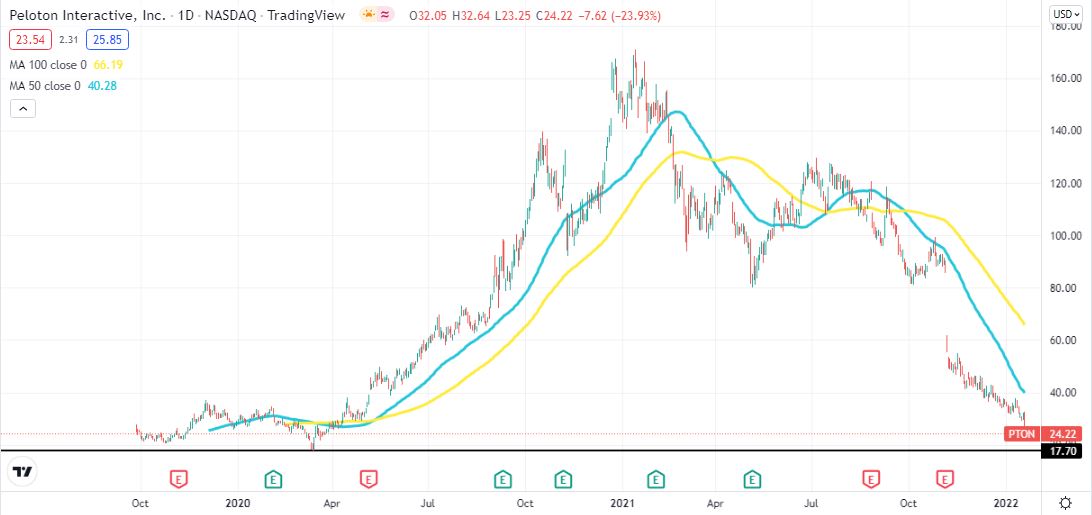
PTON 1-day chart
Like this article? Help us with some feedback by answering this survey:
Author

Clay Webster
FXStreet
Clay Webster grew up in the US outside Buffalo, New York and Lancaster, Pennsylvania. He began investing after college following the 2008 financial crisis.


![How Wall Street rigs the game [Video]](https://editorial.fxsstatic.com/images/i/market-chaos-01.jpg)