Peloton Interactive Stock News and Forecast: Peloton is peddaling squares, avoid
- Peloton shares rebound as the company raises more money.
- PTON stock up 15% on Tuesday, dead cat bounce?
- Peloton still struggling after stellar lockdown performance.

Peloton rallied sharply on Tuesday as the fitness company announced a slightly larger than expected share raise. The company raised just over $1.1 billion, about $100 million more than anticipated, and Peloton could raise as much as $1.25 billion if the full overallotment by underwriters is taken up. Clearly, demand was high, but we will outline below how we still feel it is best to avoid this one from an investment point of view. If short-term trading is your game, then that is entirely different. In that case, you need some volatility, and Peloton certainly provides that. Just manage your risk carefully.
-637727467052174671.png)
Peloton 15-minute chart
Just to dampen some of the recent enthusiasm, we present the 15-minute interval chart going back to the start of November. Yesterday's gain for Peloton barely registers, the stock is still down nearly 40% for November.
Peloton stock news
By now the reason for the shocking performance is well known, but here is a recap in case you missed it. Peloton benefitted hugely from the early days of the pandemic as everyone was stuck at home. Sales of fitness equipment soared. Peloton rode the trend and saw revenues and sales surge.
However, looking at the income table below, we can see the surge in revenue is nearly back to where it was prior to the pandemic. September 2020 saw Peloton revenue hit $757 million, rising to $1.26 billion by March 2021. Now growth has slowed, and revenue has dropped back to $805.2 million. However, in that time period expenses have soared. September 2020 saw gross profit of $328 million and net income of $69.3 million. As of September 2021, gross profit slipped to $262.7 million, and Peloton showed a net income loss of $376 million.


More troubling is the lack of control or even knowledge it appears is exercised by those in charge. After the recent earnings that started this cratering in the share price, the company said on November 4 that there was no need for Peloton to raise cash. Less than two weeks later, here we are with a $1 billion-plus share sale. Two weeks! So was the company just trying to hope for the best or did it not really know its position? Neither is a good answer.
We cannot fault the company or any company for that matter for raising cash. Cash is flowing around freely looking for a home. If you can raise it cheaply and easily, why not do so? Our concern is the optics: either the company did not think it needed cash or it was hoping it did not need cash. Both do not inspire much confidence in management.
Peloton priced the stock offering at $46 per share. This compares to yesterday's closing price of $54.85.
Peloton stock forecast
The fundamental picture outlined above looks bearish. Growth is slowing, but expenses are not, and now Peloton has reported another EPS loss. It did the same back in August when it reported EPS of -$1.05 when the estimate was $-0.44.
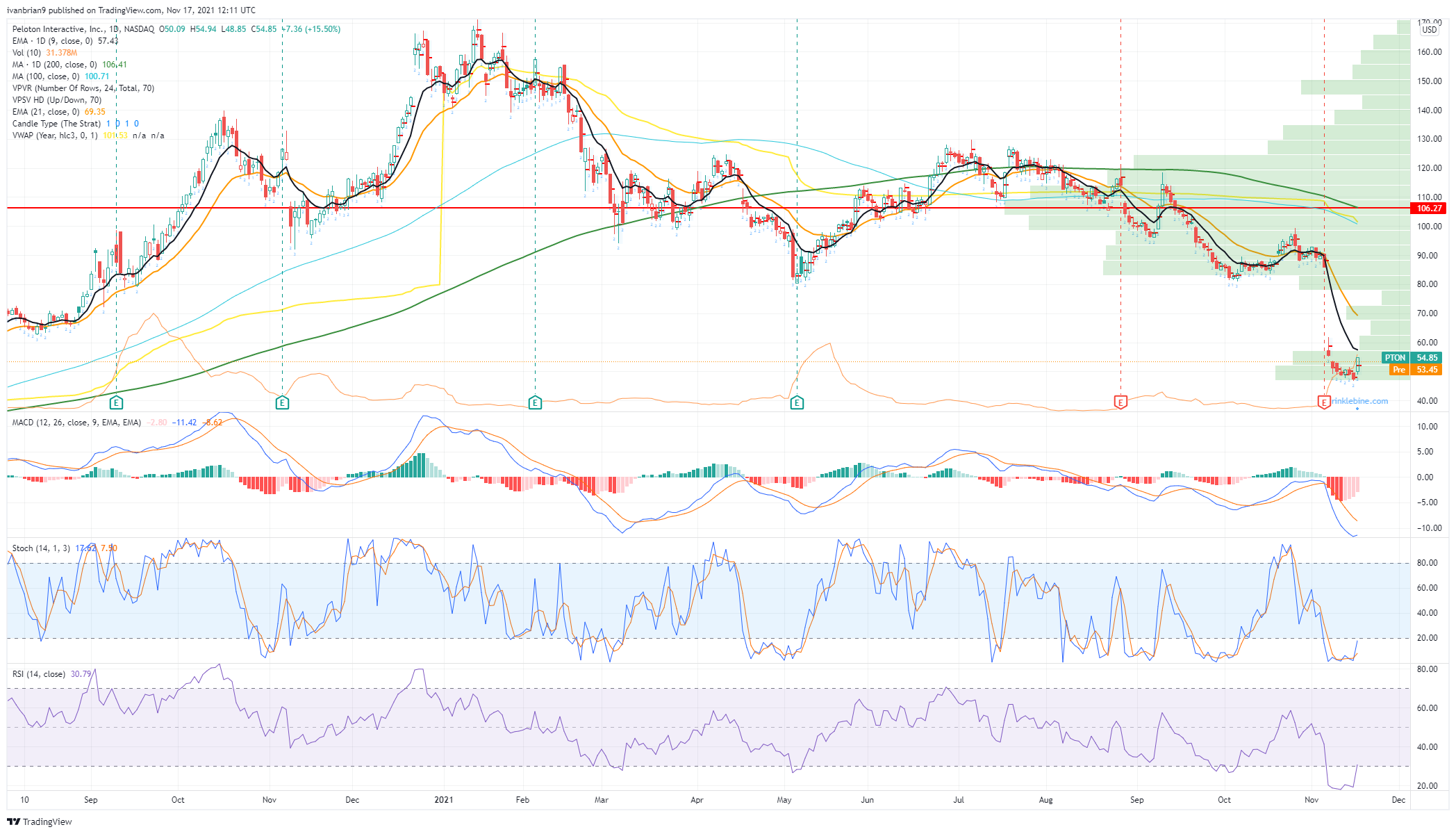
Take a look at the chart below. Nothing positive to see here. Strong red candles, bears are in control. Yesterday looks like a dead cat bounce. Only breaking the 9-day at $57.45 will make us rethink this. $61.45 would be the next resistance. If yesterday's move was a sign of the bottom, then Peloton would need to gain again today and build on that. A red day today shows it for what it was, a dead cat bounce.
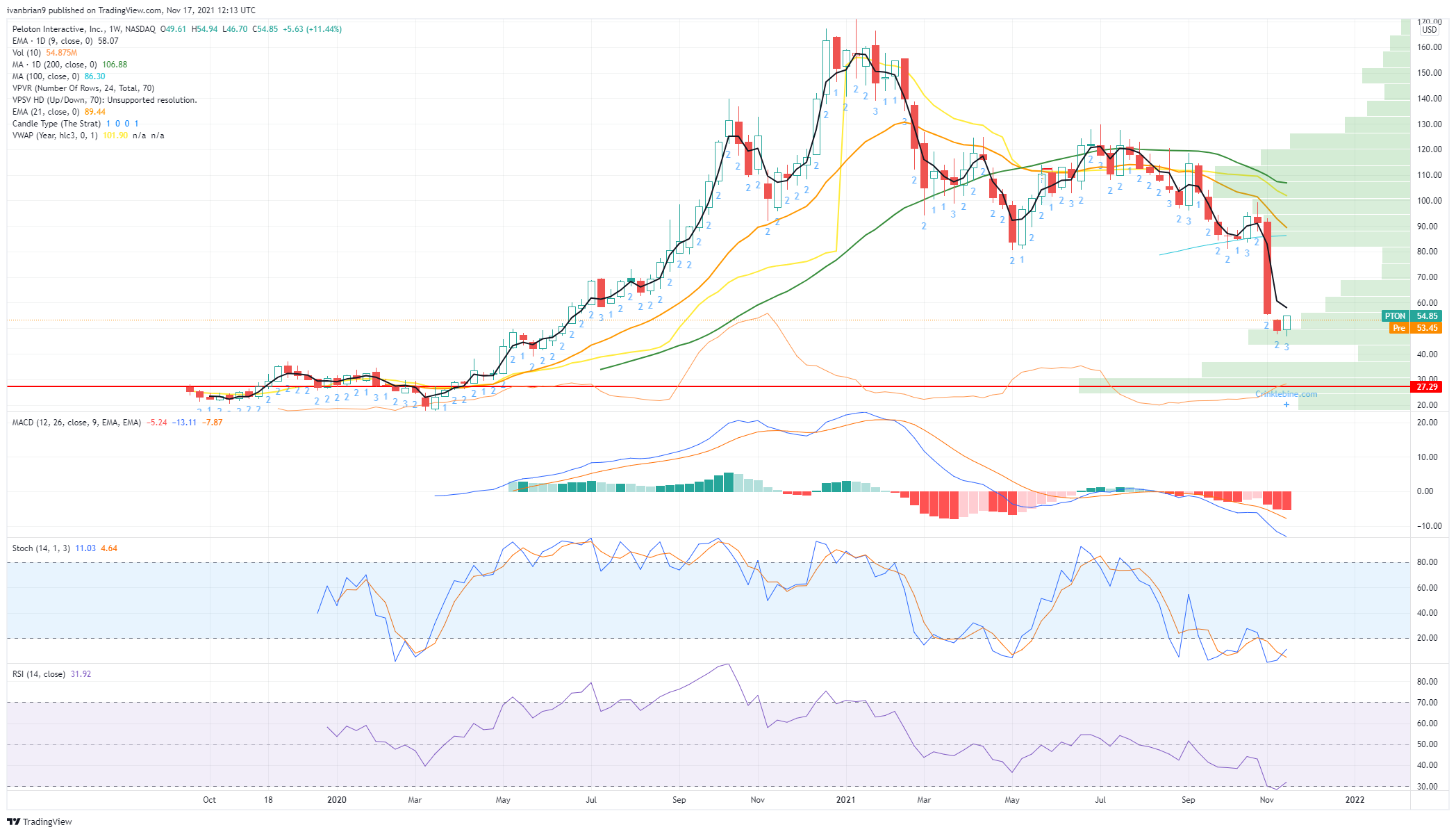
The weekly chart below shows us the targets. Peloton has support at $27.29 from the point of control. This is the price with the highest amount of volume and so is an equilibrium. Below $30, the volume profile bar is huge, so it may stabilize then. That is the time to reassess the bearish argument and see if it is a dip worth buying.
PTON daily chart
Author

Ivan Brian
FXStreet
Ivan Brian started his career with AIB Bank in corporate finance and then worked for seven years at Baxter. He started as a macro analyst before becoming Head of Research and then CFO.