Oracle's force majeure on New Mexico data center sends AI stocks lower
- ORCL sinks on New Mexico data center troubles.
- Oracle issues force majeure as Project Jupiter campus gets stuck in regulatory and public approval thickets.
- AI stocks give up ground as NASDAQ leads other indices lower.
- ORCL stock is likely to retest $114.50.

Oracle (ORCL) stock sinks over 4% on Thursday after the hyperscaler sent a force majeure notice to the developer building its new data center campus in New Mexico. That news rippled through artificial intelligence (AI) stocks and set up the Thursday session as another consecutive retreat.
The data center in question, dubbed Project Jupiter, has faced regulatory hurdles and local opposition, and Oracle is said to be using the force majeure notice to disentangle itself from contractual payments if the data center does not come online on schedule in 2028.
The NASDAQ Composite, S&P 500 and Dow Jones Industrial Average all begin Thursday with losses between 0.2% and 0.7%. The growth and tech-rich NASDAQ is performing the worst at the time of writing. The only positive from the Oracle news is that Wednesday's surge in US Treasury yields is retreating somewhat.
Oracle's force majeure is everyone's headache
Bloom Energy (BE), which produces solid oxide fuel cells that convert natural gas into electricity for data centers, also slid 4%. Nvidia (NVDA), the primary supplier of GPUs used in AI data centers, sank 1.5%, while hyperscaler Microsoft (MSFT) also lost 2.5%. Sandisk (SNDK), which supplies NAND memory chips to data centers, also declined 2.5%.
While Oracle's issue with local opposition to its Project Jupiter data center buildout is primarily its own concern, the larger industry is seeing public opposition to data centers rise as the federal midterm elections in November draw closer. The governors of big states like Texas and Pennsylvania have taken a harder line on data center development in recent months, although critics note that both of them accept plenty of donor money from the AI industry.
This event also follows last week's announcement from Anthropic CEO Dario Amodei that his company plans to slow down model development to ensure that safety mechanisms are in place. Executives from OpenAI and SpaceXAI (SPCX) also publicly agreed with that sentiment.
A slowdown in the AI model race would likely mean that the leading AI hyperscalers take longer to reach positive operating cash flow. Apollo Global Management chief economist Torsten Slok has claimed this month that the entire AI trade hinges on the hyperscalers tripling their combined operating cash flow from $600 billion presently to $2 trillion.
Slok theorizes that if the five major hyperscalers — Microsoft, Oracle, Meta Platforms (META), Alphabet (GOOGL) and Amazon (AMZN) — fail to reach that $2 trillion figure quickly, investor appetite for the broader AI trade could fade, credit spreads on hyperscaler debt would likely widen, and companies could be forced to scale back spending plans.
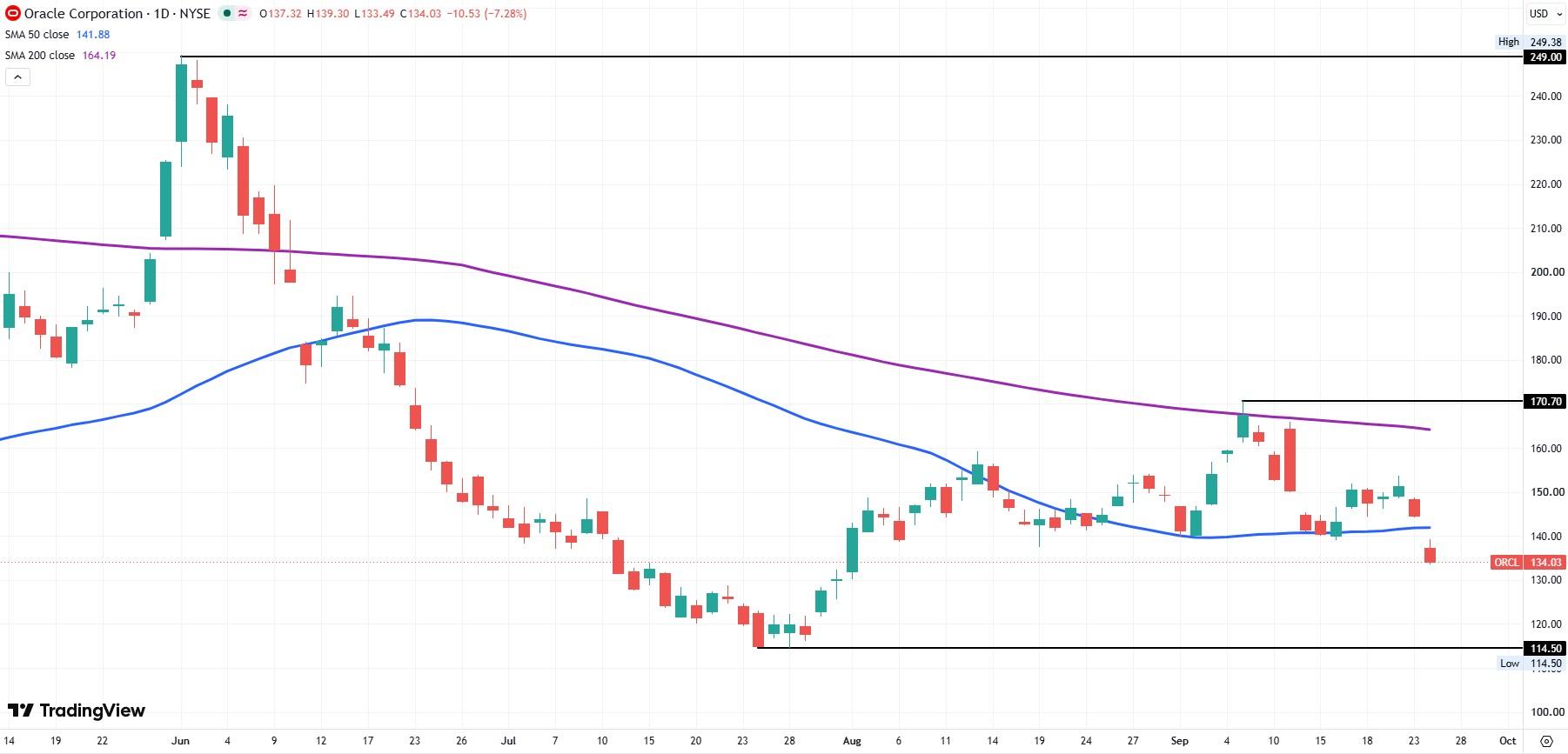
Oracle stock chart
Oracle stock has been in a technical downtrend since early January of this year, so this news is somewhat unsurprising. It's long been understood that Oracle is the weakest among equals in the hyperscaler space, and that any downdraft in the AI buildout should hit it hardest. This belief can be measured the clearest by comparing Oracle's credit default swaps to those of other hyperscalers. Oracle 5-year CDS yields are routinely 25% higher than its peers.
Since early January, ORCL stock's 50-day Simple Moving Average (SMA) has trended below its 200-day SMA. Since hitting a range high near $249 on June 1, Oracle shares have drifted lower. The latest range high near $170 on September 8 servers a lower high on the daily chart and tells us that the downtrend should continue.
At this point, ORCL is trading beneath the short-term support shelf at $140. This means that bears intend to retest the $114.50 support level. If support can't hold, then expect ORCL to drop to three-year-old support circa $100.
Until Oracle shares retake the $170.70 range high and the 50-day SMA overcomes its 200-day counterpart, being bullish on ORCL is a lost cause. With so many other options in the AI realm, why bother betting on the slowest horse.
Author

Clay Webster
FXStreet
Clay Webster grew up in the US outside Buffalo, New York and Lancaster, Pennsylvania. He began investing after college following the 2008 financial crisis.