NZD/USD subdued below 0.6900 but kiwi remains close to post-pandemic highs
- NZD/USD was hit alongside other risk assets amid a mild deterioration of sentiment on Tuesday.
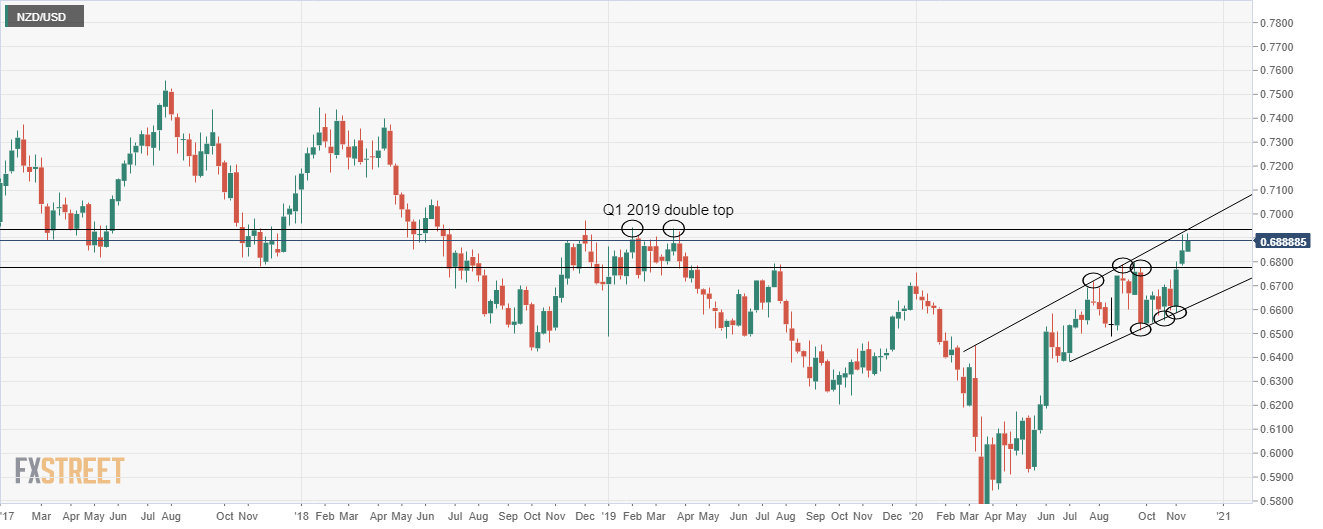
- The kiwi still trades close to post-pandemic/multi-year highs and is eyeing a test of a key Q1 2019 double top.


NZD/USD hit fresh post-pandemic and multi-year highs of 0.6919 during the Tuesday Asia Pacific session, but has since come off the boil and fallen back below 0.6900 and now trades with losses on the day of nearly 20 pips or 0.2%.
Kiwi price action set to remain subject to risk appetite/USD dynamics this week
The only data of note so far this week was from GlobalDairyTrade (GDT) during the early Tuesday European afternoon; GDT's Price Index beat expectations, rising 1.8% versus expectations for a 3.5% drop in prices, but this little to affect NZD at the time. Aside from Q3 Producer Price Inflation data out at 21:45GMT on Tuesday night, which is unlikely to trigger much NZD volatility, there are practically no domestic New Zealand economic events of note this week. Thus, kiwi is likely to continue to trade as a function of broader risk appetite and US dollar conditions.
In terms of risk appetite; on Tuesday, risk assets have seen a minor pullback from Moderna vaccine update risk on driven gains on Monday, with soft US retail sales numbers doing little to help - albeit these numbers are being seen as somewhat out of date, given the focus is on US economic performance in November and onwards given the country has been going back into lockdown only in recent weeks.
The S&P 500 currently trades around 0.3% lower, crude oil markets are in the red and, as a result, the more risk-sensitive G10 currencies NZD, AUD, CAD and SEK are all underperforming.
In terms of the US dollar; despite today’s relatively risk-off market feel, the dollar index (DXY) trades lower by slightly more than 20 points on Tuesday and is back below 92.50. DXY is eyeing a test of monthly lows at 92.14, and soft US dollar conditions are offering risk-sensitive pairings like NZD/USD and AUD/USD some support.
In recent days, USD has seemingly lost its status as a safe-haven currency, and its relationship to, for example, equity market movements has become increasingly more difficult to gauge. For now, increasingly dovish/concerned about the pandemic sounding FOMC members are keeping USD on the defensive.
Bullish kiwi eyeing up a test of Q1 2019 double top and long-term uptrend
Kiwi has put in a solid performance so far this November, gaining nearly 4.5% already. Bullish conditions have already taken the currency back to fresh post-pandemic highs and highs since Q1 2019.
But significant resistance lies to the upside; a double top formed in Q1 2019 sits in the 0.6930s, as well as an uptrend that has been in play as resistance since mid-March this year, which is likely to come into play before 0.6950.
In the more immediate future, however, NZD/USD is going to have to climb back above the 0.6900 level and surpass Tuesday morning highs at 0.6919 before having a crack at these longer-term levels.
In terms of the downside NZD/USD scenario, aside from Tuesday lows around 0.6875 set earlier on in the session, there is not much by way of significant resistance until the low 0.6800s/high 0.6700s; the 13 November low comes in at 0.6811, and 2 and 18 September highs at 0.6790 and 0.6798 respectively.
NZD/USD weekly-chart
Author
Joel Frank
Independent Analyst
Joel Frank is an economics graduate from the University of Birmingham and has worked as a full-time financial market analyst since 2018, specialising in the coverage of how developments in the global economy impact financial asset