|

NZD/USD Price Analysis: Pair surges, strengthening bullish signals

  • NZD/USD jumps 1.65% on Monday, reaching 0.5675 on fresh buying interest.
  • RSI climbs to positive terrain, reflecting steady bullish momentum and room for further gains.
  • MACD histogram shows rising green bars, indicating an accelerating upward trajectory.

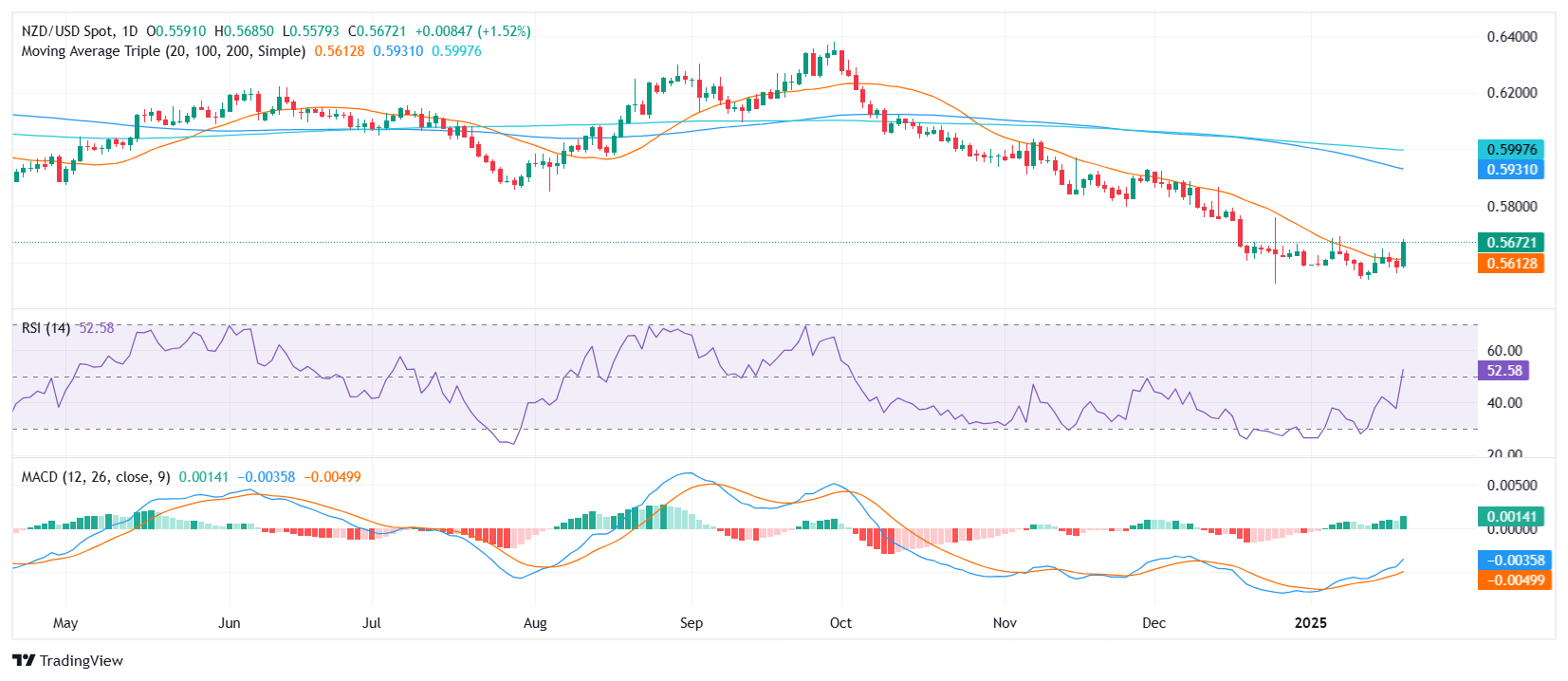
NZD/USD rallied on Monday, notching a 1.65% advance to settle around the 0.5675 mark. This robust performance comes amid a notable shift in sentiment, with traders appearing more inclined to favor the Kiwi dollar after its recent stretch of subdued price action. The mood has turned convincingly bullish, supported by technical studies pointing to ongoing upside potential.

According to the Relative Strength Index (RSI), which has pushed up to 52 and crossed the 50 middle point, the pair still has room to extend its climb despite trending on the higher side of the scale. In the meantime, the Moving Average Convergence Divergence (MACD) histogram continues to print progressively taller green bars, confirming that buying pressure remains intact. Together, these indicators hint at a market biased toward additional gains in the near term.

On the immediate horizon, any pullback may initially target the 0.5650 region, with stronger support near 0.5620 if the pair faces stronger selling. To the upside, a break beyond 0.5700 could open the door toward 0.5730, further reinforcing the pair’s shift in favor of the bulls.

NZD/USD daily chart
Author

Patricio Martín

Patricio is an economist from Argentina passionate about global finance and understanding the daily movements of the markets.


More from Patricio Martín
Share:

Editor's Picks

AUD/USD consolidates above 0.7000; remains close to monthly top

AUD/USD holds steady above 0.7000 during the Asian session on Friday, trading just below the previous day's monthly low amid diverging forces. A hawkish RBA continues to support the Aussie, while the recent decline in US bond yields keeps the US Dollar depressed near a three-week low. However, oil-driven inflation fears reinforce Fed hike bets, which, along with geopolitical risks, could benefit the safe-haven buck and cap the currency pair.

USD/JPY bounces off one-month low; climbs to 157.00 amid reviving USD demand

USD/JPY rebounds from the 156.00 neighborhood, or a one-month low touched during Friday’s Asian session, with bulls looking to extend momentum beyond 157.00 amid the emergence of some US Dollar buying. Meanwhile, Japan's National CPI rose to a nine-month peak and reaffirmed BoJ rate-hike bets, which could support the Japanese Yen and cap gains for the currency pair.

Gold treads water around $4,000

Gold prices maintain its offered stance in place at the end of the week, hovering around the key $4,000 threshold per troy ounce. The persistent selling bias in the precious metal comes amid decent gains in the US Dollar and an acceptable rebound in US Treasury yields across the curve, all alongside further upside traction in crude oil prices.

Crypto Today: Bitcoin holds the 50-day EMA as Ethereum and XRP face structural resistance

Bitcoin gradually ticks up on Friday, trading above $81,000. The Crypto King has recently defended structural support near $80,000, reinforcing the prevailing bullish outlook. Ethereum similarly edges higher above $2,400, while Ripple trades above $1.32 after testing support around $1.30.

The French bond panic is overdone. Here's what the market is misreading 

France's 10-year government bond yield has climbed above 5%, reigniting fears of a sovereign debt crisis in the Eurozone. With public debt exceeding €3.5 trillion, persistent budget deficits and a fragmented political landscape, investors are increasingly questioning the French government's ability to stabilize its finances.

What November 3 means for the Fed's rate path and the US Dollar

The USD faces a decisive period ahead of the November 3 midterm elections. While markets anticipate another interest rate increase from the Fed in December, the battle for control of Congress could reshape fiscal policy expectations and, indirectly, the path of US monetary policy in 2027.















