NZD/USD holding above 0.7220-0.7240 support zone for now
- NZD/USD currently trades just below the 0.7250 mark, but is holding above the 0.7220-0.7240 support zone for now.
- NZD/USD continues to focus on global themes, such as sentiment towards the US dollar and the reflation narratives.

NZD/USD currently trade just below the 0.7250 mark, down about 0.2% or just under 20 pips on the day amid indecisive US dollar trading conditions. The pair has swung as high as the 0.7280s and as low as the 0.7220s but has been moving closer to Friday’s lows again in recent trade amid a pick up in the US dollar that has seen the Dollar Index move back above 90.00.
The pair did not see much of a reaction to the release of the December US labour market report, given that markets are looking through any near-term economic weakness and towards the post-Covid-19 recovery at the moment.
Driving NZD/USD this week
NZD/USD continues to focus on global themes, such as sentiment towards the US dollar and the reflation narratives, both of which have received a boost since the victory of the Democrats in the Georgia Senate elections that handed them control over Congress and ensures that more US stimulus is on the way.
These two factors have had a mixed impact on NZD/USD thus far; the more markets bet on inflation (i.e. the higher US inflation expectations and commodity prices rise), the better this is for commodity-export dependent countries such as New Zealand and their currencies. Meanwhile, the more USD sentiment improves, the more this weighs on the cross; the bullish USD arguments right now go along the lines of more fiscal stimulus translating into stronger short, medium and long-term growth and a more hawkish Fed.
While most analysts expect the markets to continue to bet on higher inflation (meaning inflation expectations, nominal bond yields and commodity prices ahead) as a result of expectations for more stimulus, the debate on the ultimate impact this will have on the US dollar rages on. The dollar bears maintain that further fiscal stimulus will not be a USD positive given that 1) it will be funded by more government debt and will likely widen the US trade deficit, 2) higher debt will make it even harder for the Fed to normalise policy and 3) it will boost global growth and risk appetite which is generally bad for safe-haven USD.
Ultimately, what happens with USD will be the ultimate determinant of whether NZD/USD is going to continue to rally or will stall for a while, but given the boost to NZD from the reflation trade, the kiwi is likely to continue to outperform its less commodity-export dependent G10 peers such as EUR, GBP and JPY.
NZD/USD still in bullish trend channel
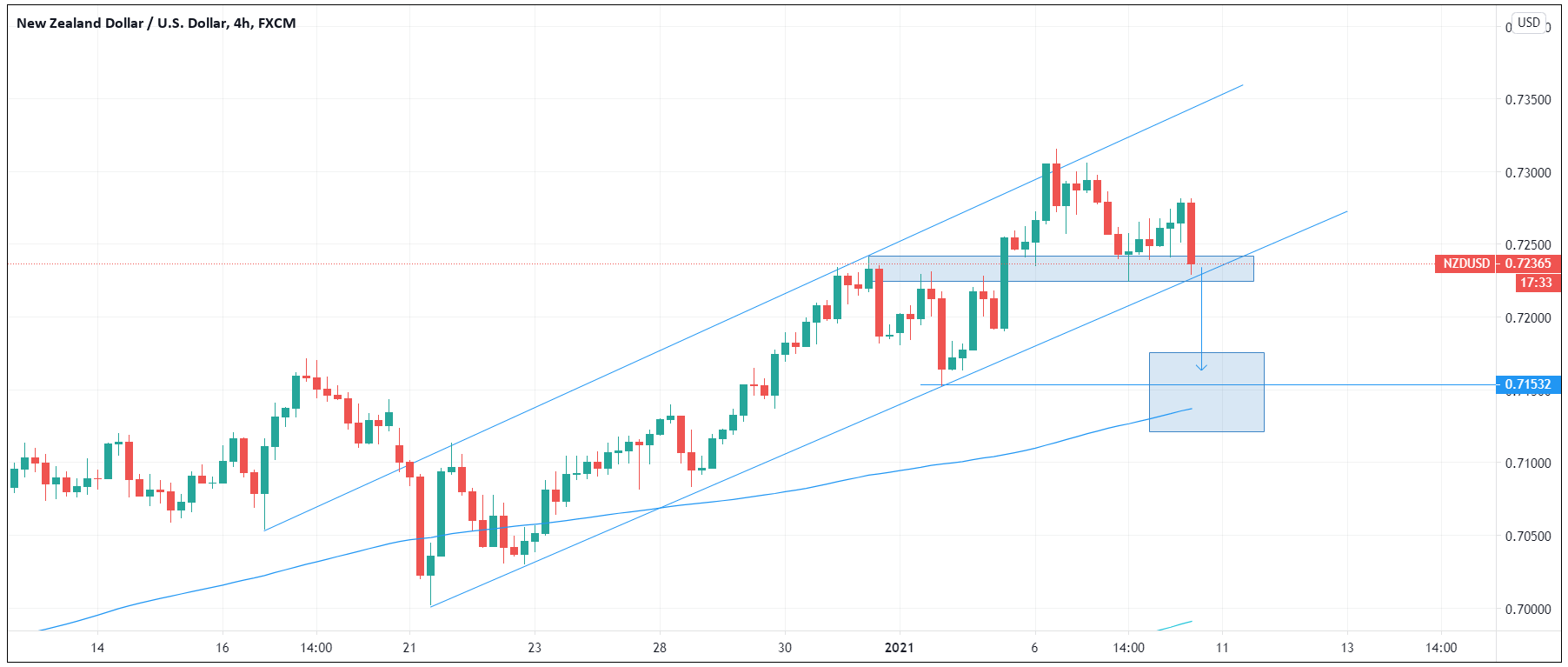
NZD/USD continues to advance within a bullish trend channel that has been in play since the second half of December 2020. To the downside, the price action has been supported by an uptrend linking the 21, 21 and 28 December, as well as the 4 January lows and to the upside, the price action is being capped by an uptrend linking the 16 December low and 21, 30 and 31 December highs.
A break below this trend channel would require a definitive break below the 0.7220-0.7240 support/resistance area that has been in play since 31 December 2020, and would likely open the door to a move towards Monday’s low at 0.7150 and perhaps a test of the pair’s 21-day moving average just below that at 0.71371.
NZD/USD four hour chart
Author

Joel Frank
Independent Analyst
Joel Frank is an economics graduate from the University of Birmingham and has worked as a full-time financial market analyst since 2018, specialising in the coverage of how developments in the global economy impact financial asset