Nvidia Q2 Earnings Preview: All eyes on NVDA after close
- Nvidia is slated to deliver fiscal 2025 Q2 earnings after the close on Wednesday.
- Wall Street expects the leading semi to deliver adjusted EPS of $0.64.
- Revenue is estimated to 10% from the first quarter.
- Lots of worries surround the delayed release of the Blackwell chips.
The moment is almost here. Despite a number of showstopping earnings calls this season, everyone has been waiting for Nvidia (NVDA) to release fiscal 2025 Q2 results, which finally arrive after the closing bell on Wednesday.
The options market tells us that traders are predicting a $300 billion move in market cap once CEO Jensen Huang turns on the mic, and this earnings event has the potential to sweep the broad market indices in its own direction. Nvidia is the main component of the artificial intelligence (AI) industry, so lots of major tech stocks can expect their near-term saga to depend on guidance for the San Jose chipmaker.
The major indices have been reticent at the open all week, and Wednesday looks the same. Dow Jones futures followed the lead of the NASDAQ and S&P 500 in selling off just before the opening bell. Worries abound that the AI rally could come to a screeching halt if Nvidia disappoints.
Nvidia earnings
Wall Street expects Nvidia to deliver $0.64 in adjusted earnings per share (EPS) in the post-market for the quarter ending in July. This amounts to a 5% gain over the first quarter’s result and a 133% rise compared to a year ago.
Revenue is projected to arrive at $28.73 billion, up 10% QoQ, and 113% above the year ago figure.
Many traders expect negativity to stem from a pushback in the debut of Nvidia’s new Blackwell GPU, originally slated for late 2024. In early August, Nvidia informed Microsoft (MSFT) that esoteric design flaws would push much of the deliveries into early 2025. Citi analyst Atif Malik cut his estimate for 2025 revenue by 5% on the news. More color from Huang is expected on this front.
Morgan Stanley said in a client note this week that the Blackwell delay will likely force big tech customers to purchase more H200 chips, which should reduce the market’s concerns about the Blackwell line.
With so much riding on the results, however, Bank of America Securities is pessimistic enough to advise its clients to buy S&P 500 puts ahead of the results. The options market is implying an 8% to 10% move following earnings, although BofA thinks that result is unlikely for NVDA and SPY put options are much cheaper.
Semiconductor stocks FAQs
A semiconductor is a term for various types of computer chips. Officially called semiconductor devices, these computer chips rely on semiconductor materials like silicon and gallium arsenide to process the electrical current that produces the modern world of computing. They come in many shapes, sizes, enhancements and configurations such as diodes, transistors and integrated circuits to more complicated applications like DRAM memory, simple processors and even GPUs.
First, there are the pure chip designers, such as Nvidia, AMD, Broadcom and Qualcomm. These companies use sophisticated software to design and test chips. Second, there are the equipment manufacturers that provide the machines necessary to build computer chips. These include ASML and Lam Research. Then, there are foundries that manufacture the chips. These include Taiwan Semiconductor and GlobalFoundries. Last of all are the integrated device manufacturers who design their own chips and additionally manufacture themselves. These include Samsung and Intel.
It is the observation that the number of transistors in an integrated circuit doubles every two years. The “law” is named after Gordon Moore, who founded Fairchild Semiconductor and later Intel. The doubling is possible due to the shrinking size of process nodes or parts in the computer chip. In 1971 the advanced commercial manufacturing had reached 10 microns in width. In 1987 semiconductor technology had advanced to 800 nanometers in width. By 1999, this process had moved to 180 nanometers. By 2007, the size had dropped to 32 nanometers, and this fell all the way to 3 nanometers in 2022, which is close to the size of human DNA.
In 2022, the global semiconductor industry had revenues just under $600 billion. In total, the industry shipped 1.15 trillion semiconductor units in 2021. The leading nations involved in the semiconductor supply chain are Taiwan, the United States, China, the Netherlands, South Korea, Japan and Israel.
Nvidia stock chart
Nvidia stock has faced resistance at $130 in recent days, which has become a second lower high since reaching an all-time high at $140.76 on June 20. The latter high is the target for bulls on Wednesday, but a number of support levels are being watched by bears.
First, the 50-day Simple Moving Average (SMA) is trending just below $121. The 100-day counterpat sits a little lower near $110, and the 200-day SMA glides along at $87.
There are also points of interest at both $92 and $96, which could pick up the slack in the event of a major catastrophe.
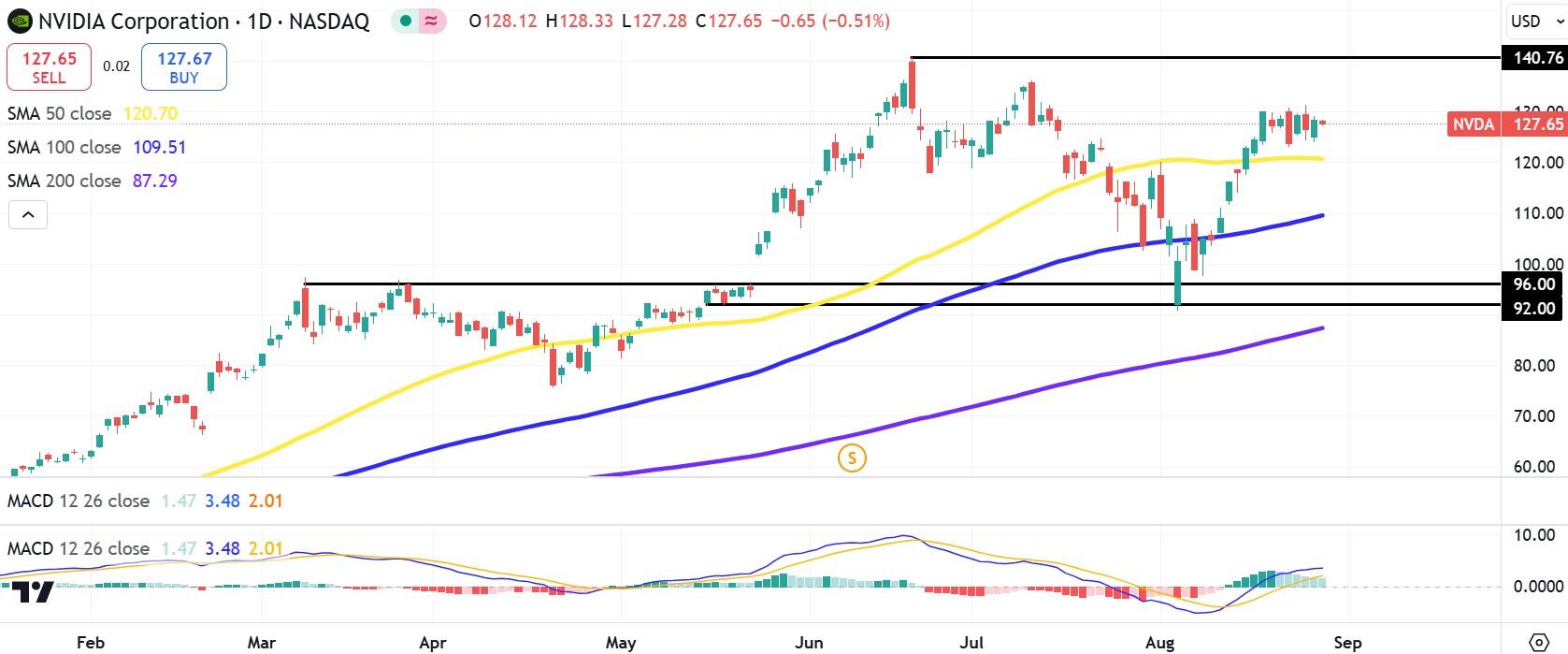
NVDA daily stock chart
Author

Clay Webster
FXStreet
Clay Webster grew up in the US outside Buffalo, New York and Lancaster, Pennsylvania. He began investing after college following the 2008 financial crisis.

















