New Zealand Dollar gains as US Dollar faces heat ahead of US Midterm elections
- NZD/USD jumps to near 0.5627 against the US Dollar with U Midterm elections in focus.
- The RBNZ is expected to remain on the monetary tightening path.
- Investors also await NZ Q3 labor market data.

The New Zealand Dollar (NZD) trades sharply higher against its peers, except the Canadian Dollar (CAD), on Tuesday. Against the US Dollar (USD), the antipodean is up 0.22% to near 0.5627.
The Kiwi dollar has remained well-supported near 0.5600 since the Reserve Bank of New Zealand’s (RBNZ) monetary policy announcement last week where it surprisingly left interest rates unchanged.
Kiwi downside seen limited as Commerzbank frames RBNZ move as a pause
Strategists at Commerzbank argue that the Reserve Bank of New Zealand’s latest decision should not be read as a shift to a softer stance, describing it instead as “more of a pause than a dovish pivot.” In their view, the policy path remains biased toward further tightening, and they “continue to expect two further hikes, in December and 1Q27, which should limit further NZD downside.”
Going forward, investors will focus on New Zealand (NZ) Q3 employment data, which is scheduled for Wednesday.
The Labor Cost Index is expected to come in lower at 0.5% from 0.7% seen in the second quarter this year. The Unemployment Rate is seen dropping to 5.5% from the previous reading of 5.6%.
On the US Dollar front, investors brace of United States (US) Midterm elections. As of writing, the US Dollar Index (DXY), which gauges the Greenback’s value against six major currencies,
US midterms seen favoring Democrats as markets eye sweep odds
Strategists at Brown Brothers Harriman note that “the US midterm elections will be held on Tuesday,” with “Democrats widely expected to win the House of Representatives.” They add that “Senate control is much closer, but the tide favors the Democratic party,” as “Democrats need a net gain of four seats to secure a majority in the Senate” — a target that is “within reach as Republicans are defending six of the seven toss-up seats.”
BBH highlights that betting markets “favor a Democratic sweep,” with Polymarket and Kalshi “putting the odds around 70%.” In their view, that “points to a relatively muted initial market reaction if Democrats win both chambers,” whereas “a Republican Senate hold would be the bigger surprise and could spark more market volatility.”
NZD/USD Technical Analysis
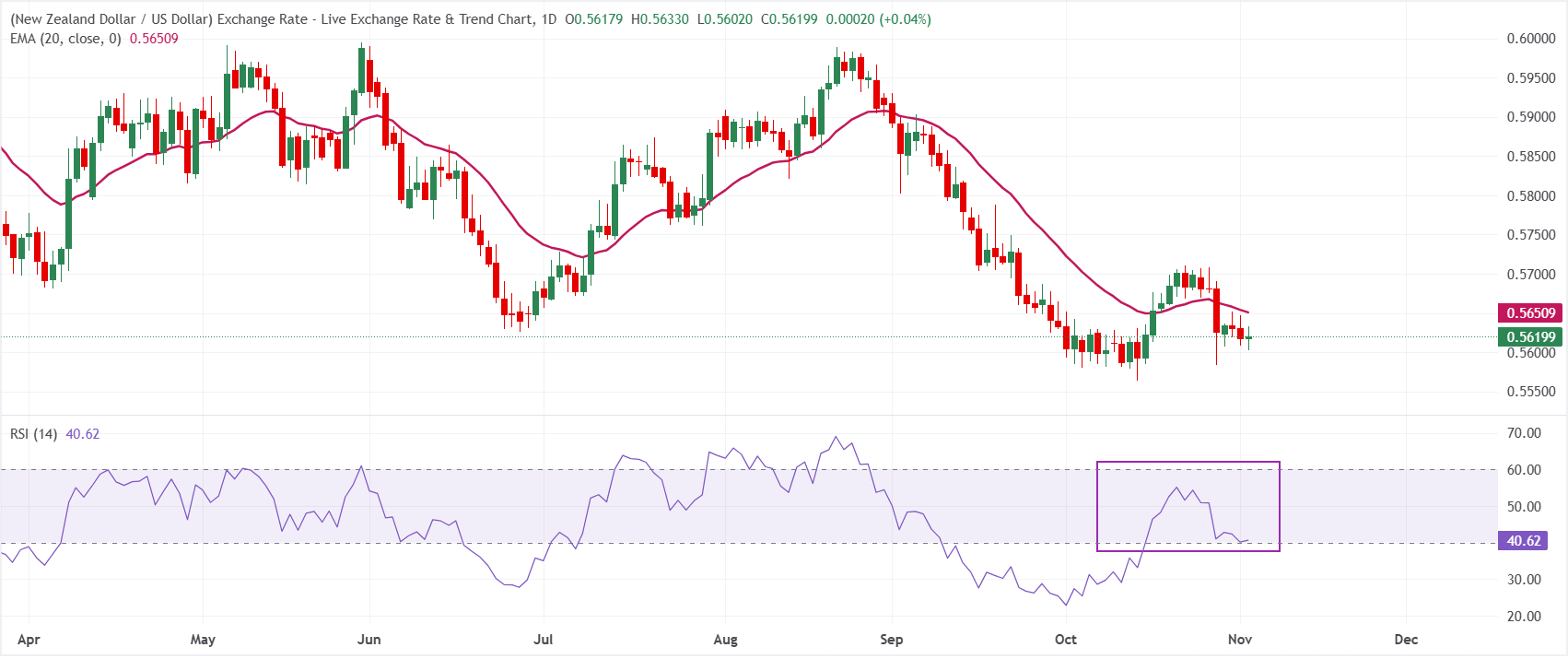
In the daily chart, NZD/USD trades at 0.5619, keeping a bearish near-term tone as it holds beneath the 20-period Exponential Moving Average (EMA) at 0.5651. The pair’s inability to reclaim this short-term EMA suggests rallies remain capped for now, while the Relative Strength Index (RSI) at around 40 shows recovering but still subdued momentum, hinting at a consolidation phase rather than an outright reversal.
On the topside, immediate resistance is located at the 20-period EMA at 0.5651, and a sustained break above this level would be needed to ease the current downside pressure. With no nearby technical supports derived from the provided dataset, traders may instead look to prior swing lows on the broader chart for potential demand zones, while the current positioning below the EMA keeps the bias tilted to the downside.
(The technical analysis of this story was written with the help of an AI tool. Know more.)
Economic Indicator
RBNZ Interest Rate Decision
The Reserve Bank of New Zealand (RBNZ) announces its interest rate decision after each of its seven scheduled annual policy meetings. If the RBNZ is hawkish and sees inflationary pressures rising, it raises the Official Cash Rate (OCR) to bring inflation down. This is positive for the New Zealand Dollar (NZD) since higher interest rates attract more capital inflows. Likewise, if it reaches the view that inflation is too low it lowers the OCR, which tends to weaken NZD.
Read more.Last release: Wed Oct 28, 2026 01:00
Frequency: Irregular
Actual: 2.75%
Consensus: 3%
Previous: 2.75%
Source: Reserve Bank of New Zealand
The Reserve Bank of New Zealand (RBNZ) holds monetary policy meetings seven times a year, announcing their decision on interest rates and the economic assessments that influenced their decision. The central bank offers clues on the economic outlook and future policy path, which are of high relevance for the NZD valuation. Positive economic developments and upbeat outlook could lead the RBNZ to tighten the policy by hiking interest rates, which tends to be NZD bullish. The policy announcements are usually followed by interim Governor Christian Hawkesby's press conference.
Author

Sagar Dua
FXStreet
Sagar Dua is associated with the financial markets from his college days. Along with pursuing post-graduation in Commerce in 2014, he started his markets training with chart analysis.