Netflix slumps, as SpaceX and chip stock sell off continues

It is a risk-off end to the week, as the global chip selloff shows no sign of abating. For now, the selloff is not turning into a threat to financial markets, and the S&P 500 is only 1% below its all-time high. However, there could be further losses and price action in July suggests that the Q2 rally is now in the rear-view mirror.
Stocks are mostly lower in Europe, although the FTSE 100 is eking out a gain due to its lack of tech exposure. US equity futures are sharply lower, with Nasdaq futures pointing to 2% decline later today, and a 1% decline in the S&P 500.
The chip stock sell-off gathers pace
South Korea’s Kospi index was closed on Friday, but it is still the second worst performing major global index this week, down nearly 9%, just above the 11% drop in China’s Shenzhen index, which suffered after a weak Q2 growth report for China. Japan’s Nikkei slipped 4% on Friday and is also lower by 6% this week. The US Nasdaq is still clinging onto a gain for the last week, and is up 0.5%, but it could play catch up later today in the chip stock race to the bottom.
SpaceX’s $1 trillion loss
The Philadelphia Semiconductor index is already down 10% this week, led lower by every member except for Nvidia, which is proving to be more resilient than smaller chip manufacturers. There are some notable underperformers in pre-market trading. SpaceX is extending its decline and is down another 4% in the pre-market, after slipping 12% in the last 5 trading sessions. It is now well below the IPO price of $135 per share and is expected to open below $130 later today at approximately $125. There could be a lot of retail traders who got caught up in the SpaceX hype nursing large losses this week, the question now is, will the sell off in chip stocks cause fire sales of assets elsewhere?
The chip sell off has spread to Europe, and not even strong Q2 results can help ASML’s share price today. Along with Infineon, it is leading the Eurostoxx 50 index lower, Infineon’s share price is down nearly 6% today, while ASML is lower by more than 4%. ASML’s fortunes highlight how this sell off is not linked to fundamentals, after it posted a strong Q2 earnings report and positive forward guidance.
There has already been a large decline in chip stocks, and valuations have moderated from elevated levels. For example, although still highly valued, SpaceX’s market cap is now lower by $1 trillion since its peak last month. This suggests that a substantial amount of exuberance has already been worked out of the market, and valuations are less stretched. However, it does not appear that a recovery is on the horizon in the short term.
Netflix matures
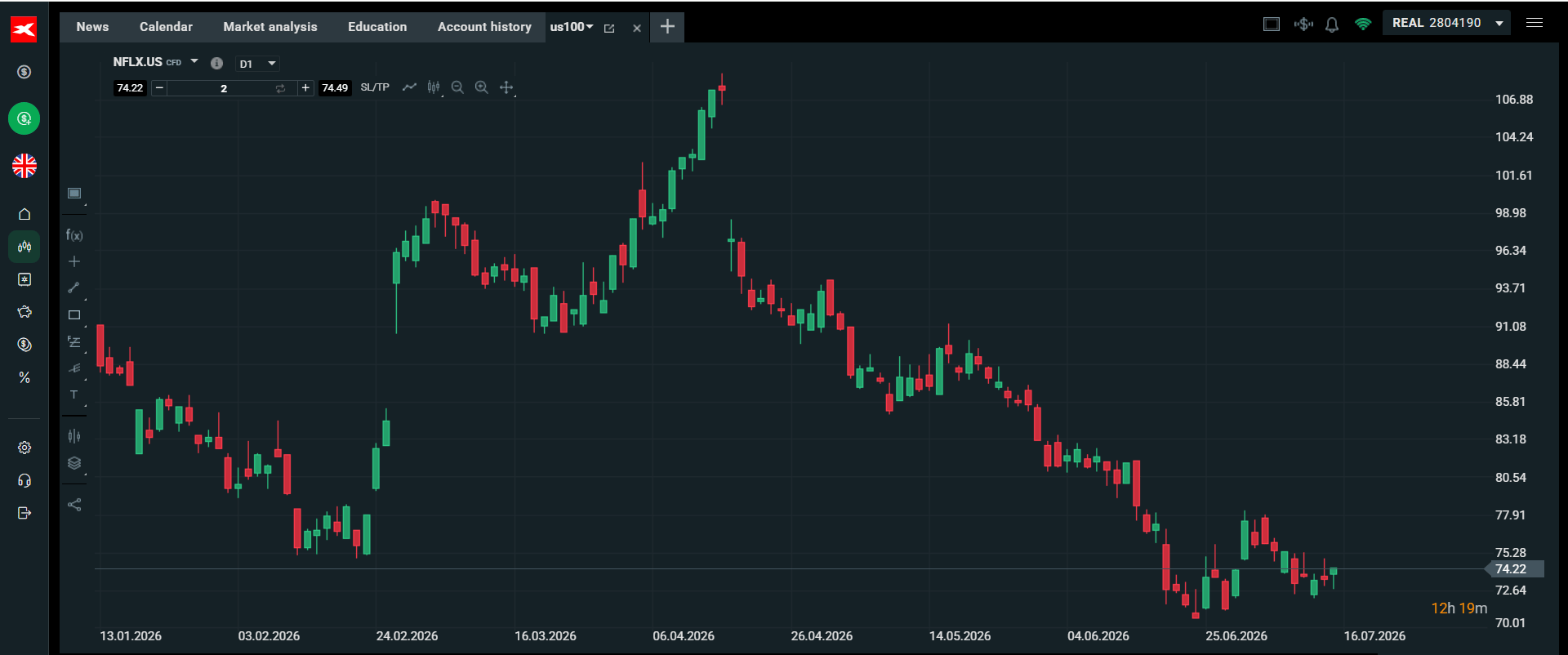
The other stock to watch today is Netflix. It reported Q2 earnings last night, and even though it reported revenues of $12.56bn, the stock sunk in post market trading. It is currently lower by 9% in the pre-market. Traders are digesting news that forward guidance was weaker than expected. This could be described as Netflix’s ‘naturally maturing growth profile’, after all, the streaming giant is 28 years old.
It is still a powerhouse, and the world’s largest streamer, although competition is ramping up. Investors are not impressed by Netflix’s big push into advertising and video games. This seems like a move back towards the legacy TV model, and far from the innovative tech giant that Netflix was once heralded as. However, one area where they are powering ahead is AI. The company said that the use of generative AI was increasing, particularly in post-production, and it had been used in over 300 titles to date. Eventually this may reduce Netflix’s content costs, but for now, Netflix also increased its content budget for this year to $20bn, which includes original programming, live events and podcasts.
Netflix’s share price is already lower by 21% so far this year and is already in bear market territory. However, last night’s results suggest that the sell off is not over yet. Usually Netflix is seen as the start of tech earnings season, this market reaction is not a good omen.
The search for safe havens
There are safe havens in this sell-off. Sovereign bonds are rising, and yields are falling on Friday. Gold is back above $4,000 per ounce, and the oil price is also higher by more than 1% as US/ Iran attacks extend into the sixth day. From a stock perspective, the rotation out of chip stocks is boosting demand for consumer staples, healthcare and real estate. This is boosting the attractiveness of the FTSE100, which has a heavy weighting of defensive sectors. Vodafone, BAT, Severn Trent and the National Grid are all leading the UK’s index higher today, and we expect it to outperform for as long as the chip stock sell-off lasts.
Overall, the market thought that Iran/ US tensions would stoke volatility. While the geopolitical backdrop is important, it’s the chip stock sell off that is dominating markets this week, and it still shows no sign of letting up.
Chart 1: Netflix
Author

Kathleen Brooks
XTB UK
Kathleen has nearly 15 years’ experience working with some of the leading retail trading and investment companies in the City of London.

















