|

Neither China nor India: This is the country’s central bank that has bought more Gold this year

  • The National Bank of Poland continued to add to its Gold reserves in April, becoming the top buyer among central banks so far this year.
  • Globally, central banks resumed net purchases in April after recording net sales seen a month earlier.
  • Gold prices remain subdued despite continued demand from central banks due to elevated global bond yields.

Poland’s central bank was the top Gold buyer in April among its peers, consolidating its position as one of the world’s most active sovereigns that accumulate the precious metal.

The bank bought 14 tonnes of Gold in the month, bringing the country’s year-to-date purchases to 45 tonnes, according to the most recent data published by the World Gold Council (WGC). 

Poland’s central bank Gold purchases so far this year have exceeded those of Uzbekistan and China, the second and third in the ranking, respectively.
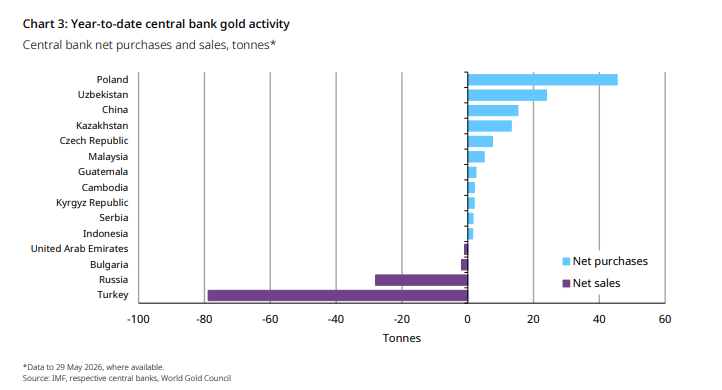
The National Bank of Poland’s Gold holdings are at 595 tonnes, about 30% of its total reserves. The bank has doubled down its bet on the precious metal as a geopolitical hedge due to increased uncertainty.  

Data from the WGC shows that global central banks resumed net Gold purchases in April, rebounding from the net sales reported in March. Back then, the immediate economic fallout from the Iran war forced some sovereigns in emerging markets to offload Gold to protect their currencies.
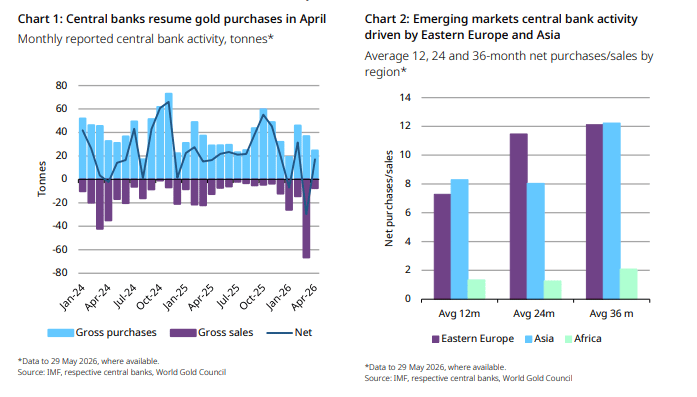
Central bank buying has been a key driver of Gold’s rally, which saw the metal almost double in price in 2025. The pace of purchases jumped significantly in 2022, after Russia’s foreign reserves were immobilized following its invasion of Ukraine.

Gold touched an all-time high of around $5,600 per troy ounce in January but has fallen about 23% since then, trading at around $4,300. 

Gold’s most recent correction, which has driven its price below its 200-day Simple Moving Average since October 2023, has been triggered by a surprisingly strong US jobs report for May, which prompted markets to price in upcoming interest-rate hikes by the Federal Reserve. As Gold doesn’t yield interest, investors have fled to other interest-bearing assets such as bonds.

Author

Valeria Bednarik

Valeria Bednarik was born and lives in Buenos Aires, Argentina. Her passion for math and numbers pushed her into studying economics in her younger years.


More from Valeria Bednarik
Share:

Editor's Picks

AUD/USD consolidates above 0.7000; remains close to monthly top

AUD/USD holds steady above 0.7000 during the Asian session on Friday, trading just below the previous day's monthly low amid diverging forces. A hawkish RBA continues to support the Aussie, while the recent decline in US bond yields keeps the US Dollar depressed near a three-week low. However, oil-driven inflation fears reinforce Fed hike bets, which, along with geopolitical risks, could benefit the safe-haven buck and cap the currency pair.

USD/JPY bounces off one-month low; climbs to 157.00 amid reviving USD demand

USD/JPY rebounds from the 156.00 neighborhood, or a one-month low touched during Friday’s Asian session, with bulls looking to extend momentum beyond 157.00 amid the emergence of some US Dollar buying. Meanwhile, Japan's National CPI rose to a nine-month peak and reaffirmed BoJ rate-hike bets, which could support the Japanese Yen and cap gains for the currency pair.

Gold treads water around $4,000

Gold prices maintain its offered stance in place at the end of the week, hovering around the key $4,000 threshold per troy ounce. The persistent selling bias in the precious metal comes amid decent gains in the US Dollar and an acceptable rebound in US Treasury yields across the curve, all alongside further upside traction in crude oil prices.

Crypto Today: Bitcoin holds the 50-day EMA as Ethereum and XRP face structural resistance

Bitcoin gradually ticks up on Friday, trading above $81,000. The Crypto King has recently defended structural support near $80,000, reinforcing the prevailing bullish outlook. Ethereum similarly edges higher above $2,400, while Ripple trades above $1.32 after testing support around $1.30.

The French bond panic is overdone. Here's what the market is misreading 

France's 10-year government bond yield has climbed above 5%, reigniting fears of a sovereign debt crisis in the Eurozone. With public debt exceeding €3.5 trillion, persistent budget deficits and a fragmented political landscape, investors are increasingly questioning the French government's ability to stabilize its finances.

What November 3 means for the Fed's rate path and the US Dollar

The USD faces a decisive period ahead of the November 3 midterm elections. While markets anticipate another interest rate increase from the Fed in December, the battle for control of Congress could reshape fiscal policy expectations and, indirectly, the path of US monetary policy in 2027.















