Breaking: UoM Consumer Sentiment Index edges lower to 55 in October vs 54.2 forecast

Consumer confidence in the United States (US) deteriorated slightly in early October, with the University of Michigan's Consumer Sentiment Index edging lower to 55 in its preliminary estimate from 55.1 in September. This print came in better than the market expectation of 54.2.
Other details of the publication showed that the Current Conditions Index improved to 61 from 60.4, while the Expectations Index retreated to 51.2 from 51.7.
Finally, the 1-year Consumer Inflation Expectation ticked down to 4.6% from 4.7% in September, and the 5-year Consumer Inflation Expectation remained unchanged at 3.7%.
Market reaction to UoM Consumer Sentiment Index data
This report failed to trigger a noticeable reaction. At the time of press, the US Dollar Index was down 0.08% on the day at 99.30.
US Dollar Price This week
The table below shows the percentage change of US Dollar (USD) against listed major currencies this week. US Dollar was the strongest against the Japanese Yen.
| USD | EUR | GBP | JPY | CAD | AUD | NZD | CHF | |
|---|---|---|---|---|---|---|---|---|
| USD | 1.30% | 1.25% | 2.11% | 0.27% | 0.60% | 1.25% | 1.13% | |
| EUR | -1.30% | -0.15% | 0.71% | -1.05% | -0.72% | -0.09% | -0.20% | |
| GBP | -1.25% | 0.15% | 0.97% | -0.90% | -0.57% | 0.06% | -0.04% | |
| JPY | -2.11% | -0.71% | -0.97% | -1.76% | -1.52% | -0.91% | -1.00% | |
| CAD | -0.27% | 1.05% | 0.90% | 1.76% | 0.37% | 0.98% | 0.86% | |
| AUD | -0.60% | 0.72% | 0.57% | 1.52% | -0.37% | 0.64% | 0.53% | |
| NZD | -1.25% | 0.09% | -0.06% | 0.91% | -0.98% | -0.64% | -0.11% | |
| CHF | -1.13% | 0.20% | 0.04% | 1.00% | -0.86% | -0.53% | 0.11% |
The heat map shows percentage changes of major currencies against each other. The base currency is picked from the left column, while the quote currency is picked from the top row. For example, if you pick the US Dollar from the left column and move along the horizontal line to the Japanese Yen, the percentage change displayed in the box will represent USD (base)/JPY (quote).
This section below was published as a preview of the University of Michigan's (UoM) Consumer Sentiment Index at 06:00 GMT.
- October’s preliminary Michigan Consumer Sentiment Index is forecast to have fallen to 54.2 from 55.1 in September.
- US consumers are likely to maintain a pessimistic view amid the deteriorating labour market.
- The negative impact on the US Dollar is likely to be offset by safe-haven demand.
In the absence of the US federal government’s data releases due to the shutdown, the preliminary figures of its monthly Consumer Confidence Index, released by the University of Michigan (UoM), are expected to gain extraordinary relevance on Friday. This survey covers US consumers’ views on their personal finances, business conditions, and purchasing plans, and is released together with the UoM Consumer Expectations Index and the UoM Consumer Inflation Expectations.
Consumption is a key contributor to the US Gross Domestic Product (GDP). In that sense, the UoM Consumer Sentiment Index, together with the Inflation Expectations, has a solid reputation as a forward-looking indicator for US economic trends, and its release tends to have a significant impact on US Dollar (USD) crosses.
Regarding October’s preliminary reading, the UoM Consumer Sentiment is expected to reveal a further deterioration of consumers’ confidence. The market consensus points to a decline to 54.2, from the 55.1 level seen in September
What to expect from October’s UoM Consumer Sentiment Index report?
October’s Consumer Sentiment report comes amid an economic data blackout from the US government, as the shutdown extends for a second week, and traders come to terms with the fact that, this time, it will be a prolonged one.
The release of the key Nonfarm Payrolls (NFP) employment report has been delayed sine die. Still, recent job data has added to evidence that the labour market keeps deteriorating fast. September’s Automated Data Processing (ADP) Employment Change report shocked investors with the largest decline in net employment in more than two years. ADP reported a 32,000 drop in private payrolls, against market expectations of a 50,000 gain, and revised August’s data to a 3,000 decline from the 54,000 increase previously estimated.
The Challenger Job Cuts, another employment gauge, revealed lower layoffs in September, but the report also stated that hiring plans by US businesses fell to their lowest levels in 16 years, confirming the trend shown by previous employment releases.
Pessimism about the job outlook was signalled as a major reason behind the deterioration of consumer sentiment in previous months, and the situation does not seem to have improved in the meantime. On the contrary, US President Donald Trump’s vow of massive layoffs in the public sector, if government funding is not restored, threatens to further undermine labor market conditions.
Against this backdrop, Consumer Sentiment is expected to have extended its decline to a five-month low of 54.2 in October, from 55.1 in September. These numbers highlight a continuation of a downward spiral in US consumers’ mindset, which would draw the Index to levels 25% below the average in the last quarter of 2024.
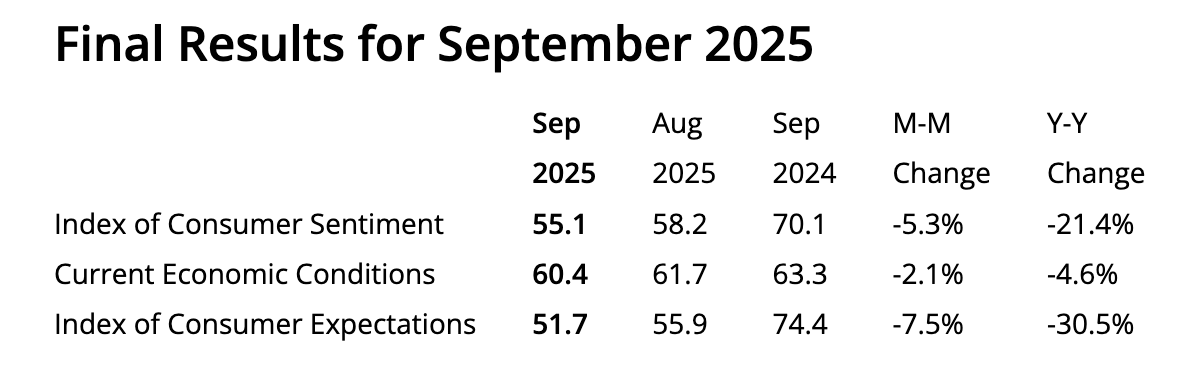
Source: University of Michigan
These figures are not particularly supportive for the US Dollar, but the negative impact on the Greenback is likely to be subdued this time due to safe-haven demand amid geopolitical and political uncertainties
When will the UoM Consumer Sentiment Index be released, and how could it affect EUR/USD?
The University of Michigan will release its Consumer Sentiment Index, together with the Consumer Inflation Expectations survey, on Friday at 14:00 GMT. The market expects the consumer sentiment to have deteriorated further in October. The negative impact on the US Dollar, however, is likely to be muted.
A quarter-point interest rate cut by the Federal Reserve in October is practically written in stone, and, from that point of view, Friday’s reading is unlikely to dent the US Dollar’s strength unless there is a sharp negative deviation from the market consensus. Investors’ concerns about the consequences of a prolonged US shutdown and Euro weakness amid France’s political uncertainty are likely to offset a potential decline in US consumer confidence,
EUR/USD 4-hour Chart
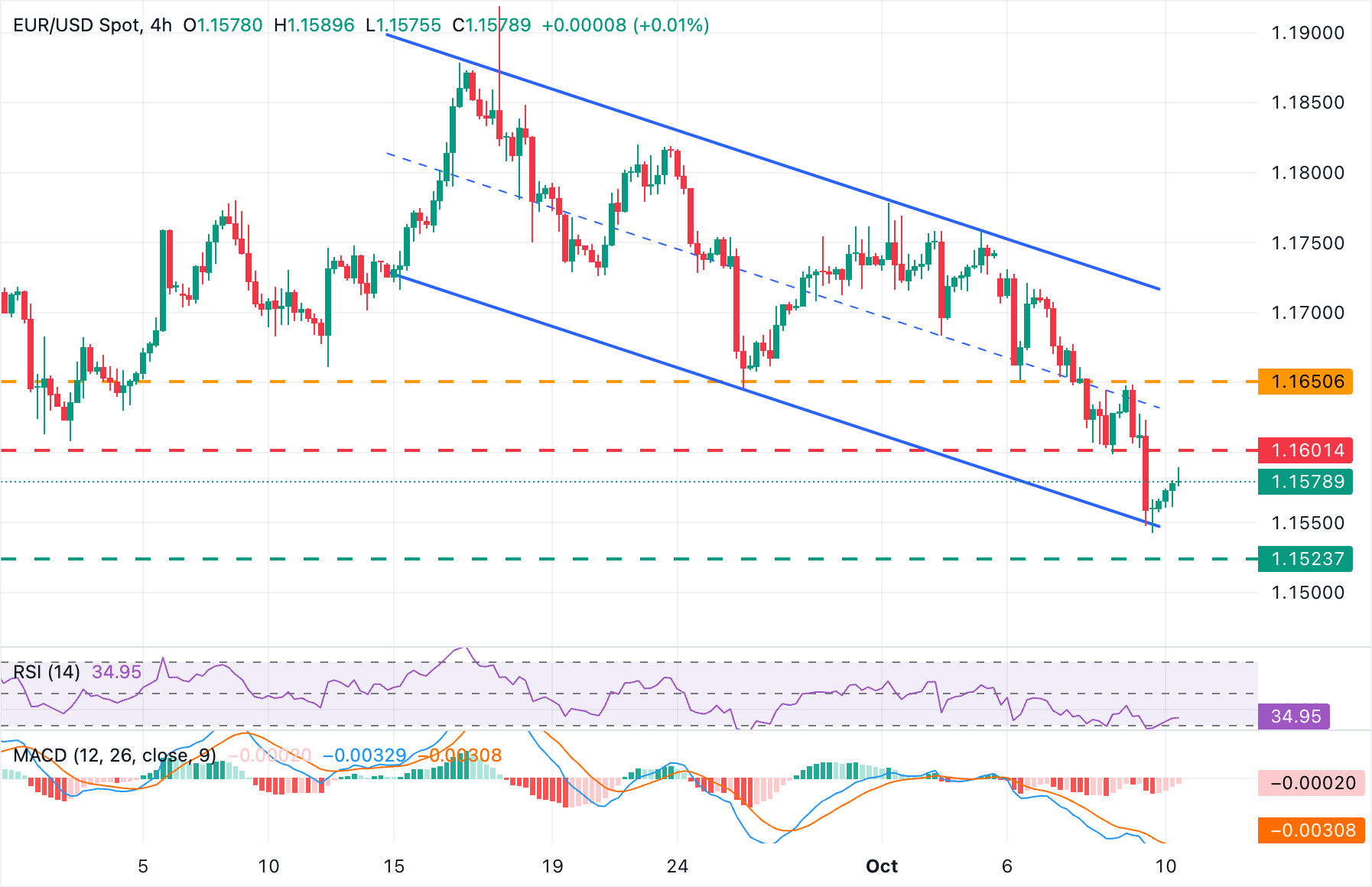
Regarding the EUR/USD, Guillermo Alcalá, FX Analyst at FXStreet, sees the pair under pressure after breaching the support area near 1.1600: “EUR/USD broke a key support area at 1.1600 on Thursday, dropping to fresh two-month lows and highlighting the strong bearish momentum. Technical indicators are pointing lower, with the Relative Strength Index (RSI) on the 4-hour chart low but still above oversold levels. In these conditions, rallies look likely to attract sellers.”
According to Alcalá, the pair needs to return above 1.1600 to avert further depreciation: "Failure to return above the 1.1600 level is likely to lead to a retest of the descending channel bottom, from mid-September highs, visible on the 4-hour chart, and Thursday's low near 1.1540. Further down, the August 5 low, near 1.1525, would be the last support area ahead of the August 1 low, near 1.1395."
Author

FXStreet Team
FXStreet
Composed of a group of economic journalists and FX experts, the FXStreet content team produces and oversees all content published on FXStreet. It provides a purely journalistic approach to the Forex market.














