Mexican Peso faces pressure as IMF downward revised GDP growth
- Mexican Peso collapses as USD/MXN climbs past 19.50 after bouncing from daily lows.
- IMF predicts Mexico's economy will grow 1.5% in 2024, further deceleration to 1.3% in 2025.
- San Francisco Fed’s Mary Daly hints at possible rate cuts, boosting USD amid a mixed US economic outlook.

The Mexican Peso lost over 1% against the US Dollar during the North American session as the Greenback strengthened on risk aversion. A scarce economic docket in Mexico left traders leaning on US data, which was mixed as inflation expectations edged higher. The USD/MXN trades at 19.66 after bouncing off daily lows of 19.33.
Market sentiment is downbeat and weighed on risk-sensitive currencies like the Peso. In the meantime, the International Monetary Fund (IMF) revealed that Mexico’s economy is expected to grow by 1.5% in 2024, citing capacity constraints and tight monetary policy.
Next year, the economy is foreseen decelerating further to 1.3%, adding that inflation is expected to get closes to the Bank of Mexico’s (Banxico) 3% goal. The Institute said that “inflation risks remain on the upside” and warned that an economic slowdown in the US, geopolitics, and unforeseen impacts from the judicial reform could impact Mexico’s economy.
Across the border, the New York Empire State Manufacturing Index posted a dismal print, while the latest New York Fed Survey for Inflation Expectations in September remained unchanged at 3%.
The USD/MXN reacted to the upside on remarks by San Francisco Fed President Mary Daly, which sponsored a leg-up toward the current exchange rate. She said the Fed’s dual mandate risks are now in balance and that the labor market is not a source of inflation.
Daly added that she’s cautiously optimistic about the economic outlook and foresees one or two rate cuts “if forecasts are met.”
Ahead in the week, the US economic docket will feature the Balance of Trade on Wednesday. On Thursday, a busy schedule would be led by the release of Retail Sales, Initial Jobless Claims, Industrial Production and further Fed speakers.
Daily digest market movers: Mexican Peso weakens as USD/MXN surges
- Mexico’s deterioration in Consumer Confidence and the IMF forecast weighed on the Mexican Peso, which is falling to two-week lows as USD/MXN rises to 19.67.
- The IMF said that a recent judicial reform creates "important uncertainties about the effectiveness of contract enforcement and the predictability of the rule of law."
- Banxico’s survey revealed that economists estimate the central bank will lower rates by 50 bps for the rest of the year. The USD/MXN exchange rate is projected to end at 19.69, and the economy is expected to grow by 1.45% in 2024.
- The New York Empire State Manufacturing Index for October, which was expected to drop from 11.3 to 2.3, came in at -11.90.
- Data from the Chicago Board of Trade via the December fed funds rate futures contract shows investors estimate 49 bps of Fed easing by the end of the year.
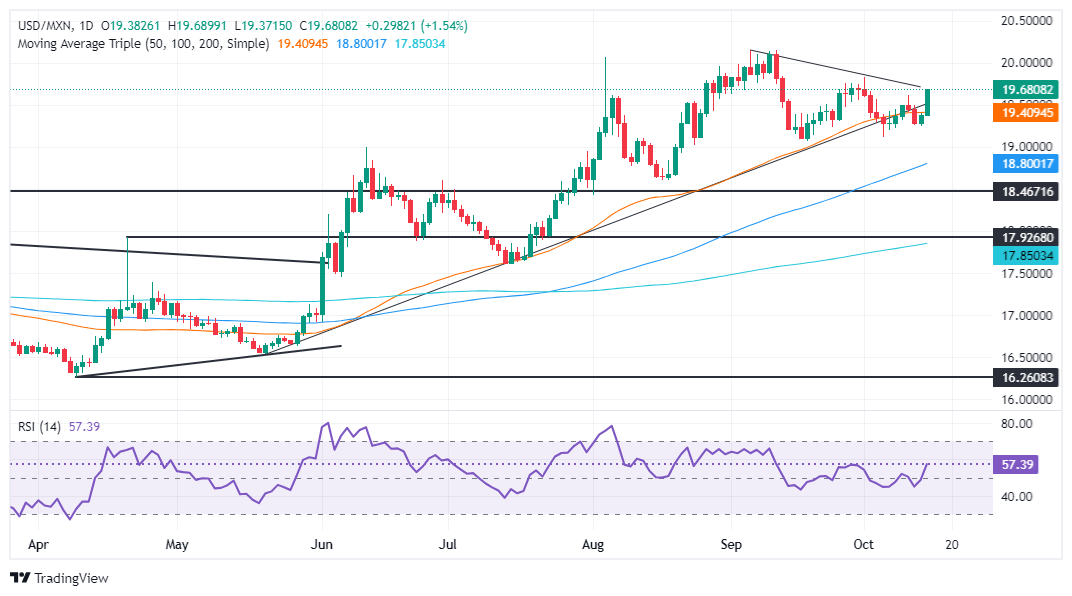
USD/MXN technical outlook: Mexican Peso plummets as USD/MXN eyes 19.70
The USD/MXN uptrend has extended for the second straight day, with buyers eyeing higher prices. Momentum favors buyers, as seen in the Relative Strength Index (RSI).
Given the backdrop, the USD/MXN's next resistance would be the October 1 high at 19.82. Once surpassed, the next stop would be the 20.00 figure, followed by the YTD peak of 20.22.
Conversely, if USD/MXN tumbles below the October 10 daily high of 19.61, up next will be the October 4 swing low of 19.10 before testing 19.00. Once broken, the next support would be the 100-day SMA at 18.78.
Mexican Peso FAQs
The Mexican Peso (MXN) is the most traded currency among its Latin American peers. Its value is broadly determined by the performance of the Mexican economy, the country’s central bank’s policy, the amount of foreign investment in the country and even the levels of remittances sent by Mexicans who live abroad, particularly in the United States. Geopolitical trends can also move MXN: for example, the process of nearshoring – or the decision by some firms to relocate manufacturing capacity and supply chains closer to their home countries – is also seen as a catalyst for the Mexican currency as the country is considered a key manufacturing hub in the American continent. Another catalyst for MXN is Oil prices as Mexico is a key exporter of the commodity.
The main objective of Mexico’s central bank, also known as Banxico, is to maintain inflation at low and stable levels (at or close to its target of 3%, the midpoint in a tolerance band of between 2% and 4%). To this end, the bank sets an appropriate level of interest rates. When inflation is too high, Banxico will attempt to tame it by raising interest rates, making it more expensive for households and businesses to borrow money, thus cooling demand and the overall economy. Higher interest rates are generally positive for the Mexican Peso (MXN) as they lead to higher yields, making the country a more attractive place for investors. On the contrary, lower interest rates tend to weaken MXN.
Macroeconomic data releases are key to assess the state of the economy and can have an impact on the Mexican Peso (MXN) valuation. A strong Mexican economy, based on high economic growth, low unemployment and high confidence is good for MXN. Not only does it attract more foreign investment but it may encourage the Bank of Mexico (Banxico) to increase interest rates, particularly if this strength comes together with elevated inflation. However, if economic data is weak, MXN is likely to depreciate.
As an emerging-market currency, the Mexican Peso (MXN) tends to strive during risk-on periods, or when investors perceive that broader market risks are low and thus are eager to engage with investments that carry a higher risk. Conversely, MXN tends to weaken at times of market turbulence or economic uncertainty as investors tend to sell higher-risk assets and flee to the more-stable safe havens.
Author

Christian Borjon Valencia
FXStreet
Markets analyst, news editor, and trading instructor with over 14 years of experience across FX, commodities, US equity indices, and global macro markets.