Mexican Peso rebounds after US election results, inflation data eyed
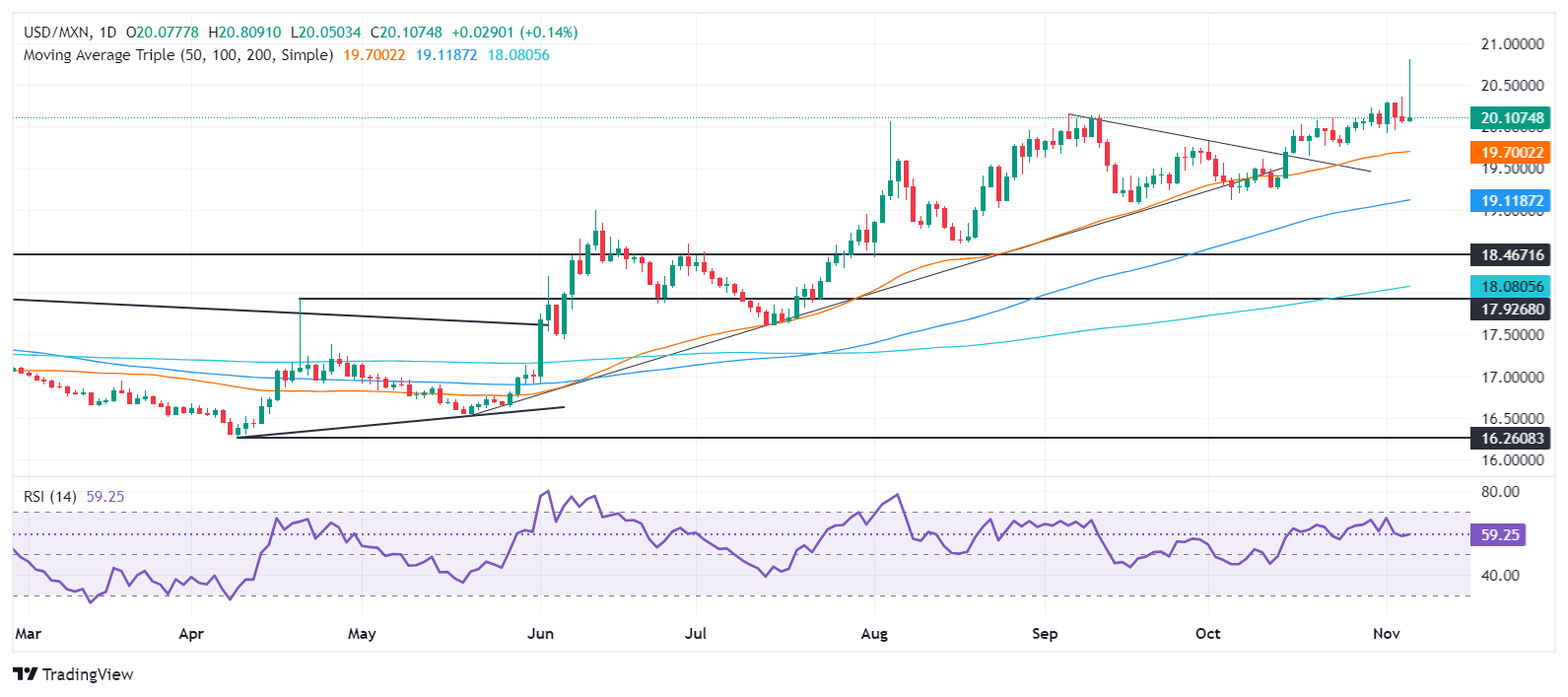
- Mexican Peso recovers but remains volatile; USD/MXN surged to yearly high of 20.80 before retreating.
- Trump’s tariff threats keep Mexican markets on edge; judicial reform ruling threatens the state of law.
- Fed's anticipated rate cut may further influence USD/MXN direction in the coming days.

The Mexican Peso recovers some ground against the Greenback after hitting a two-year low. Yet it treads water as investors digest former President Donald Trump’s victory in the US election. At the time of writing, the USD/MXN trades at 20.09, virtually unchanged.
Mexico’s economic docket remained absent, though the day's highlight was the Supreme Court's discussion of Judge Juan Luis González Alcántara Carranca's proposal to invalidate some parts of the judicial reform bill approved by the ruling party, Morena, at the Congress.
The Supreme Court discussed the Gonzalez project and needed at least eight votes for its approval. Nevertheless, seven magistrates voted in favor, and four voted against it. This means the judicial reform approved in September remains in force, and the first election of judges and magistrates will be in June 2025.
Aside from this, the US presidential election overshadowed most news around the financial markets. The Republican candidate, former President Donald Trump, won the 2024 election with at least 277 Electoral College votes and led the red sweep, with the Republicans obtaining the majority in the Senate and possibly in the House of Representatives.
The USD/MXN remained volatile during the session, which began with the exotic pair rallying to new yearly highs of 20.80 before retreating somewhat to current exchange rates. Trump’s harsh rhetoric against Mexico keeps Peso holders nervous. He stated that he would impose 25% tariffs on all imports from Mexico if the government failed to dismantle drug cartels.
The US economic docket remains empty during the day. The Federal Reserve (Fed) began its two-day meeting that would end on Thursday. The Fed is expected to lower rates by 25 basis points (bps) to the 4.50%-4.75% range. After that Fed Chair Jerome Powell would host his usual press conference.
Daily digest market movers: Mexican Peso falls following US election results
- The USD/MXN remains adrift from political turmoil in Mexico after the approval of the controversial judiciary reform.
- Analysts see Mexico’s inflation moderating in October, according to Reuters.
- They project the Consumer Price Index (CPI) in October at 4.73% above the prior month’s 4.58% YoY. However, core CPI is expected to decrease for the 21st straight month to 3.85% from 3.91%.
- On Tuesday, the US economic schedule revealed that the Balance of Trade deficit widened while business activity cooled slightly.
- S&P Global revealed that October’s service activity dipped, while the Institute for Supply Management’s (ISM) Services PMI improved for the same period.
- Data from the Chicago Board of Trade, via the December fed funds rate futures contract, shows investors estimate 49 bps of Fed easing by the end of the year.
USD/MXN technical outlook: Mexican Peso remains on the defensive despite trimming earlier losses
The USD/MXN uptrend remains in play despite the pair trimming some of its earlier gains. However, buyers need to reclaim the 20.50 psychological figure if they would like to re-test two-year highs of 20.80. In that outcome, and once that resistance level is cleared, the next stop would be 21.00. A breach of the latter will expose 22.00, followed by the November 26 swing high of 22.15.
Mexican Peso FAQs
The Mexican Peso (MXN) is the most traded currency among its Latin American peers. Its value is broadly determined by the performance of the Mexican economy, the country’s central bank’s policy, the amount of foreign investment in the country and even the levels of remittances sent by Mexicans who live abroad, particularly in the United States. Geopolitical trends can also move MXN: for example, the process of nearshoring – or the decision by some firms to relocate manufacturing capacity and supply chains closer to their home countries – is also seen as a catalyst for the Mexican currency as the country is considered a key manufacturing hub in the American continent. Another catalyst for MXN is Oil prices as Mexico is a key exporter of the commodity.
The main objective of Mexico’s central bank, also known as Banxico, is to maintain inflation at low and stable levels (at or close to its target of 3%, the midpoint in a tolerance band of between 2% and 4%). To this end, the bank sets an appropriate level of interest rates. When inflation is too high, Banxico will attempt to tame it by raising interest rates, making it more expensive for households and businesses to borrow money, thus cooling demand and the overall economy. Higher interest rates are generally positive for the Mexican Peso (MXN) as they lead to higher yields, making the country a more attractive place for investors. On the contrary, lower interest rates tend to weaken MXN.
Macroeconomic data releases are key to assess the state of the economy and can have an impact on the Mexican Peso (MXN) valuation. A strong Mexican economy, based on high economic growth, low unemployment and high confidence is good for MXN. Not only does it attract more foreign investment but it may encourage the Bank of Mexico (Banxico) to increase interest rates, particularly if this strength comes together with elevated inflation. However, if economic data is weak, MXN is likely to depreciate.
As an emerging-market currency, the Mexican Peso (MXN) tends to strive during risk-on periods, or when investors perceive that broader market risks are low and thus are eager to engage with investments that carry a higher risk. Conversely, MXN tends to weaken at times of market turbulence or economic uncertainty as investors tend to sell higher-risk assets and flee to the more-stable safe havens.
Author

Christian Borjon Valencia
FXStreet
Markets analyst, news editor, and trading instructor with over 14 years of experience across FX, commodities, US equity indices, and global macro markets.