Mexican Peso treads water as Trump tariffs coming on February 1
Most recent article: Mexican Peso rallies as US-Mexico tariff pause eases tensions
- Mexican Peso erased gains of 0.61% and turns negatively as Trump's threat of 25% tariffs would be enacted.
- The White House denied Reuters’ report about US delaying tariffs implementation to March 1.
- Mixed US economic indicators and Fed commentary maintain cautious market sentiment.
The Mexican Peso (MXN) erases some of its earlier gains and losses ground against the US Dollar (USD), down a minimal 0.07% on Friday, extending its drop after losing more than 1% on Thursday. The tariff trade continues to boost the Greenback, after The White House confirmed that President Donald Trump will enact 25% tariffs on Canada and Mexico, beginning on February 1. The USD/MXN trades at 20.72 after hitting a daily low of 20.45.
Recently, US Press Secretary Karoline Leavitt emphasized that tariffs of 25% would be enacted on Canada and Mexico on February 1, sad that previous reports were wrong. She also added that Washington would apply 10% duties on goods imported from China.
Following the report, the Greenback advanced and the Mexican Peso tumbled, as the USD/MXN soared above 20.70 and retested the daily high at 20.74. below 20.50.
A Reuters report, citing unnamed sources, indicated that the US plans to impose tariffs until March 1. The article noted that former President Donald Trump is expected to announce the tariffs, which will include a process for countries to request exemptions on specific imports.
Aside from this, the latest US inflation report and the Federal Reserve’s (Fed) preferred inflation gauge, the Core Personal Consumption Expenditures (PCE) Price Index, increased in December as expected, exceeding November’s reading. In the twelve months to December, Core PCE remained unchanged compared to the latest figures.
The data comes after the US GDP report for the last quarter was weaker than expected and following the Fed’s last monetary policy meeting.
Of note, the Fed parade has begun, as Governor Michelle Bowman and Chicago’s Fed President Austan Goolsbee crossed the newswires.
Daily digest market movers: Mexican Peso drops as Washington says Reuters article is incorrect
- A Reuters exclusive report revealed that US President Trump is expected to announce new tariffs against Canada and Mexico that will begin March 1.
- “The sources, who asked not to be named because they are not authorized to speak publicly on the matter, said they did not have details on a final tariff rate, but noted Trump has consistently said that he plans to impose a 25% tariff on imports from the two countries on Saturday,” said the Reuters report.
- JP Morgan revealed via Reuters that the Mexican Peso could depreciate 11.8% if the US imposes 25% tariffs on Saturday. The US bank said that the “base case” is for tariffs to be postponed.
- The U.S. Core PCE rose by 2.8% YoY in December, in line with expectations, while monthly inflation increased by 0.2%, up from November’s 0.1%.
- Fed Governor Michelle Bowman maintained a hawkish stance, boosting the U.S. dollar by emphasizing that inflation risks remain skewed to the upside. While she did not rule out rate cuts, she stressed they would be data-dependent and likely gradual.
- Chicago Fed President Austan Goolsbee expressed confidence in the December inflation report, stating that inflation is progressing toward the 2% target.
- Money market futures now price in 50 basis points of Fed rate cuts in 2025, with traders anticipating the first move in June.
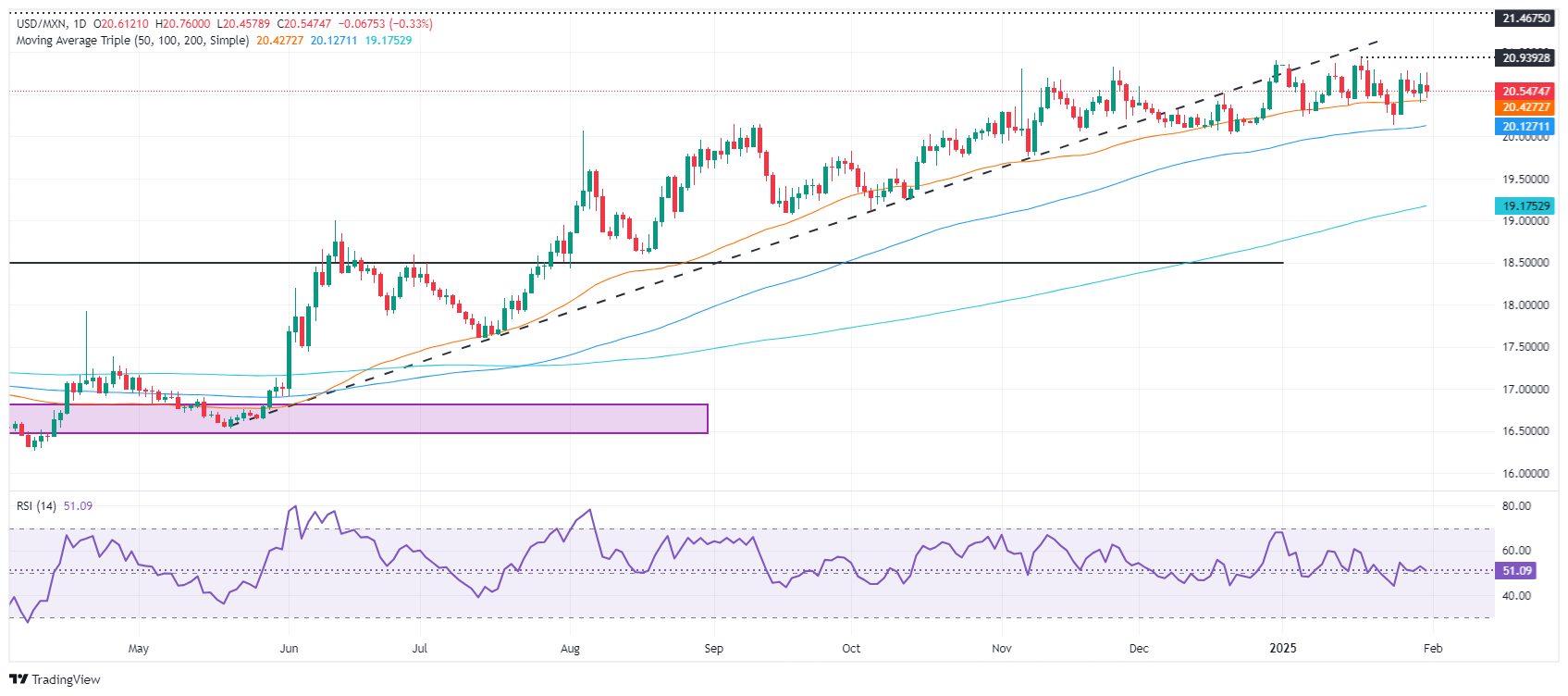
Technical outlook: Mexican Peso appreciates but clashes with support at 20.50
USD/MXN uptrend is intact despite the ongoing pullback following Reuters source's tariffs news on Mexico. The exotic pair dupped to 20.45 shy of challenging the 50-day Simple Moving Average (SMA) of 20.40 but jumped a sign that sellers were outnumbered by buyers, opening the door to reclaim 20.50.
On further strength, the USD/MXN's next resistance would be the January 28 swing high of 20.77. If that level is taken out, the next resistance would be 21.00, followed by the March 8, 2022, high at 21.46. Conversely, if the exotic pair tumbles below the 50-day SMA, further downside is seen at the 100-day SMA at 20.08, before the 20.00 figure.
Banxico FAQs
The Bank of Mexico, also known as Banxico, is the country’s central bank. Its mission is to preserve the value of Mexico’s currency, the Mexican Peso (MXN), and to set the monetary policy. To this end, its main objective is to maintain low and stable inflation within target levels – at or close to its target of 3%, the midpoint in a tolerance band of between 2% and 4%.
The main tool of the Banxico to guide monetary policy is by setting interest rates. When inflation is above target, the bank will attempt to tame it by raising rates, making it more expensive for households and businesses to borrow money and thus cooling the economy. Higher interest rates are generally positive for the Mexican Peso (MXN) as they lead to higher yields, making the country a more attractive place for investors. On the contrary, lower interest rates tend to weaken MXN. The rate differential with the USD, or how the Banxico is expected to set interest rates compared with the US Federal Reserve (Fed), is a key factor.
Banxico meets eight times a year, and its monetary policy is greatly influenced by decisions of the US Federal Reserve (Fed). Therefore, the central bank’s decision-making committee usually gathers a week after the Fed. In doing so, Banxico reacts and sometimes anticipates monetary policy measures set by the Federal Reserve. For example, after the Covid-19 pandemic, before the Fed raised rates, Banxico did it first in an attempt to diminish the chances of a substantial depreciation of the Mexican Peso (MXN) and to prevent capital outflows that could destabilize the country.
Author

Christian Borjon Valencia
FXStreet
Markets analyst, news editor, and trading instructor with over 14 years of experience across FX, commodities, US equity indices, and global macro markets.