Meta Platforms' share split, negative FCF, expanding capex lead NASDAQ lower
- Meta reports its first negative free cash flow in its public history as AI capex surges.
- Q3 earnings beat on the adjusted measure but missed on GAAP consensus.
- The NASDAQ sold off over 2% in response on Thursday.

Meta Platforms (META) beat Wall Street consensus for Q3 and hiked its revenue projection for the fourth quarter on Wednesday, but Thursday's market performance tells us that the market is queasy about the company's introduction of a new class of common stock and its massive jump in future spending commitments.
More important to some is the fact that the third quarter marked the first time in Meta's decade and a half as a public company that it posted negative free cash flow (FCF). It's not that Meta's business is shrinking by any measure, but instead the massive increase in AI data center spending is overshadowing CEO Mark Zuckerberg's growing profits.
The NASDAQ has shifted more than 2% lower in response to Meta's travails as several leading AI stocks shed weight. META stock tanked about 6% in Thursday's morning session.
Positive Meta's Q3 earnings overshadowed by $825 billion future spending
The parent of Facebook, Instagram and the Muse AI agent, Meta posted a beat on its top and bottom lines. The company confirmed adjusted earnings per share (EPS) of $7.40, which beat the analyst consensus of $6.80. Revenue jumped 26% YoY to $64.6 billion, beating consensus by $1.2 billion. And it shouldn't be lost on any shareholders that the company hiked Q4 revenue projections to an impressive range of $73 billion to $76 billion.
Still, Meta took a hefty but expected litigation charge of $9.9 billion related to its many child-safety lawsuits that pushed GAAP EPS to $3.83, a miss of $1.63 per share compared with Wall Street estimates.
But shareholders let out a figurative gasp when Meta hiked its estimate of future capex commitments to $825 billion, up from the $700 billion figure it issued in July. This figure combines off-balance-sheet spending commitments, largely for data center and related spending agreements that the company has made with suppliers and corporate partnerships through 2036.
This means that the 80% increase in AI infrastructure spending that Meta reported for Q3 wasn't a one-off but rather the new normal. That $34.9 billion in Q3 capex, largely for AI, outpaced the $32.8 billion in operating cash flow and led to $-2.1 billion in free cash flow in the quarter. This is the first time since the company went public in 2012 that it has issued negative free cash flow. FCF reached $10.6 billion in the same quarter a year earlier.
Meta said that full-year 2026 capex would finish the year between $135 billion and $145 billion, raising the lower end of the range by $5 billion. Zuckerberg said the heavy capex was necessary as the company's new Muse AI agent was “compute-intensive" enough that the company is not ready to roll it out to users outside the United States yet.
Meta issues new share class
Zuckerberg and company also surprised the market with a new share class, nonvoting Class C common stock. This procedure effectively serves as a 2-for-1 stock split, with every share of META Class A or Class B shares guaranteeing shareholders one new share of Class C stock sometime in January of next year when the arrangement is finalized.
The new structure helps Zuckerberg retain voting power over his company and would allow META to raise more equity capital to fund its AI rollout.
That is important to shareholders since Bloomberg reports that the company's five-year credit default swaps climbed about 9 basis points to above 119 basis points annually following the earnings release. That's the highest level for META bond insurance since the credit default swaps began trading one year ago.
Meta stock technical analysis
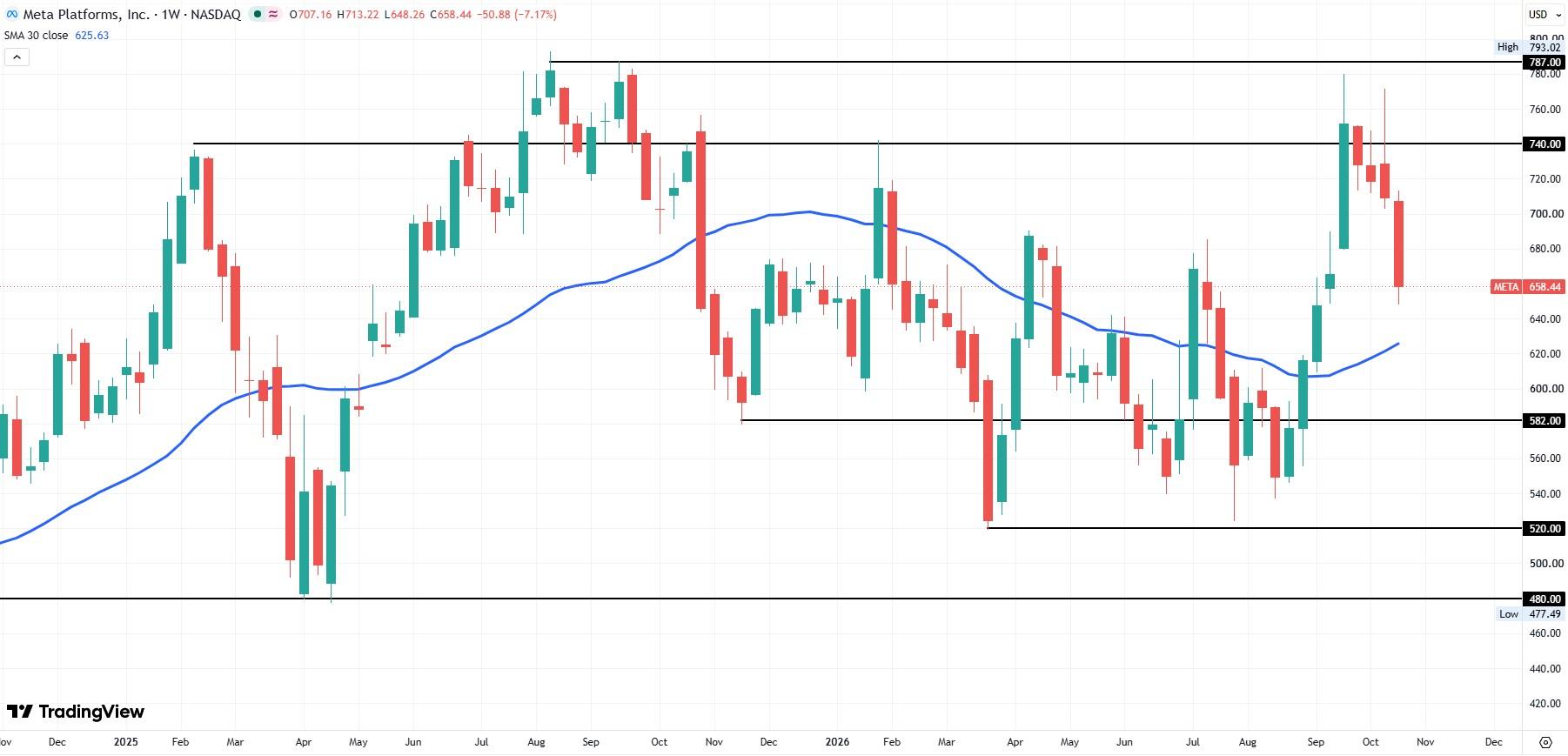
META shares are now trading well into correction territory following the Q3 release. Shares near $658 are trading about 15.5% off the September highs that were achieved on the back of Muse's rollout.
Ever a volatile stock, bulls looking for an entry might have to wait until META tags the 30-week Simple Moving Average (SMA), which now sits close to $625. Below that level lies the $582 support level that propped it up in November 2025. Additionally, there is further support in the $520 to $540 region that fortified the share price in March through the summer months of this year.
However, if the worries blow over quickly, the current $660 region that has acted as occasional resistance over the past year could flip into support as well.
Author

Clay Webster
FXStreet
Clay Webster grew up in the US outside Buffalo, New York and Lancaster, Pennsylvania. He began investing after college following the 2008 financial crisis.

















