Japanese Yen bears seem non-committed; USD/JPY remains below mid-155.00s
- The Japanese Yen attracts fresh sellers amid fading safe-haven demand.
- Worries about Trump’s trade tariffs seem to undermine the JPY further.
- The divergent BoJ-Fed expectations should help limit losses for the JPY.

The Japanese Yen (JPY) remains depressed through the early European session on Tuesday amid worries that Japan will also be an eventual target for US President Donald Trump's trade tariffs. Furthermore, US President Donald Trump's decision to delay plans to impose trade tariffs on Canada and Mexico dents demand for safe-haven assets, which further undermines the safe-haven JPY. This, along with the emergence of some US Dollar (USD) buying, assists the USD/JPY pair to hold above the 155.00 psychological mark.
Any meaningful JPY depreciation, however, seems limited amid bets that the Bank of Japan (BoJ) will hike rates further. Adding to this, the prospects for further policy easing by the Federal Reserve (Fed), which would result in a narrowing rate differential between Japan and the US, contribute to limiting losses for the JPY. Hence, it will be prudent to wait for strong follow-through selling before confirming that the USD/JPY pair has formed a near-term bottom and positioning for any meaningful appreciating move.
Japanese Yen bears refrain from placing aggressive bets amid divergent BoJ-Fed expectations
- Investors breathed a sigh of relief after US President Donald Trump agreed to delay 25% trade tariffs against Canada and Mexico by 30 days, undermining the safe-haven Japanese Yen.
- Japan's Prime Minister Shigeru Ishiba is set to meet with Trump later this week and their conversation may provide more hints about the risk of tariffs as Japan has a large trade surplus with the US.
- Japan's Finance Minister Katsunobu Kato said on Monday that the government intends to monitor the impact of Trump's new tariffs on its currency amid worries about the potential economic fallout.
- Bank of Japan's Summary of Opinions released on Monday showed board members agreed that it will be necessary to continue hiking interest rates if economic activity and prices remain on track.
- Moreover, a rise in core inflation in Japan's capital city Tokyo, by the fastest annual pace in nearly a year, keeps alive expectations for further interest rate hikes by the Bank of Japan.
- The Institute of Supply Management's (ISM) Manufacturing Purchasing Managers' Index climbed from 49.3 in the previous month to 50.9 in January, beating expectations for a reading of 49.8.
- Additionally, the Prices Paid Index—which measures inflation—rose to 54.9 from 52.5, while the Employment Index increased to 50.3 from 45.4, and the New Orders Index improved to 55.1.
- This comes on top of speculation that Trump's trade tariffs could push up inflation and give the Federal Reserve less impetus to cut interest rates further, which underpins the US Dollar.
- The view was echoed by comments from Chicago Fed President Austan Goolsbee, who warned that uncertainty over Trump’s policies could delay the central bank’s plans to cut interest rates.
- Separately, Atlanta Fed President Raphael Bostic noted on Monday that although the US labor market remains surprisingly resilient, tariff threats throw a wrench into outlook expectations.
- Meanwhile, Fed governor Michelle Bowman said on Friday that rate cuts are still expected this year but added that future moves should be cautious and gradual, with time to assess data.
- Traders now look forward to the US economic data – Job Openings and Labor Turnover Survey (JOLTS) and Factory Orders – for short-term opportunities later during the North American session.
USD/JPY pair needs to find acceptance above the 156.00 mark for bulls to retain near-term control
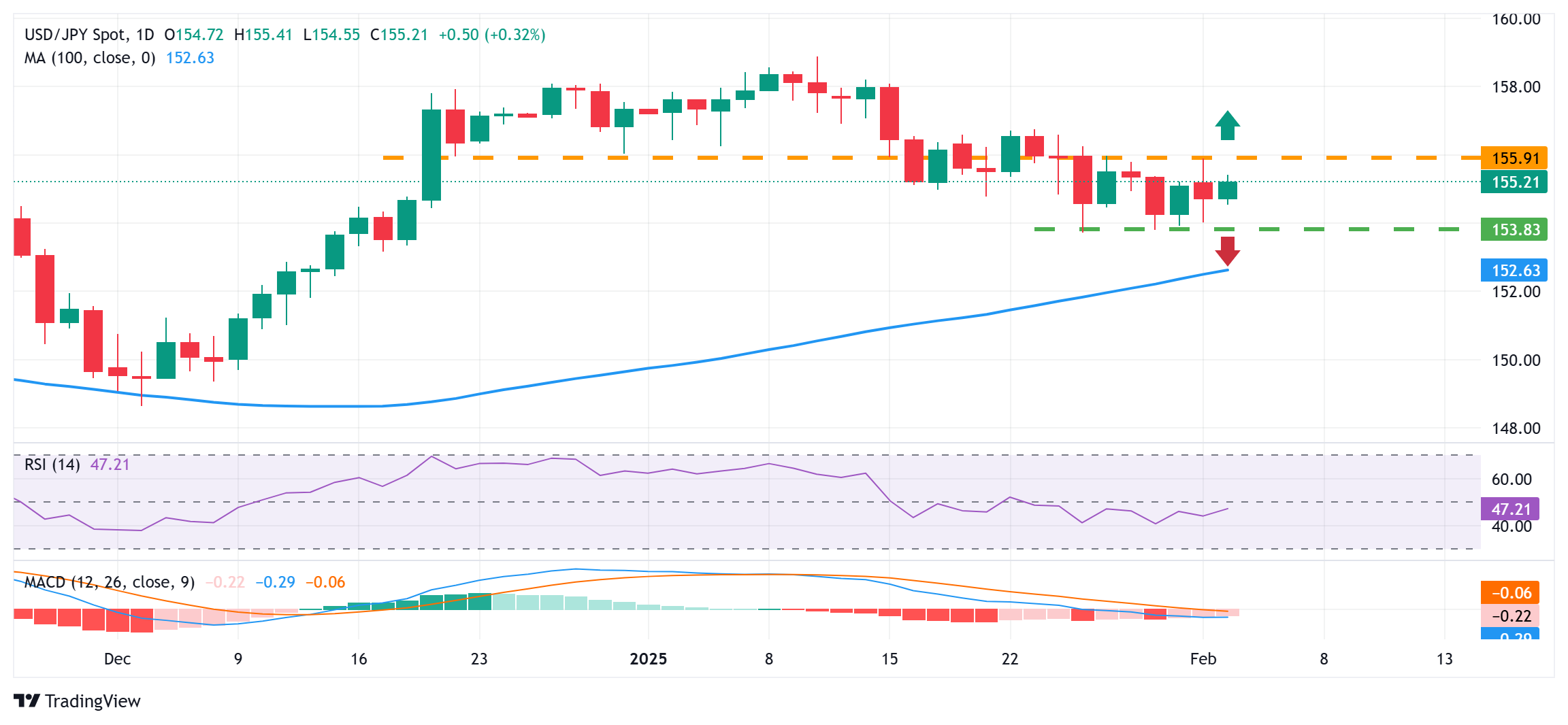
From a technical perspective, the USD/JPY pair might continue to confront stiff resistance near the 156.00 mark. This is closely followed by last week's swing high, around the 156.25 region, above which spot prices could climb to the 156.75 supply zone. Some follow-through buying, leading to subsequent strength beyond the 157.00 round figure, will shift the bias in favor of bullish traders and pave the way for a move towards reclaiming the 158.00 mark with some intermediate hurdle near the 157.50 area.
On the flip side, weakness below the 155.00 psychological mark now seems to find support near the 154.65 region ahead of the 154.30 area, the 154.00 round figure, and the 153.70 zone, or over a one-month low touched in January. A convincing break below the said support levels could make the USD/JPY pair vulnerable to accelerate the fall towards the 153.00 mark en route to the 152.60-152.55 region and the 152.30 area. The latter represents the 100-day Simple Moving Average (SMA) and should act as a strong base for spot prices.
Economic Indicator
JOLTS Job Openings
JOLTS Job Openings is a survey done by the US Bureau of Labor Statistics to help measure job vacancies. It collects data from employers including retailers, manufacturers and different offices each month.
Read more.Next release: Tue Feb 04, 2025 15:00
Frequency: Monthly
Consensus: 8M
Previous: 8.098M
Source: US Bureau of Labor Statistics
Author

Haresh Menghani
FXStreet
Haresh Menghani is a detail-oriented professional with 10+ years of extensive experience in analysing the global financial markets.