Japanese Yen remains under pressure against US Dollar, US CPI data eyed
- Japanese Yen edges down against the US Dollar ahead of the US inflation data for July.
- The US CPI data is expected to influence Fed interest rate expectations significantly.
- The Japanese Yen struggles to revive despite hawkish BoJ bets.

The Japanese Yen (JPY) trades cautiously against the US Dollar (USD) during the European trading session on Wednesday, with the USD/JPY edging up to near 159.36. The pair is expected to face heightened uncertainty as the United States (US) Consumer Price Index (CPI) data is scheduled to be published at 12:30 GMT.
Dollar watches US CPI as DXY hovers near key range
Analysts at ING note that market expectations for the US inflation release remain modest, with consensus pointing to "a reasonably subdued set of numbers: 0.1% month-on-month for headline and 0.2% for core." They highlight that such outcomes would "see the year-on-year rates drop to 3.4% and 2.5% respectively – inching closer to the Fed's 2% inflation target."
Ahead of the US CPI data, the US Dollar Index (DXY), which tracks the Greenback's value against six major currencies, trades marginally higher to near 99.86. The USD Index has been trading sideways in a tight range this week below 100.00.
Regarding the US Dollar, ING attributes the anticipated softness to "lower gasoline prices, broadening signs of rental deflation and soft wages," and suggests that the Dollar could be vulnerable if the data undershoots. For the currency complex, the bank flags that "for today, let's see whether a soft CPI print can break DXY to the downside from its 99.40-100.00 trading range."
Before the US CPI data release, the CME FedWatch tool shows that traders are divided about an interest rate hike in the September policy meeting.
Meanwhile, the Japanese Yen has underperformed for over a week despite fears of US-Japan intervention and Bank of Japan (BoJ) interest rate hikes remaining intact.
BoJ tightening odds rise as DBS flags hawkish shift and persistent yen weakness
Economists at DBS Group Research highlight that the latest Bank of Japan communications have turned notably more constructive on tightening. They note that “the Summary of Opinions from the July 30-31 BoJ meeting, released this week, was materially more hawkish than the headline decision suggests,” reinforcing the case for an earlier move away from ultra-loose settings.
DBS argues that “from an economic fundamental perspective, there are growing reasons for the BoJ to bring forward its tightening cycle,” pointing to firm wage-driven reflation and strengthening CPI as key supports. At the same time, they stress that “from a financial market perspective, faster policy normalization may also be needed to address persistent JPY weakness,” with currency dynamics increasingly feeding into policy considerations.
Even so, DBS cautions that “an early September hike would need to be managed carefully,” given the potential for market volatility around the September 17-18 meeting. The bank currently “pencilled in a BoJ policy rate hike to 1.25% in October, while currently assigning a nearly 50% probability to an earlier move at the September 17-18 meeting,” underscoring that the balance of risks has shifted meaningfully toward a sooner-than-expected adjustment.
USD/JPY Technical Analysis
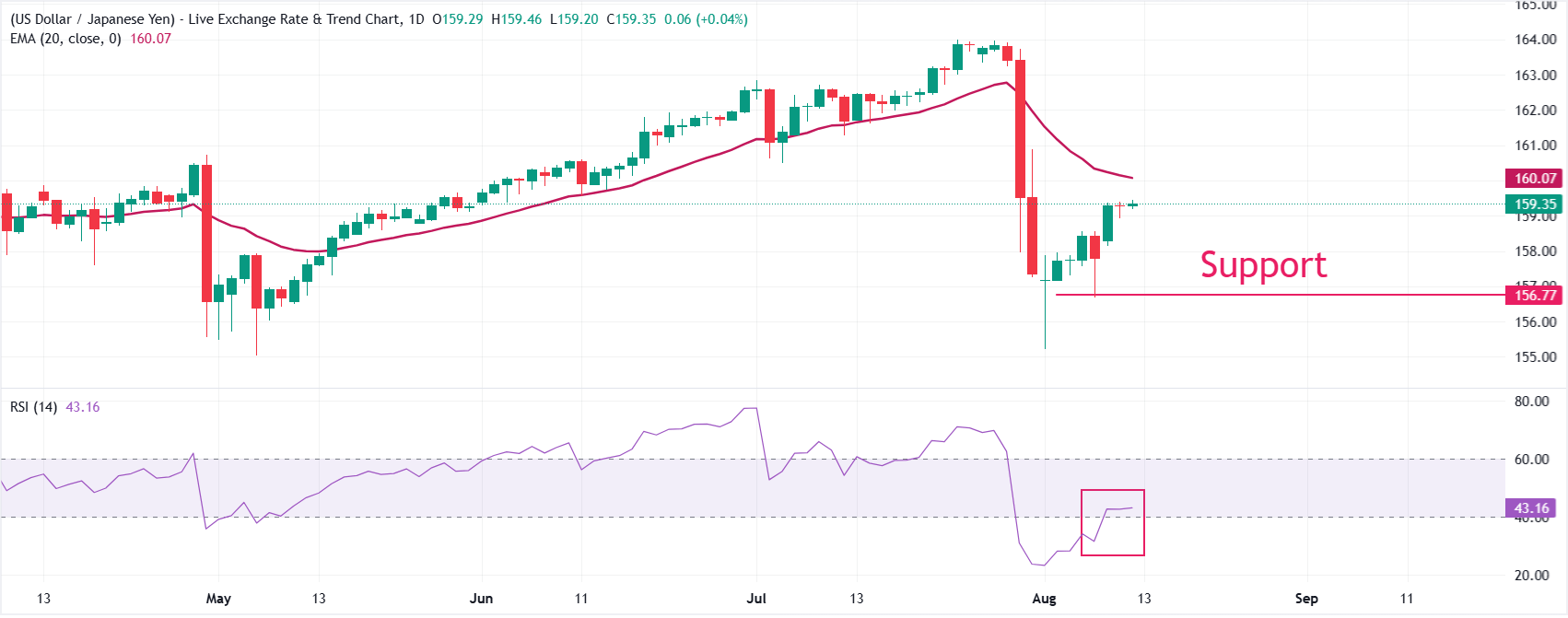
USD/JPY trades at 159.35. The pair holds a bearish near-term bias as it remains below the 20-period exponential moving average (EMA) at 160.07, suggesting that recent rebounds are still capped by overhead trend resistance. Momentum has stabilized after the earlier oversold readings, with the Relative Strength Index (RSI) recovering toward 43, but this only hints at fading downside pressure rather than a clear bullish shift while price trades under the short-term EMA.
On the topside, immediate resistance is located at the 20-day EMA near 160.07, which is the first hurdle bulls would need to reclaim to ease the current downside bias and open the way for a more sustained recovery. A daily close above this barrier would suggest that sellers are losing control, whereas failure to overcome 160.07 keeps the risk tilted toward further consolidation or renewed slippage below 159.00 in the coming sessions.
(The technical analysis of this story was written with the help of an AI tool. Know more.)
Economic Indicator
Consumer Price Index (YoY)
Inflationary or deflationary tendencies are measured by periodically summing the prices of a basket of representative goods and services and presenting the data as The Consumer Price Index (CPI). CPI data is compiled on a monthly basis and released by the US Department of Labor Statistics. The YoY reading compares the prices of goods in the reference month to the same month a year earlier.The CPI is a key indicator to measure inflation and changes in purchasing trends. Generally speaking, a high reading is seen as bullish for the US Dollar (USD), while a low reading is seen as bearish.
Read more.Next release: Wed Aug 12, 2026 12:30
Frequency: Monthly
Consensus: 3.4%
Previous: 3.5%
Source: US Bureau of Labor Statistics
The US Federal Reserve (Fed) has a dual mandate of maintaining price stability and maximum employment. According to such mandate, inflation should be at around 2% YoY and has become the weakest pillar of the central bank’s directive ever since the world suffered a pandemic, which extends to these days. Price pressures keep rising amid supply-chain issues and bottlenecks, with the Consumer Price Index (CPI) hanging at multi-decade highs. The Fed has already taken measures to tame inflation and is expected to maintain an aggressive stance in the foreseeable future.
Author

Sagar Dua
FXStreet
Sagar Dua is associated with the financial markets from his college days. Along with pursuing post-graduation in Commerce in 2014, he started his markets training with chart analysis.