Japanese Yen remains depressed against broadly stronger USD; bullish potential seems intact
- The Japanese Yen attracts some sellers following the release of Japan’s National CPI print.
- A modest USD uptick further lends support to USD/JPY and lifts it above the 149.00 mark.
- The divergent BoJ-Fed policy expectations should cap any meaningful gains for the major.

The Japanese Yen (JPY) maintains its offered tone through the early European session in the wake of domestic data released this Friday, which showed that Japan's National Consumer Price Index (CPI) slowed in February. Apart from this, a goodish pickup in the US Dollar (USD) demand, bolstered by the Federal Reserve's (Fed) forecast for only two 25 basis points (bps) rate cuts by the end of this year, assists the USD/JPY pair to stick to its intraday gains above mid-149.00s.
Meanwhile, investors now seem convinced that strong wage growth could boost consumer spending and contribute to rising inflation, giving the Bank of Japan (BoJ) headroom to continue raising interest rates further in 2025. This marks a big divergence in comparison to expectations for further policy easing by the Fed, which should cap the USD gains and lend support to the lower-yielding JPY, warranting caution before placing bullish bets around the USD/JPY pair.
Japanese Yen sticks to negative bias; hawkish BoJ expectations could help limit deeper losses
- Data released earlier this Friday showed that Japan's National Consumer Price Index (CPI) rose 3.7% YoY in February, slower than 4% in the previous month. Meanwhile, the nationwide core CPI, which excludes fresh food items, climbed 3% during the reported month from a year earlier compared to 3.2% in January, though the reading was slightly above the 2.9% expected.
- Meanwhile, the preliminary results from Japan's annual spring labor negotiations revealed that firms largely agreed to union demands for strong wage growth for the third consecutive year. This, in turn, is anticipated to boost consumer spending and contribute to broadening inflationary pressures in Japan, giving the Bank of Japan headroom to keep hiking rates.
- Moreover, BoJ Governor Kazuo Ueda said earlier this week that the Shunto result is largely in line with our January view and the central bank wants to conduct policies before it is too late. Ueda added that achieving a 2% inflation target is important for long-term credibility and the BoJ will keep adjusting the degree of easing if the economic, price outlook is to be realized.
- In contrast, the Federal Reserve signaled that it would deliver two 25 basis points rate cuts by the end of this year. Moreover, the central bank revised its growth outlook downward amid the uncertainty over the impact of the Trump administration's trade policies. Adding to this, Fed Chair Jerome Powell said that tariffs are likely to dampen economic growth.
- Both Russia and Ukraine stepped up aerial attacks on Thursday. In fact, Ukraine struck Russia’s Engels airbase, which hosts Russian strategic bombers used to attack Ukraine, in the Saratov region with attack drones, causing a fire and explosions in the area. Furthermore, Ukraine’s air force said Thursday that Russia had launched 171 drones over its territory.
- Israel resumed heavy strikes across Gaza early this week, breaking the ceasefire with Hamas that was in place since late January. In response, Hamas fired three rockets at Israel on Thursday, without causing casualties. The development raises the risk of a further escalation of geopolitical tensions in the Middle East and underpins the safe-haven Japanese Yen.
- The US Dollar looks to build on its modest recovery move from a multi-month low touched earlier this week and further lends some support to the USD/JPY pair. However, the divergent BoJ-Fed policy expectations should keep a lid on any meaningful gains for the currency pair in the absence of any relevant market-moving economic releases from the US on Friday.
USD/JPY looks to build on intraday move up and aim to reclaim the 150.00 psychological mark
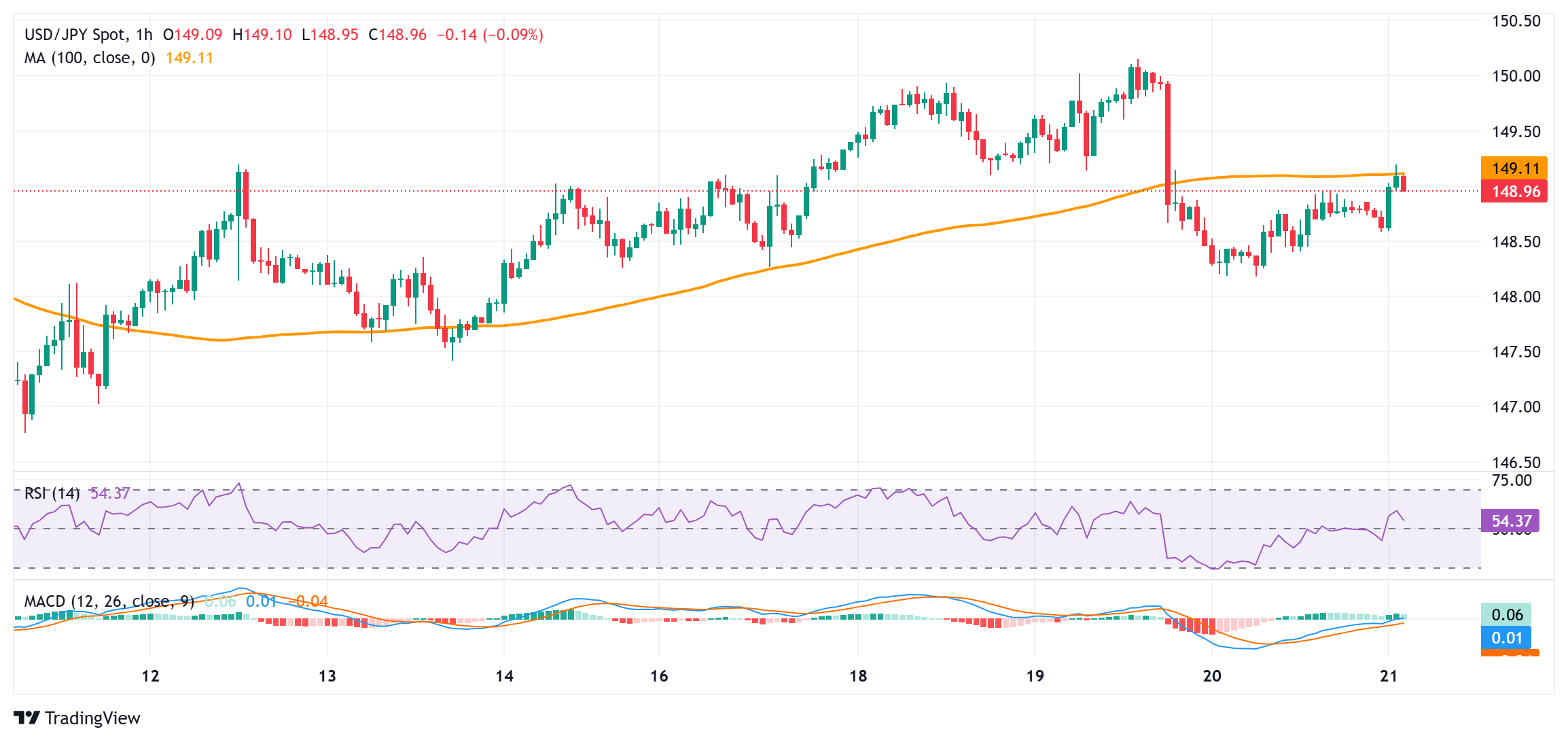
From a technical perspective, any further move up beyond the 149.25-149.30 immediate hurdle could assist the USD/JPY pair to reclaim the 150.00 psychological mark. Some follow-through buying beyond the 150.15 area might prompt a short-covering rally and lift spot prices to the 150.60 intermediate barrier en route to the 151.00 mark and the monthly peak, around the 151.30 region.
On the flip side, the Asian session low, around the 148.60-148.55 region, now seems to protect the immediate downside, below which the USD/JPY pair could accelerate the fall towards the weekly low, around the 148.28-148.15 area touched on Thursday. This is followed by the 148.00 mark and the 147.75 horizontal support, which if broken should pave the way for a fall towards the 147.30 region en route to the 147.00 mark and the 146.55-146.50 area, or the lowest level since early October touched earlier this month.
Bank of Japan FAQs
The Bank of Japan (BoJ) is the Japanese central bank, which sets monetary policy in the country. Its mandate is to issue banknotes and carry out currency and monetary control to ensure price stability, which means an inflation target of around 2%.
The Bank of Japan embarked in an ultra-loose monetary policy in 2013 in order to stimulate the economy and fuel inflation amid a low-inflationary environment. The bank’s policy is based on Quantitative and Qualitative Easing (QQE), or printing notes to buy assets such as government or corporate bonds to provide liquidity. In 2016, the bank doubled down on its strategy and further loosened policy by first introducing negative interest rates and then directly controlling the yield of its 10-year government bonds. In March 2024, the BoJ lifted interest rates, effectively retreating from the ultra-loose monetary policy stance.
The Bank’s massive stimulus caused the Yen to depreciate against its main currency peers. This process exacerbated in 2022 and 2023 due to an increasing policy divergence between the Bank of Japan and other main central banks, which opted to increase interest rates sharply to fight decades-high levels of inflation. The BoJ’s policy led to a widening differential with other currencies, dragging down the value of the Yen. This trend partly reversed in 2024, when the BoJ decided to abandon its ultra-loose policy stance.
A weaker Yen and the spike in global energy prices led to an increase in Japanese inflation, which exceeded the BoJ’s 2% target. The prospect of rising salaries in the country – a key element fuelling inflation – also contributed to the move.
Author

Haresh Menghani
FXStreet
Haresh Menghani is a detail-oriented professional with 10+ years of extensive experience in analysing the global financial markets.
















