Japanese Yen recovers further from two-week low against retreating USD; looks to US data for fresh impetus
- The Japanese Yen weakens across the board on Thursday in reaction to the tariff-block news.
- The USD benefits from Wednesday’s hawkish FOMC Minutes and supports the USD/JPY pair.
- The divergent BoJ-Fed policy expectations keep a lid on any further gains for the currency pair.

The Japanese Yen (JPY) moves away from a two-week trough touched against its American counterpart earlier this Thursday. As investors digest a federal court ruling against US President Donald Trump’s ‘liberation day’ trade tariffs, bets that the Bank of Japan (BoJ) will hike interest rates again lend some support to the JPY. Apart from this, the emergence of some intraday US Dollar (USD) selling near a one-and-a-half-week high contributes to the USD/JPY pair's pullback of around 80-85 pips from levels beyond the 146.00 mark.
Meanwhile, traders are still pricing in the possibility that the Federal Reserve (Fed) will step in to support economic growth and lower borrowing costs further in 2025. This marks a big divergence in comparison to hawkish BoJ expectations, which could further benefit the lower-yielding JPY. However, a fresh wave of the global risk-on trade might hold back traders from placing fresh bullish bets around the safe-haven JPY and act as a tailwind for the USD/JPY pair ahead of key inflation figures from the US and Japan on Friday.
Japanese Yen bears turn cautious amid expectations that the BoJ will hike rates again
- US President Donald Trump’s proposed reciprocal trade tariffs were blocked by the Court of International Trade on Wednesday. The court ruled that the president overstepped his authority by imposing tariffs on goods from nearly every country in the world.
- The global risk sentiment gets a strong lift following the court's order, with Wall Street futures and equities across Asia rising sharply on Thursday. This undermines demand for traditional safe-haven assets, including the Japanese Yen, during the Asian session.
- Demand at an auction of Japan's longest-tenor bonds on Wednesday fell to the lowest since July and added to worries about the fiscal health of the economy. This further drives flows away from the JPY and pushes the USD/JPY pair higher for the fourth straight day.
- Meanwhile, traders have been pricing in the possibility that the Bank of Japan will hike interest rates again this year amid signs of broadening inflation in Japan. Hence, the focus will remain glued to the release of the Tokyo Consumer Price Index on Friday.
- Minutes of the Federal Reserve's May 6-7 policy meeting released on Wednesday revealed a consensus to maintain the wait-and-see approach on interest rates amid the uncertainty about the economic outlook and trade policies. The outlook supports the US Dollar.
- The CME Group's FedWatch Tool, however, indicates a greater chance that the US central bank might still deliver at least two 25 basis point rate cuts this year. This marks a big divergence in comparison to hawkish BoJ expectations and favors the JPY bulls.
- Market participants now look forward to Thursday's US economic docket – featuring the release of the Prelim Q1 GDP print, the usual Weekly Initial Jobless Claims, and Pending Home Sales data. This, along with Fedspeaks, might influence the USD demand.
USD/JPY could accelerate the corrective slide once the 145.00 pivotal support is broken
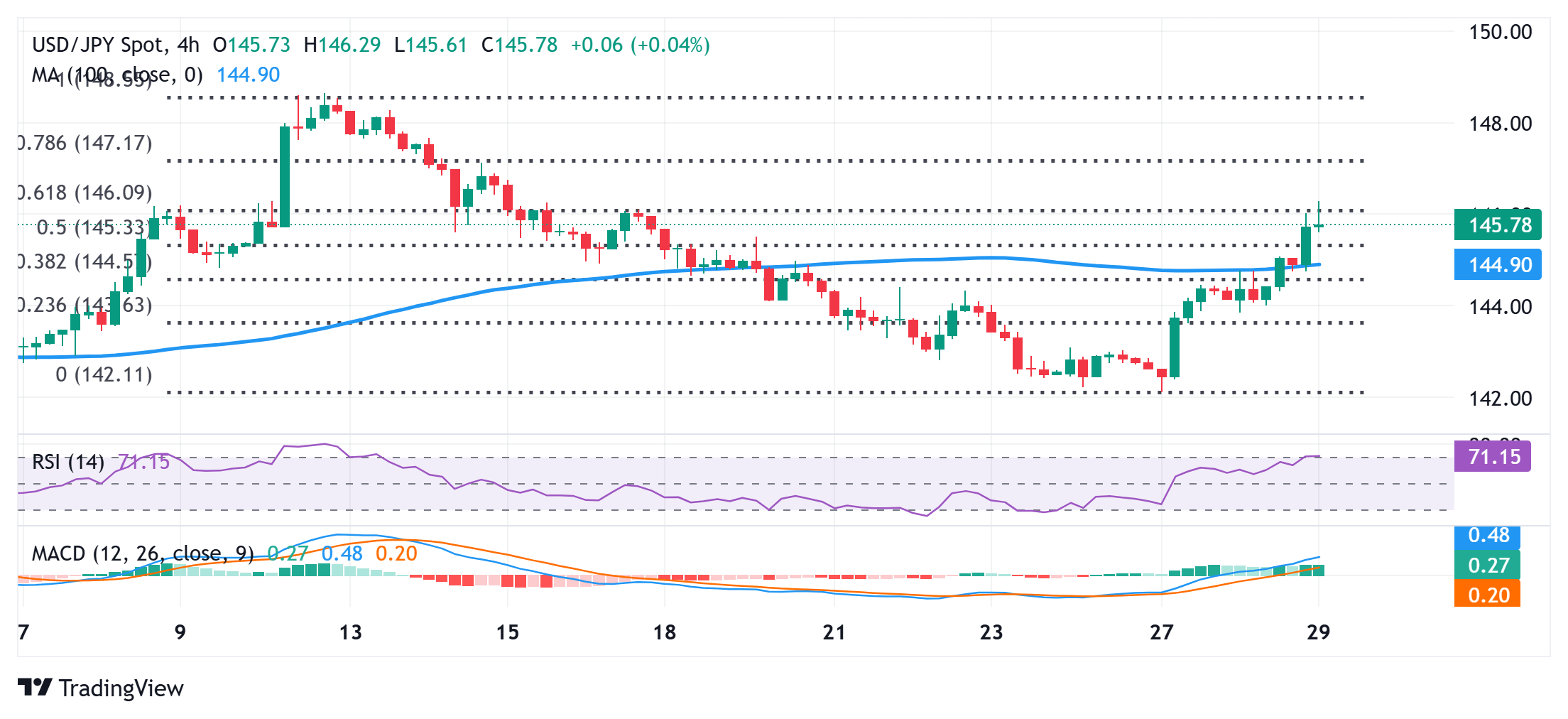
From a technical perspective, the USD/JPY pair stalls its strong intraday move up near the 50% retracement level of the recent downfall from the monthly peak amid a slightly overbought Relative Strength Index (RSI) on hourly charts. That said, oscillators on the daily chart have just started gaining positive traction and support prospects for an extension of the weekly uptrend. Hence, any corrective pullback below the 145.35 region, or the 38.2% Fibonacci retracement level could be seen as a buying opportunity and remain limited near the 145.00 psychological mark. The latter is near the 200-period Simple Moving Average (SMA) on the 4-hour chart, which if broken will negate the near-term positive outlook.
On the flip side, the USD/JPY bulls might now await sustained strength and acceptance above the 146.00 mark before placing fresh bets. Spot prices might then accelerate the positive move towards the 146.70-146.75 intermediate hurdle en route to the 147.00 round figure and the next relevant barrier near the 147.60 supply zone. Some follow-through buying should allow the currency pair to climb further beyond the 148.00 mark, towards the monthly swing high, around the 148.65 region.
Economic Indicator
Initial Jobless Claims
The Initial Jobless Claims released by the US Department of Labor is a measure of the number of people filing first-time claims for state unemployment insurance. A larger-than-expected number indicates weakness in the US labor market, reflects negatively on the US economy, and is negative for the US Dollar (USD). On the other hand, a decreasing number should be taken as bullish for the USD.
Read more.Next release: Thu May 29, 2025 12:30
Frequency: Weekly
Consensus: 230K
Previous: 227K
Source: US Department of Labor
Every Thursday, the US Department of Labor publishes the number of previous week’s initial claims for unemployment benefits in the US. Since this reading could be highly volatile, investors may pay closer attention to the four-week average. A downtrend is seen as a sign of an improving labour market and could have a positive impact on the USD’s performance against its rivals and vice versa.
Author

Haresh Menghani
FXStreet
Haresh Menghani is a detail-oriented professional with 10+ years of extensive experience in analysing the global financial markets.