Indian Rupee struggles for relief despite centre hikes import duty on Gold and Silver
- The Indian Rupee strives for a temporary ground against the US Dollar, despite the increase in import duty on Gold and Silver.
- Fears of prolonged Hormuz closure are expected to keep oil prices elevated.
- The US Dollar gains as hot inflation data lifts hawkish Fed bets.
The Indian Rupee (INR) strives to regain ground against the US Dollar (USD) on Wednesday. The USD/INR pair is almost flat, close to its all-time high of 95.70, even as the increase in import duty on Gold and Silver to 15% from 6% by the Indian government.
Import duty on precious metals increases to 15% from 6%
India’s Department of Revenue under the Customs Act released a notification overnight that reflected a significant increase in the import tariffs on Gold and Silver to 15%. The notification also showed that Gold and Silver findings - small components such as hooks, clasps, clamps, pins, and screw backs used in jewellery manufacturing will now attract 5% customs duty.
Market participants had anticipated that the Indian government could hike import duty on precious metals, in an attempt to curb imports of bullion to ease pressure on the country’s foreign exchange reserves.
Over the weekend, Indian Prime Minister (PM) Narendra Modi urged citizens to postpone their non-essential gold purchases for almost a year while warning that India’s forex reserves are draining due to geopolitical tensions. Indian PM Modi also urged reducing fuel consumption and avoiding foreign travel.
The ongoing US-Iran deadlock keeps oil prices broadly higher
In the Asian trade, the WTI Oil price has corrected to near $97.20, but is still over 6% higher so far this week, as negotiations between the United States (US) and Iran failed to achieve a breakthrough. US President Donald Trump rebuffed Iran’s counterproposal, calling it “totally unacceptable” first and then terming it a “stupid proposal”.
Meanwhile, Iran remains firm on its demands regarding a permanent resolution with the US and the reopening of the Strait of Hormuz. Iran’s deputy foreign minister, Kazem Gharibabadi, said earlier in the day that Iran’s position was that any peace deal must include reparations for Iran, Iranian sovereignty over the Strait of Hormuz, and an end to US sanctions.
Speaking at a conference in Switzerland late on Tuesday, Reserve Bank of India (RBI) Governor Sanjay Malhotra said that the government may need to hike oil prices if Middle East tensions drag on, Reuters reports. Malhotra added, "Central banks need to be cautious, follow a policy of "gradualism" in the face of heightened uncertainty."
FIIs continue to remain net sellers
Amid growing concerns regarding India Inc.’s earnings projections due to higher energy prices, foreign investors continue to dump their stake in the Indian stock market. So far in May, Foreign Institutional Investors (FIIs) have remained net sellers in six of seven trading days and have offloaded their stake worth Rs. 21,469.30 crore.
A higher US Dollar could strengthen USD/INR further
While a sudden hike in import duty on precious metals has put slight pressure on USD/INR, the pair could extend its ongoing rally as hot US inflation data for April has strengthened the US Dollar. During the press time, the US Dollar Index (DXY) is close to its weekly high of 98.46 posted on Tuesday.
The data showed on Wednesday that the US headline CPI grew at an annualized pace of 3.8%, stronger than estimates of 3.7% and the March reading of 3.3%. Signs of further acceleration in inflationary pressures have prompted expectations of interest rate hikes by the Federal Reserve (Fed) this year.
Technical Analysis: USD/INR holds close to all-time high near 95.70
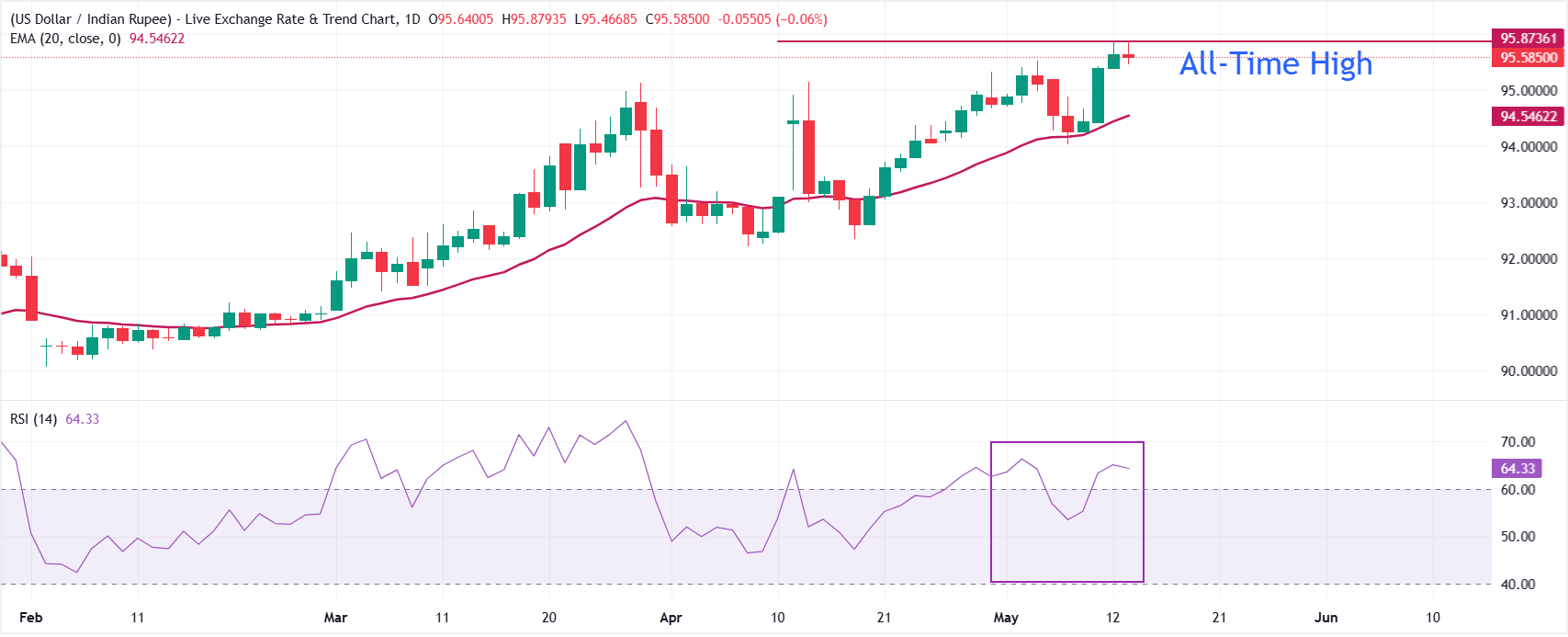
USD/INR trades almost flat at around 95.70, maintaining a bullish near-term bias as spot holds firmly above the 20-period Exponential Moving Average (EMA) at 94.55. The pair has been carving out higher closes in recent sessions, and the Relative Strength Index (14) around 65 suggests persistent upward momentum, though edging toward overbought territory.
On the downside, initial support is now seen at the 20-period EMA near 94.56, which acts as the first line of demand should any corrective pullback unfold. Looking up, the pair is in uncharted territory and could gain further toward 96.00
(The technical analysis of this story was written with the help of an AI tool.)
Indian economy FAQs
The Indian economy has averaged a growth rate of 6.13% between 2006 and 2023, which makes it one of the fastest growing in the world. India’s high growth has attracted a lot of foreign investment. This includes Foreign Direct Investment (FDI) into physical projects and Foreign Indirect Investment (FII) by foreign funds into Indian financial markets. The greater the level of investment, the higher the demand for the Rupee (INR). Fluctuations in Dollar-demand from Indian importers also impact INR.
India has to import a great deal of its Oil and gasoline so the price of Oil can have a direct impact on the Rupee. Oil is mostly traded in US Dollars (USD) on international markets so if the price of Oil rises, aggregate demand for USD increases and Indian importers have to sell more Rupees to meet that demand, which is depreciative for the Rupee.
Inflation has a complex effect on the Rupee. Ultimately it indicates an increase in money supply which reduces the Rupee’s overall value. Yet if it rises above the Reserve Bank of India’s (RBI) 4% target, the RBI will raise interest rates to bring it down by reducing credit. Higher interest rates, especially real rates (the difference between interest rates and inflation) strengthen the Rupee. They make India a more profitable place for international investors to park their money. A fall in inflation can be supportive of the Rupee. At the same time lower interest rates can have a depreciatory effect on the Rupee.
India has run a trade deficit for most of its recent history, indicating its imports outweigh its exports. Since the majority of international trade takes place in US Dollars, there are times – due to seasonal demand or order glut – where the high volume of imports leads to significant US Dollar- demand. During these periods the Rupee can weaken as it is heavily sold to meet the demand for Dollars. When markets experience increased volatility, the demand for US Dollars can also shoot up with a similarly negative effect on the Rupee.
Author

Sagar Dua
FXStreet
Sagar Dua is associated with the financial markets from his college days. Along with pursuing post-graduation in Commerce in 2014, he started his markets training with chart analysis.
















