Indian Rupee surges as RBI unveils measures to boost foreign investment
- The Indian Rupee gains against the US Dollar after the RBI's monetary policy announcement.
- RBI Governor Malhotra leaves Repo Rate steady at 5.25%, raises inflation projections, and lowers growth forecasts.
- Investors await the US NFP data for fresh cues regarding the Fed’s monetary policy outlook.

The Indian Rupee gains against the US Dollar (USD) after the Reserve Bank of India’s (RBI) monetary policy decision, with the USD/INR pair sliding to near 95.00.
As expected, the RBI has left its Repo Rate steady at 5.25%, with a warning that adverse implications of the extended disruption in global supply chains and higher energy prices have prompted risks both to inflation and growth. However, RBI Governor Sanjay Malhotra has stated that the headline inflation is still below the central bank’s target, and the core inflation is much lower, excluding precious metals.
Regarding the monetary policy outlook, RBI Governor Malhotra has guided that it is “prudent to wait for greater clarity to emerge” and the central bank will remain “data-dependent”.
The RBI has raised the retail inflation forecast for the Financial Year (FY) 2026-27 to 5.1% from 4.6% previously anticipated, and has lowered the GDP growth forecast to 6.6% from 6.9%. Meanwhile, RBI Governor Sanjay Malhotra has stressed that the central bank remains firmly committed to its inflation mandate despite recent external shocks.
In the monetary policy announcement, the RBI also addressed the issue of significant foreign outflows and unveiled various measures to boost foreign inflows into the economy, especially the withdrawal of taxes on interest income earned from government securities as well as on capital gains.
Geopolitical tensions to remain a key drag on Indian Rupee
Continued hostilities between Israel and Lebanon, despite the United States (US)-brokered ceasefire, have escalated the US-Iran deal uncertainty.
Hezbollah chief Naim Qassem has rejected the ceasefire deal as a “farce”, warning that northern Israel will remain a target for fighters as long as Israel continues to bomb Lebanon, Al Jazeera reported.
Ongoing Israel-Lebanon attacks could result in a resumption in oil prices’ rally, a scenario that will be unfavorable for currencies from economies, such as India, which rely heavily on oil imports to meet their energy needs.
US NFP data awaited
Later in the day, investors will pay close attention to the US Nonfarm Payrolls (NFP) data for May, which will be published at 12:30 GMT. The US official employment data will influence market expectations for the Federal Reserve’s (Fed) monetary policy outlook.
The US NFP report is expected to show that employers hired 85K fresh workers, lower than 115K in April. The Unemployment Rate is seen steady at 4.3%.
Year-on-Year (YoY) Average Hourly Earnings, a key measure of wage growth, is estimated to arrive lower at 3.4% from the previous reading of 3.6%. On a monthly basis, the wage growth measure is expected to have grown 0.3% faster than 0.2% in April.
Technical Analysis: USD/INR tumbles to near 95.00
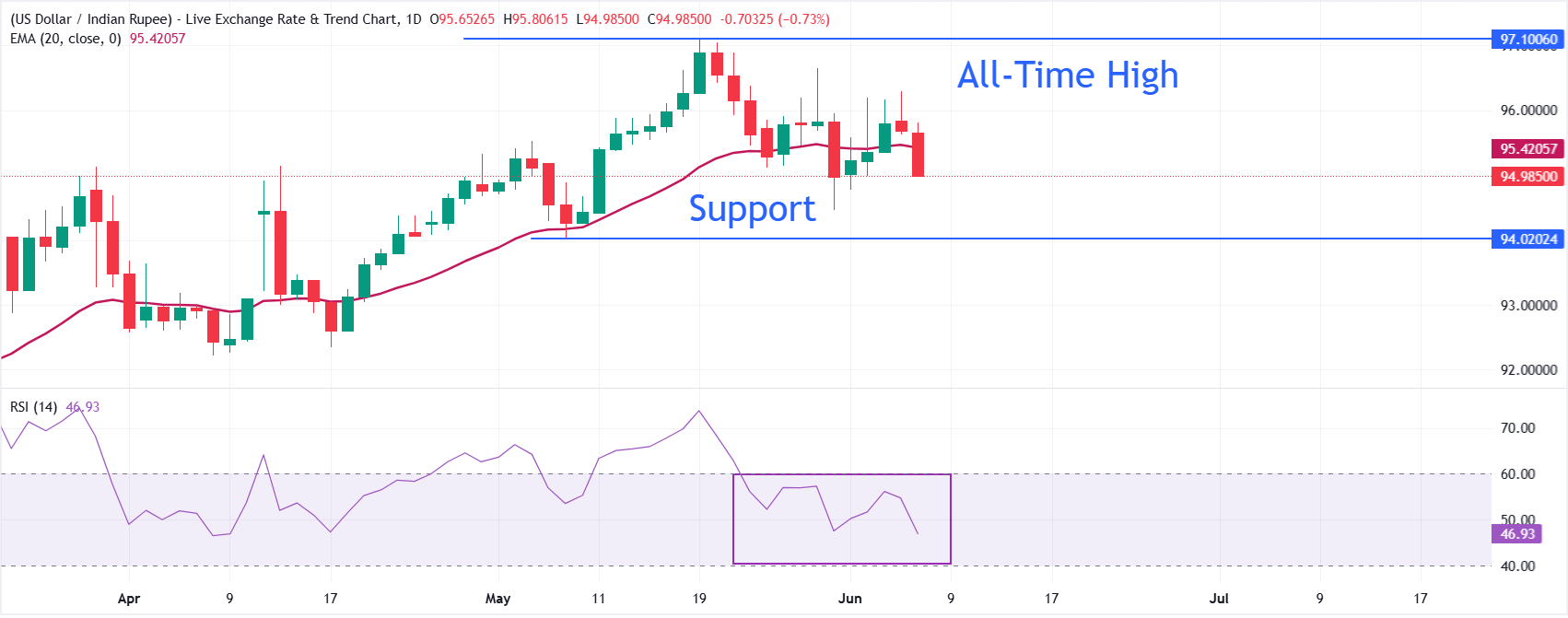
USD/INR trades sharply lower at around 95.28 at press time. The near-term tone of the pair has become uncertain as it has fallen back below the 20-period Exponential Moving Average (EMA), which is at 95.45.
The Relative Strength Index (RSI) has fallen to near 47.00, indicating a surge in sellers' dominance but not an outright bearish momentum.
On the downside, the pair could slide to the May 7 low around 94.00 if it fails to hold 95.00. Looking up, the pair might aim to revisit the all-time high slightly above 97.00 if it manages to rise above the June 4 high at 96.30
(The technical analysis of this story was written with the help of an AI tool.)
Economic Indicator
Nonfarm Payrolls
The Nonfarm Payrolls release presents the number of new jobs created in the US during the previous month in all non-agricultural businesses; it is released by the US Bureau of Labor Statistics (BLS). The monthly changes in payrolls can be extremely volatile. The number is also subject to strong reviews, which can also trigger volatility in the Forex board. Generally speaking, a high reading is seen as bullish for the US Dollar (USD), while a low reading is seen as bearish, although previous months' reviews and the Unemployment Rate are as relevant as the headline figure. The market's reaction, therefore, depends on how the market assesses all the data contained in the BLS report as a whole.
Read more.Next release: Fri Jun 05, 2026 12:30
Frequency: Monthly
Consensus: 85K
Previous: 115K
Source: US Bureau of Labor Statistics
America’s monthly jobs report is considered the most important economic indicator for forex traders. Released on the first Friday following the reported month, the change in the number of positions is closely correlated with the overall performance of the economy and is monitored by policymakers. Full employment is one of the Federal Reserve’s mandates and it considers developments in the labor market when setting its policies, thus impacting currencies. Despite several leading indicators shaping estimates, Nonfarm Payrolls tend to surprise markets and trigger substantial volatility. Actual figures beating the consensus tend to be USD bullish.
Author

Sagar Dua
FXStreet
Sagar Dua is associated with the financial markets from his college days. Along with pursuing post-graduation in Commerce in 2014, he started his markets training with chart analysis.