Brent nears a critical crossroads as the global economy faces one too

Markets spent last Friday digesting a Reuters report that Iran has told the Houthis to stand ready to close Bab el-Mandeb if the US strikes Iranian power infrastructure — missiles and drones are reportedly already positioned near the strait, awaiting the order from IRGC officers in Yemen. The threat escalated over the weekend when the Houthis declared a maritime embargo against Saudi Arabia, accusing Riyadh of bombing Sanaa airport. That matters because Saudi Arabia has been routing meaningful crude volumes via pipeline to a Red Sea export terminal as a relief valve during the Hormuz closure — a Bab el-Mandeb squeeze would choke that workaround too. Context: this is the same chokepoint the Houthis hit in 2023-24, cutting Red Sea traffic roughly in half and pushing carriers around the Cape of Good Hope; a late-2025 ceasefire brought flows back, and the strait’s importance has only grown since Hormuz shut down this spring, as it’s one of the few remaining outlets for Gulf barrels reaching Europe and Asia.
EIA data show crude and petroleum liquids through Bab el-Mandeb collapsed from over 9 million b/d in 2023 to around 4 million b/d in 2024-25 after the first Houthi campaign, but have climbed back to roughly 5.4 million b/d in Q1 2026 as barrels get rerouted away from Hormuz; LNG flows, which had dropped to zero, have revived to about 2.9 billion cubic feet/day. The strait still handles near 12% of global seaborne oil trade — a fraction of Hormuz’s ~20 million b/d, but not something markets can easily absorb losing on top of an already-closed Gulf chokepoint.
A quick note on Hormuz: the brief reopening under June’s Islamabad Memorandum has unwound. After the ceasefire broke down around July 7, Iran resumed strikes on tankers and the IRGC re-declared the strait closed on July 19; the latest PortWatch read (July 12) put transits at just 10 vessels versus an ~88/day pre-crisis baseline, with roughly 490 vessels now anchored nearby. On production, Kuwait was forced into a ~2.8 million b/d output cut once storage hit capacity with no export route, and JPMorgan has flagged total Gulf shut-ins could approach 5 million b/d the longer the closure drags on — with some analysts warning 10-30% of that capacity could see permanent decline-curve damage rather than a clean snap-back.
Technical analysis
About two weeks ago (July 8 ), we already covered Brent, arguing that at the levels it had returned to trading (around $76 that morning), and given the broader global backdrop, we saw further upside potential for the black gold. We identified initial targets at $81.20, $82.60, and finally $87.50. Brent is currently trading at $87.05, after reaching $88.99 yesterday, meaning all of our projected targets have now been achieved.
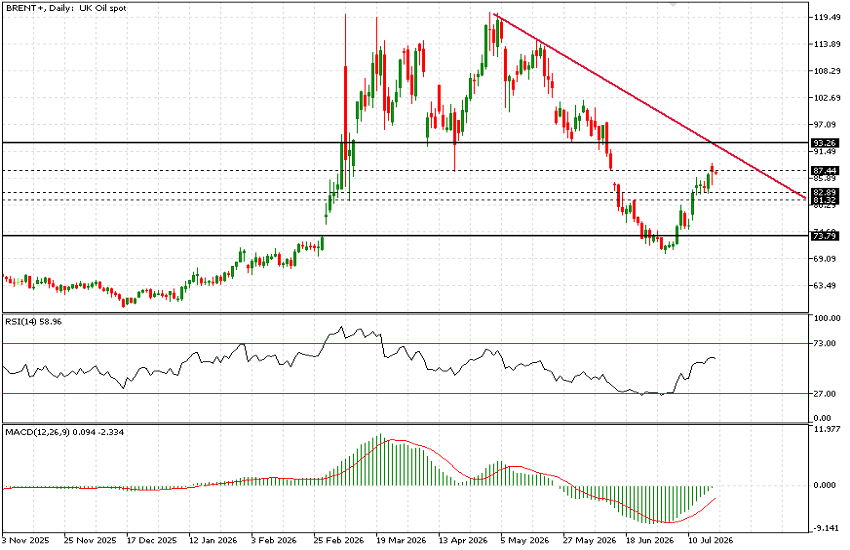
What happens next? Looking purely at the technical picture, we believe that, given how sharp the rally has been over the past few days, there may still be some room for further gains before Brent reaches the descending daily trendline, which currently comes in at around $92.30. Of course, it is by no means a rule set in stone that a trendline must be tested with pinpoint accuracy—after all, every trendline is ultimately just a technical hypothesis—but it is worth keeping in mind.
If Brent does move up to test that area, it will be approaching a truly critical zone. Just slightly higher, around $93.00–$93.25, lies the support floor that held prices up between March and early June. A return above that level would be technically bearish for the outlook and would also carry broader macroeconomic implications. Higher oil prices would add further pressure to the global economy at a time when strategic reserves are becoming increasingly depleted (the U.S. Strategic Petroleum Reserve has been cut roughly in half over the past five years and is at its lowest level since 1984), while also weighing on the valuation of other financial assets.
In any case, Brent’s price action throughout August will be well worth watching closely.
Author

Marco Turatti
Independent Analyst
More than 10 years of experience in institutional trading, several years in retail brokerage as a Market Analyst and Head of Dealing.