Indian Rupee gives back major early gains while approaching closing bell
- The Indian Rupee starts the week on a positive note against the US Dollar due to multiple tailwinds.
- US President Trump halts attacks on Iran as it agrees to the nuclear deal and the Hormuz reopening.
- Investors await the RBI’s policy, which will be announced on Wednesday.
The Indian Rupee (INR) surrenders a majority of its early gains against the US Dollar (USD) near the closing session on Monday. The USD/INR is slightly lower at near 95.35, having recovered from its over three-week low of 95.15.
The Indian currency strengthened as the announcement of a ceasefire between the United States (US) and Iran after renewed hostilities in the Middle East in July has pushed oil prices sharply lower.
In the opening trade, the MCX Crude Oil contract expiring on August 19 trades over 6% lower to near Rs. 7,600.
Currencies from economies, such as India, which rely heavily on oil imports to meet their energy needs, tend to underperform in a high oil price environment.
US pauses Iran attacks
Over the weekend, US President Donald Trump announced that planned attacks on Iran have been suspended as the nation has agreed to the nuclear deal and the reopening of the Strait of Hormuz, a vital passage for almost 20% of the global energy supply.
“We have just been asked by Iran, and other Middle Eastern Countries, to hold off any attack in that the perimeters of a deal has been agreed to. This would include the Immediate, Complete, and Total OPENING OF THE HORMUZ STRAIT, and an end to Iran’s nuclear threat,” Trump wrote on Truth Social.
The renewed US-Iran peace hopes appear to have given a lifeline to Indian stock markets. At press time, the Nifty50 Index is up 0.7% at around 24,555.
RBI policy in focus
On the domestic front, the major event for the Indian currency this week will be the Reserve Bank of India’s (RBI) monetary policy announcement on Wednesday.
Economists at ING expect the Reserve Bank of India to leave the policy stance unchanged at its upcoming meeting, stating that “we expect the Reserve Bank of India to keep the repo rate unchanged at 5.25% on Wednesday.” They acknowledge that “headline inflation surprised to the upside in June, largely due to higher fuel prices,” but stress that “underlying price pressures remain contained.” In their view, “core inflation continues to run below the RBI's target, providing policymakers with sufficient room to keep policy rates unchanged while monitoring evolving risks to the inflation outlook.”
US Dollar recovers gains ahead of ISM Manufacturing PMI
The US Dollar Index (DXY) turns positive after a weak opening in the European session, trading marginally higher at around 99.82. The Greenback rebounds as traders are confident that the Federal Reserve (Fed) will deliver an interest rate hike at the September policy meeting. The USD Index opened lower as a significant plunge in oil prices diminished the appeal of safe-haven assets.
According to the CME FedWatch tool, the odds of the Fed hiking interest rates next month are 67.7%.
This week, investors will focus on a slew of US economic data, especially the US Nonfarm Payrolls (NFP) data for July, which will be released on Friday. Later in the day, investors will focus on the US ISM Manufacturing PMI data for July. The Manufacturing PMI is expected to arrive at 54.0, up from 53.3 in June.
Technical Analysis: USD/INR stays below 20-day EMA
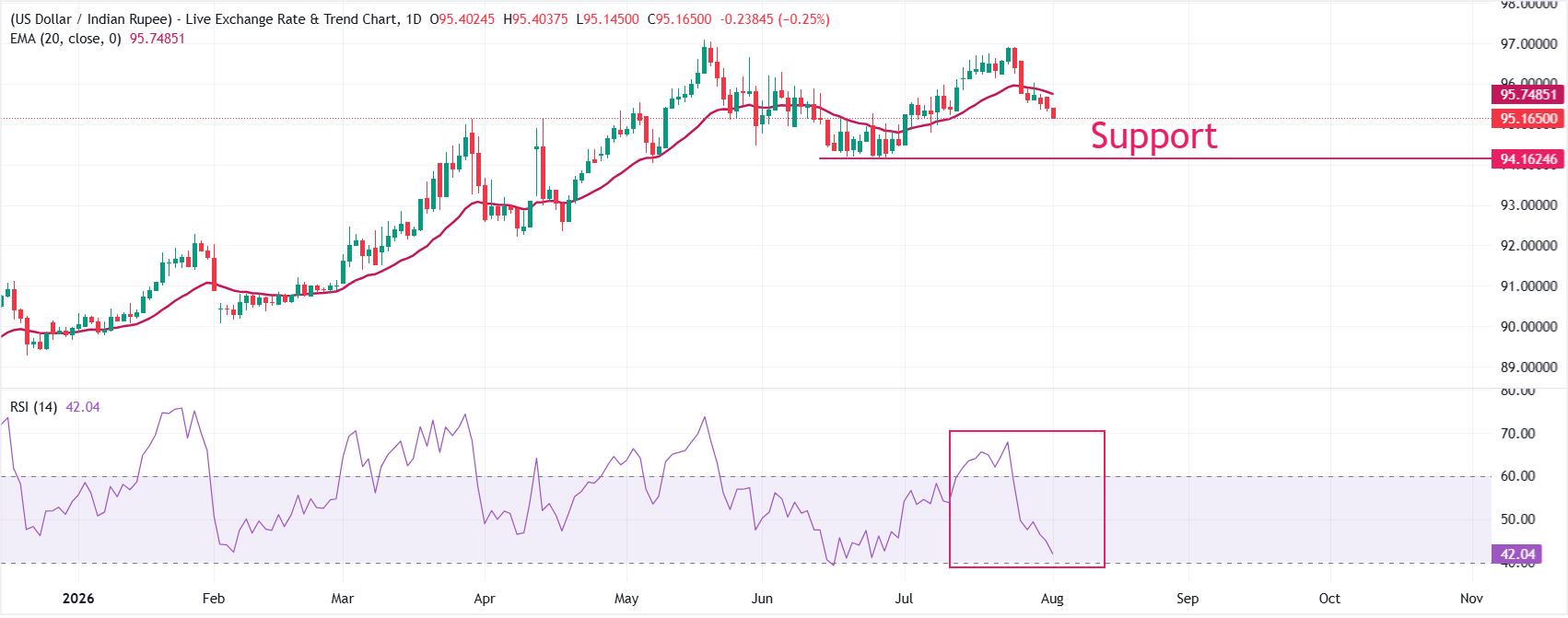
USD/INR trades lower at 95.35, keeping a bearish near-term tone as it holds below the 20-day exponential moving average (EMA) at 95.75. The EMA overhead suggests rallies remain capped for now, while the Relative Strength Index (RSI) at 42 stays below the neutral 50 line, hinting at lingering downside pressure rather than a decisive oversold condition.
On the topside, initial resistance is defined by the 20-day EMA clustered near 95.75, and a daily close above this barrier would be needed to ease the current bearish bias and open the way for a stronger recovery. On the downside, the July 7 low at 94.78 is the key support level, followed by the June 26 low at 94.15.
(The technical analysis of this story was written with the help of an AI tool. Know more.)
Economic Indicator
ISM Manufacturing PMI
The Institute for Supply Management (ISM) Manufacturing Purchasing Managers Index (PMI), released on a monthly basis, is a leading indicator gauging business activity in the US manufacturing sector. The indicator is obtained from a survey of manufacturing supply executives based on information they have collected within their respective organizations. Survey responses reflect the change, if any, in the current month compared to the previous month. A reading above 50 indicates that the manufacturing economy is generally expanding, a bullish sign for the US Dollar (USD). A reading below 50 signals that factory activity is generally declining, which is seen as bearish for USD.
Read more.Next release: Mon Aug 03, 2026 14:00
Frequency: Monthly
Consensus: 54
Previous: 53.3
Source: Institute for Supply Management
The Institute for Supply Management’s (ISM) Manufacturing Purchasing Managers Index (PMI) provides a reliable outlook on the state of the US manufacturing sector. A reading above 50 suggests that the business activity expanded during the survey period and vice versa. PMIs are considered to be leading indicators and could signal a shift in the economic cycle. Stronger-than-expected prints usually have a positive impact on the USD. In addition to the headline PMI, the Employment Index and the Prices Paid Index numbers are watched closely as they shine a light on the labour market and inflation.
Author

Sagar Dua
FXStreet
Sagar Dua is associated with the financial markets from his college days. Along with pursuing post-graduation in Commerce in 2014, he started his markets training with chart analysis.