Indian Rupee rallies further as US Dollar extends weakness
- The Indian Rupee gains sharply against the US Dollar after the Tuesday holiday.
- Concerns regarding AI growth and Fed repricing weigh on the US Dollar.
- The RBI continues to defend the Indian currency.

The Indian Rupee (INR) opens sharply higher against the US Dollar (USD) on Wednesday after a holiday the previous day. The USD/INR pair posts a fresh six-week low near 96.30 amid continued underperformance of the US Dollar.
As of writing, the US Dollar Index (DXY), which tracks the Greenback’s value against six major currencies, trades almost flat at around 101.77, but is close to its nearly three-week low of 101.50 posted the previous day.
The US Dollar has been under pressure due to weakness in United States (US) Artificial Intelligence (AI)-related stocks and US bond yields being in a corrective phase amid Federal Reserve (Fed) repricing. Financial market participants see further downfall in the US Dollar on the back of these headwinds.
USD slide seen extending as Fed risks reprice and tech jitters build
Strategists at Scotiabank observe that “broad USD weakness looks poised to extend in the short run as markets reassess near-term Fed tightening risks,” pointing to last week’s “heavy net losses for the DXY” as evidence that the “Sep/Oct rally in the index is poised to correct or reverse, potentially towards the 100.80/101.30 area at least.” They add that “a deeper shake out in tech stocks could become a further headwind for the USD, given the dominance of the AI build out in the US growth/inflation narrative,” suggesting that renewed pressure on the sector may reinforce the current Dollar downtrend.
According to the CME FedWatch tool, the Fed is almost certain to leave interest rates unchanged at the policy meeting later this month. A month ago, the tool was showing a meaningful chance that the central bank could hike rates in October meeting too. Traders repriced hawkish Fed bets as several officials indicated no urgency for an another interest rate hike.
RBI doubles down on multi-layered defence to steady the rupee
Economists at DBS Group Research highlight that the Reserve Bank of India (RBI) has adopted a “multi-layered defence strategy to support the rupee this year,” combining “outright intervention in spot/forwards, regulatory action, liquidity steps, administrative measures and moves to curb import-related dollar demand.” According to DBS, the authorities are “likely not done yet and remain ready to take further action, as required,” with RBI Governor Malhotra underscoring the central bank’s resolve in a recent interview, stressing that “The RBI is determined to do whatever is necessary to ensure orderly movement in the foreign exchange market.”
However, DBS doubts sustained INR’s appreciation due to multiple headwinds. DBS says that even after recent policy efforts to shore up the Rupee, “we see limited room for sustained INR appreciation on grounds of manufacturing/trade competitiveness." They add that “a challenging portfolio flows outlook leaves the door open to further gradual rupee depreciation subject to global developments,” noting the currency’s “high sensitivity to oil price movements and risk sentiments.”
USD/INR Technical Analysis
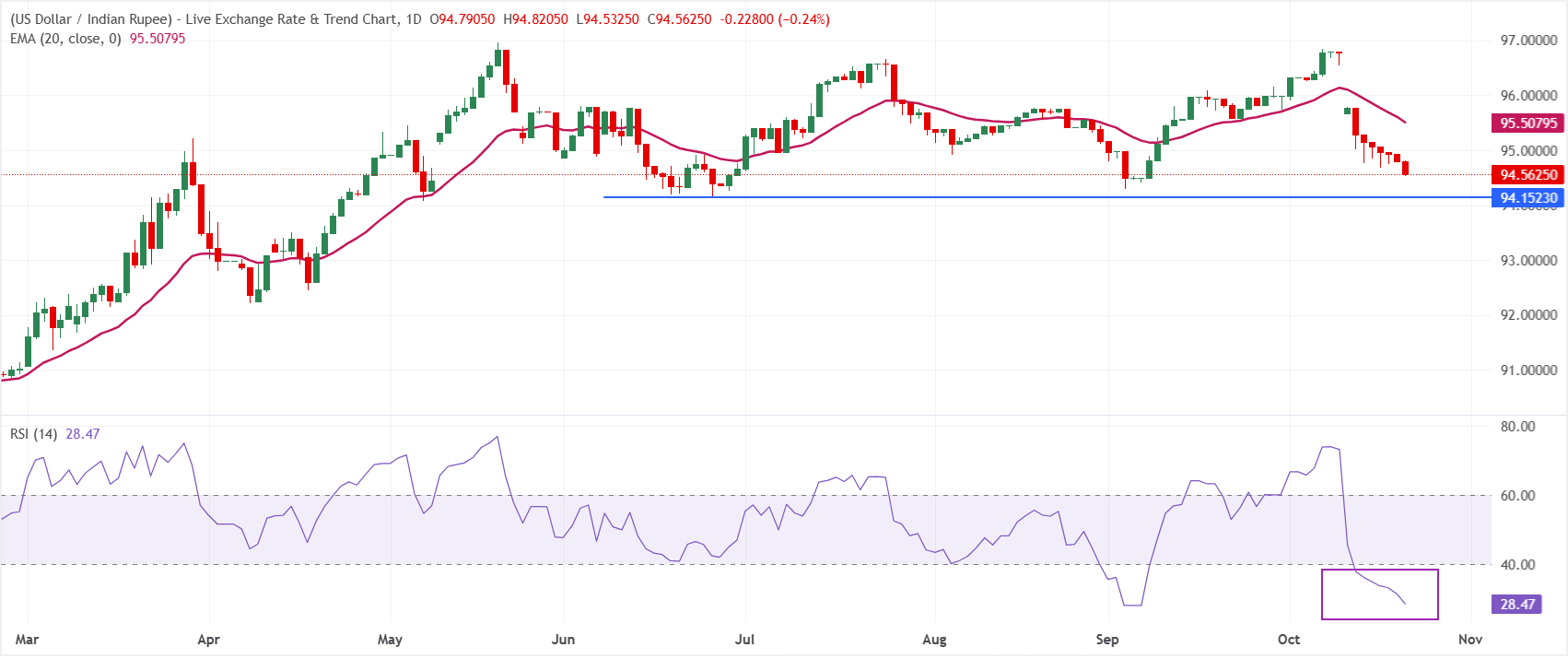
In the daily chart, USD/INR trades at 94.5625, keeping a bearish near-term tone as spot holds well below the 20-period Exponential Moving Average (EMA) at 95.5079. The pair has unwound sharply from its recent highs, and while the Relative Strength Index (RSI) at 28.47 sits in oversold territory, this momentum reading only hints at stretched downside conditions rather than a clear recovery, leaving price action still capped by overhead trend resistance.
On the topside, immediate resistance is located at the 20-period EMA near 95.51, where any rebound would likely face renewed selling pressure. On the downside, while no clear price-based support has formed close to the current level, the oversold RSI around 28 suggests that bears could start to lose conviction on further declines, with any stabilization above 94.56 needed to reduce the risk of an extended slide.
(The technical analysis of this story was written with the help of an AI tool. Know more.)
Indian Rupee FAQs
The Indian Rupee (INR) is one of the most sensitive currencies to external factors. The price of Crude Oil (the country is highly dependent on imported Oil), the value of the US Dollar – most trade is conducted in USD – and the level of foreign investment, are all influential. Direct intervention by the Reserve Bank of India (RBI) in FX markets to keep the exchange rate stable, as well as the level of interest rates set by the RBI, are further major influencing factors on the Rupee.
The Reserve Bank of India (RBI) actively intervenes in forex markets to maintain a stable exchange rate, to help facilitate trade. In addition, the RBI tries to maintain the inflation rate at its 4% target by adjusting interest rates. Higher interest rates usually strengthen the Rupee. This is due to the role of the ‘carry trade’ in which investors borrow in countries with lower interest rates so as to place their money in countries’ offering relatively higher interest rates and profit from the difference.
Macroeconomic factors that influence the value of the Rupee include inflation, interest rates, the economic growth rate (GDP), the balance of trade, and inflows from foreign investment. A higher growth rate can lead to more overseas investment, pushing up demand for the Rupee. A less negative balance of trade will eventually lead to a stronger Rupee. Higher interest rates, especially real rates (interest rates less inflation) are also positive for the Rupee. A risk-on environment can lead to greater inflows of Foreign Direct and Indirect Investment (FDI and FII), which also benefit the Rupee.
Higher inflation, particularly, if it is comparatively higher than India’s peers, is generally negative for the currency as it reflects devaluation through oversupply. Inflation also increases the cost of exports, leading to more Rupees being sold to purchase foreign imports, which is Rupee-negative. At the same time, higher inflation usually leads to the Reserve Bank of India (RBI) raising interest rates and this can be positive for the Rupee, due to increased demand from international investors. The opposite effect is true of lower inflation.
Author

Sagar Dua
FXStreet
Sagar Dua is associated with the financial markets from his college days. Along with pursuing post-graduation in Commerce in 2014, he started his markets training with chart analysis.
















