Indian Rupee declines as Fed likely to hike interest rates at least twice this year
- The Indian Rupee trades lower against the US Dollar as hawkish Fed bets have escalated.
- The odds of the Fed raising interest rates twice this year have increased to 58.5%.
- Lower oil prices will likely support the Indian Rupee.

The Indian Rupee (INR) trades lower against the US Dollar (USD) in India's afternoon trading hours on Monday. The USD/INR pair rises to near 94.75 as the US Dollar outperforms its peers amid expectations that the Federal Reserve (Fed) will deliver at least two interest rate hikes this year.
US Dollar trades firm on hawkish Fed bets
The USD/INR pair rises as the US Dollar gains in the wake of the accelerating hawkish Fed bets. As of writing, the US Dollar Index (DXY), which tracks the Greenback’s value against six major currencies, trades 0.15% higher to near 100.90.
According to the CME FedWatch tool, the odds of the Fed delivering at least two interest rate hikes this year are 58.5%, a sharp increase from the 17.1% seen a week ago.
Hawkish Fed bets have accelerated following the monetary policy announcement on Wednesday, in which the Economic Projections report showed that nine of 19 policymakers believe they will need to raise the Fed's policy rate this year.
Lower Oil prices to support Indian Rupee
Oil prices resume their downside journey, following positive commentary from Iran towards ongoing negotiations over the peace deal with the United States (US). At press time, the MCX Crude Oil contract expiring on July 20 is down 1.35% to near 7,163.
Currencies from economies, such as India, which rely heavily on imports to meet their energy needs, outperform when oil prices remain lower.
Iran’s Foreign Minister Abbas Araghchi has described the talks with the US in Switzerland as having delivered “major progress,” CNBC reported. Araghchi said that Tehran had secured what he described as waivers for oil and petrochemical exports, the lifting of the US blockade on its seaports, the release of some frozen assets, and the launch of a reconstruction and development plan.
Iran’s Foreign Minister Araghchi has also confirmed the establishment of a “de-confliction” cell with the US, facilitated by the mediating countries Qatar and Pakistan, to ensure a ceasefire in Lebanon.
Positive commentary from Iran has dashed fears of the Strait of Hormuz closure again and renewed hostilities in the Middle East. Over the weekend, US President Donald Trump threatened to "take over" the Hormuz, in an interview with Fox News, and hit the nation hard if Iran closes the waterway again. Trump’s threats came after Iran’s news agency reported that Tehran had closed the Hormuz again in response to a ceasefire violation in Lebanon.
FIIs made significant investment in Indian stock market on Friday
Lower oil prices and hopes of continued progress in the US-Iran peace talks have improved the sentiment of foreign investors toward the Indian stock market. On Friday, Foreign Institutional Investors (FIIs) purchased shares worth Rs. 4,859.07 crore, the highest amount of one-day investment seen in months.
Technical Analysis: USD/INR finds cushion above 94.00
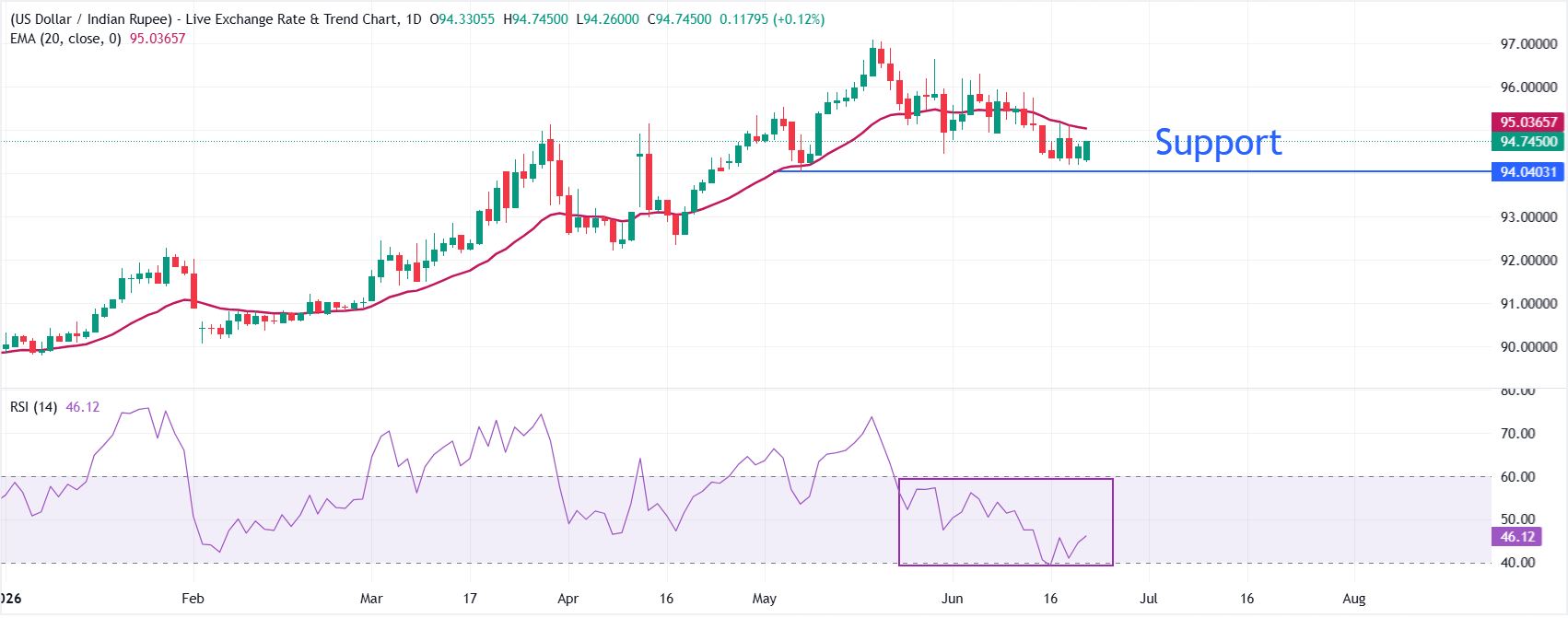
USD/INR trades higher at around 94.70 at press time. However, the near-term bias is bearish as price holds well below the 20-day Exponential Moving Average (EMA) at 95.00.
The Relative Strength Index (RSI) at about 46.00 suggests subdued momentum, hinting that the pair remains under pressure without yet reaching oversold conditions.
On the downside, the pair could slide to 93.00 if it extends its decline below the May 7 low at 94.03. Looking up, the pair could advance to the June 12 high at 95.76 if it manages to return above the 20-day EMA.
(The technical analysis of this story was written with the help of an AI tool.)
Fed FAQs
Monetary policy in the US is shaped by the Federal Reserve (Fed). The Fed has two mandates: to achieve price stability and foster full employment. Its primary tool to achieve these goals is by adjusting interest rates. When prices are rising too quickly and inflation is above the Fed’s 2% target, it raises interest rates, increasing borrowing costs throughout the economy. This results in a stronger US Dollar (USD) as it makes the US a more attractive place for international investors to park their money. When inflation falls below 2% or the Unemployment Rate is too high, the Fed may lower interest rates to encourage borrowing, which weighs on the Greenback.
The Federal Reserve (Fed) holds eight policy meetings a year, where the Federal Open Market Committee (FOMC) assesses economic conditions and makes monetary policy decisions. The FOMC is attended by twelve Fed officials – the seven members of the Board of Governors, the president of the Federal Reserve Bank of New York, and four of the remaining eleven regional Reserve Bank presidents, who serve one-year terms on a rotating basis.
In extreme situations, the Federal Reserve may resort to a policy named Quantitative Easing (QE). QE is the process by which the Fed substantially increases the flow of credit in a stuck financial system. It is a non-standard policy measure used during crises or when inflation is extremely low. It was the Fed’s weapon of choice during the Great Financial Crisis in 2008. It involves the Fed printing more Dollars and using them to buy high grade bonds from financial institutions. QE usually weakens the US Dollar.
Quantitative tightening (QT) is the reverse process of QE, whereby the Federal Reserve stops buying bonds from financial institutions and does not reinvest the principal from the bonds it holds maturing, to purchase new bonds. It is usually positive for the value of the US Dollar.
Author

Sagar Dua
FXStreet
Sagar Dua is associated with the financial markets from his college days. Along with pursuing post-graduation in Commerce in 2014, he started his markets training with chart analysis.














