Indian Rupee clings to early gains driven by lower oil prices, weak US Dollar
- The Indian Rupee is slightly positive due to the US Dollar’s broader underperformance.
- Weak US NFP data weighs on the US Dollar.
- Lower oil prices will continue to offer support to the US Dollar.

The Indian Rupee (INR) trades slightly higher against the US Dollar (USD) in India's afternoon trading hours on Friday. The USD/INR pair drops to near 95.26 due to broader underperformance in the US Dollar, following the release of the weak United States (US) Nonfarm Payrolls (NFP) data for June on Thursday.
As of writing, the US Dollar Index (DXY), which tracks the Greenback’s value against six major currencies, trades marginally lower to near 100.78. On Thursday, the USD Index declined almost 0.6% from Wednesday’s closing price.
The table below shows the percentage change of Indian Rupee (INR) against listed major currencies today. Indian Rupee was the strongest against the US Dollar.
| USD | EUR | GBP | JPY | CAD | AUD | INR | CHF | |
|---|---|---|---|---|---|---|---|---|
| USD | -0.14% | -0.08% | 0.00% | 0.04% | -0.19% | -0.35% | -0.05% | |
| EUR | 0.14% | 0.06% | 0.13% | 0.17% | -0.11% | -0.08% | 0.08% | |
| GBP | 0.08% | -0.06% | 0.04% | 0.12% | -0.17% | -0.27% | 0.03% | |
| JPY | 0.00% | -0.13% | -0.04% | 0.06% | -0.23% | -0.18% | -0.04% | |
| CAD | -0.04% | -0.17% | -0.12% | -0.06% | -0.29% | -0.24% | -0.09% | |
| AUD | 0.19% | 0.11% | 0.17% | 0.23% | 0.29% | 0.04% | 0.20% | |
| INR | 0.35% | 0.08% | 0.27% | 0.18% | 0.24% | -0.04% | 0.16% | |
| CHF | 0.05% | -0.08% | -0.03% | 0.04% | 0.09% | -0.20% | -0.16% |
The heat map shows percentage changes of major currencies against each other. The base currency is picked from the left column, while the quote currency is picked from the top row. For example, if you pick the Indian Rupee from the left column and move along the horizontal line to the US Dollar, the percentage change displayed in the box will represent INR (base)/USD (quote).
US NFP report shows moderate labor demand
The US NFP report showed that employers hired 57K fresh jobs in June, significantly lower than estimates of 110K. Also, the May data was revised lower to 129K from 172K. The Unemployment Rate dropped to 4.2% against the estimates and the previous reading of 4.3%.
Average Hourly Earnings, a key measure of wage growth, rose by 3.5% Year-on-Year (YoY), as expected, faster than the previous reading of 3.4%.
Signs of soft job demand have forced traders to reconsider hawkish Federal Reserve (Fed) interest rate expectations. Following the US official employment data release, the odds of the Fed delivering at least one interest rate hike in the September policy meeting have diminished to 53.2% from almost 64% seen on Wednesday, according to the CME FedWatch tool.
Considering the latest remarks from Fed officials that their majority priority is taming “high inflation”. On Wednesday, Fed Chair Kevin Warsh warned at the European Central Bank (ECB) Forum in Sintra that inflation remains “too high”, while stressing the need to bring price stability. As expected, Warsh didn't offer any cues regarding the Fed’s future decisions on interest rates.
Oil prices stabilize near pre-Middle East war levels
The MCX Crude Oil contract expiring on July 20 appears to have stabilized in the 6,450-6,600 range after falling over 20% in June. Oil prices will likely remain near pre-Middle East war levels, as Qatar has touted “progress” in indirect talks between the US and Iran.
Lower oil prices bode well for currencies from economies, such as India that rely heavily on oil imports to meet their energy needs.
FIIs keep lowering stake in Indian stock market
Foreign Institutional Investors (FIIs) have remained net sellers in the first two trading days of July, offloading their stake worth Rs. 1.452.32 crore. However, the amount of selling has declined as oil prices have returned lower, with investors focusing on business updates from financial services and consumption companies of India Inc.
Technical Analysis: USD/INR holds 20-day EMA, Descending Triangle breakout
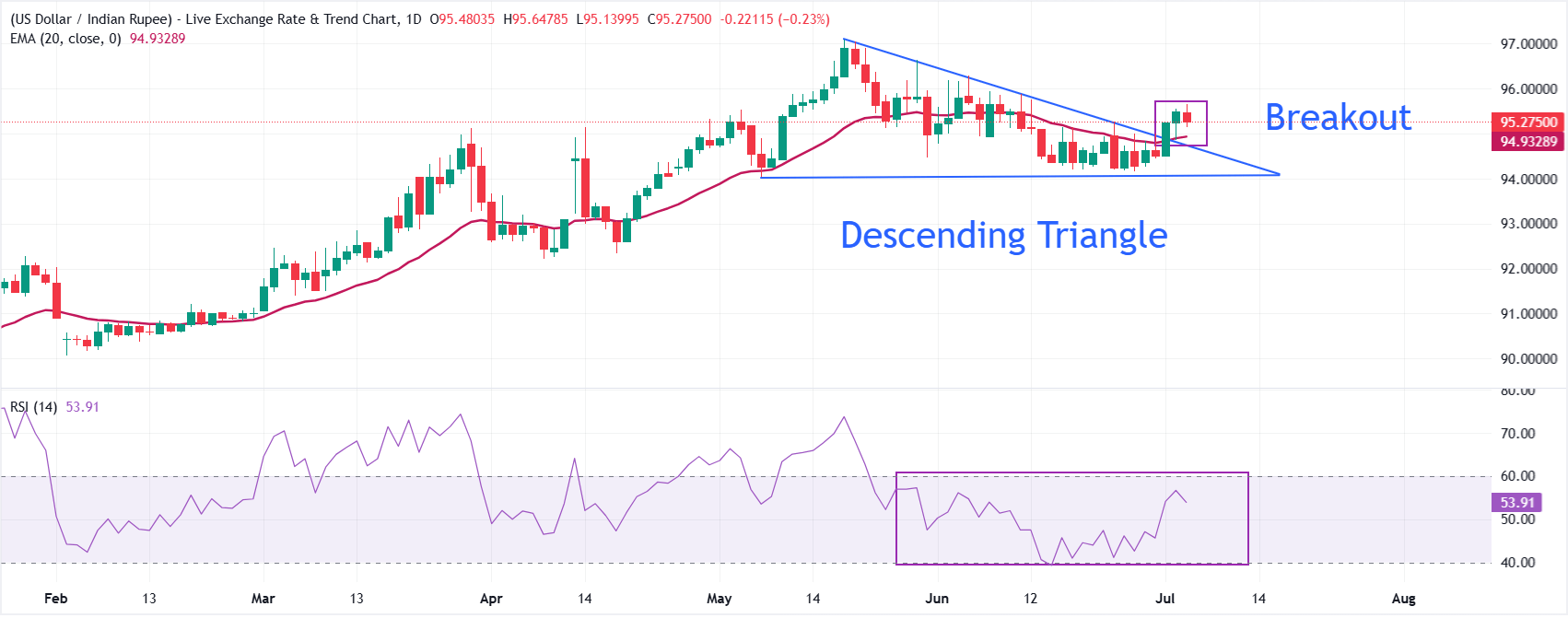
USD/INR trades at around 95.26, holding a modest bullish bias as it consolidates above the 20-day Exponential Moving Average (EMA) at roughly 94.93 and the breakout of the Descending Triangle formation.
The Relative Strength Index (RSI) at around 54 suggests mildly positive, but not overstretched, momentum.
On the downside, initial support is seen at the 20-day EMA near 94.933, reinforced by the reclaimed downward trend-line region around 94.764, with deeper protection at the structural support zone near 94.065. Looking down, the pair could extend its advance towards 96.00 if it continues to hold the Descending Triangle breakout.
(The technical analysis of this story was written with the help of an AI tool.)
Fed FAQs
Monetary policy in the US is shaped by the Federal Reserve (Fed). The Fed has two mandates: to achieve price stability and foster full employment. Its primary tool to achieve these goals is by adjusting interest rates. When prices are rising too quickly and inflation is above the Fed’s 2% target, it raises interest rates, increasing borrowing costs throughout the economy. This results in a stronger US Dollar (USD) as it makes the US a more attractive place for international investors to park their money. When inflation falls below 2% or the Unemployment Rate is too high, the Fed may lower interest rates to encourage borrowing, which weighs on the Greenback.
The Federal Reserve (Fed) holds eight policy meetings a year, where the Federal Open Market Committee (FOMC) assesses economic conditions and makes monetary policy decisions. The FOMC is attended by twelve Fed officials – the seven members of the Board of Governors, the president of the Federal Reserve Bank of New York, and four of the remaining eleven regional Reserve Bank presidents, who serve one-year terms on a rotating basis.
In extreme situations, the Federal Reserve may resort to a policy named Quantitative Easing (QE). QE is the process by which the Fed substantially increases the flow of credit in a stuck financial system. It is a non-standard policy measure used during crises or when inflation is extremely low. It was the Fed’s weapon of choice during the Great Financial Crisis in 2008. It involves the Fed printing more Dollars and using them to buy high grade bonds from financial institutions. QE usually weakens the US Dollar.
Quantitative tightening (QT) is the reverse process of QE, whereby the Federal Reserve stops buying bonds from financial institutions and does not reinvest the principal from the bonds it holds maturing, to purchase new bonds. It is usually positive for the value of the US Dollar.
Author

Sagar Dua
FXStreet
Sagar Dua is associated with the financial markets from his college days. Along with pursuing post-graduation in Commerce in 2014, he started his markets training with chart analysis.